 SUNSET:

 0
0I might be the last to know, but a new-to-me discovery has me viewing globulars in a whole new light.
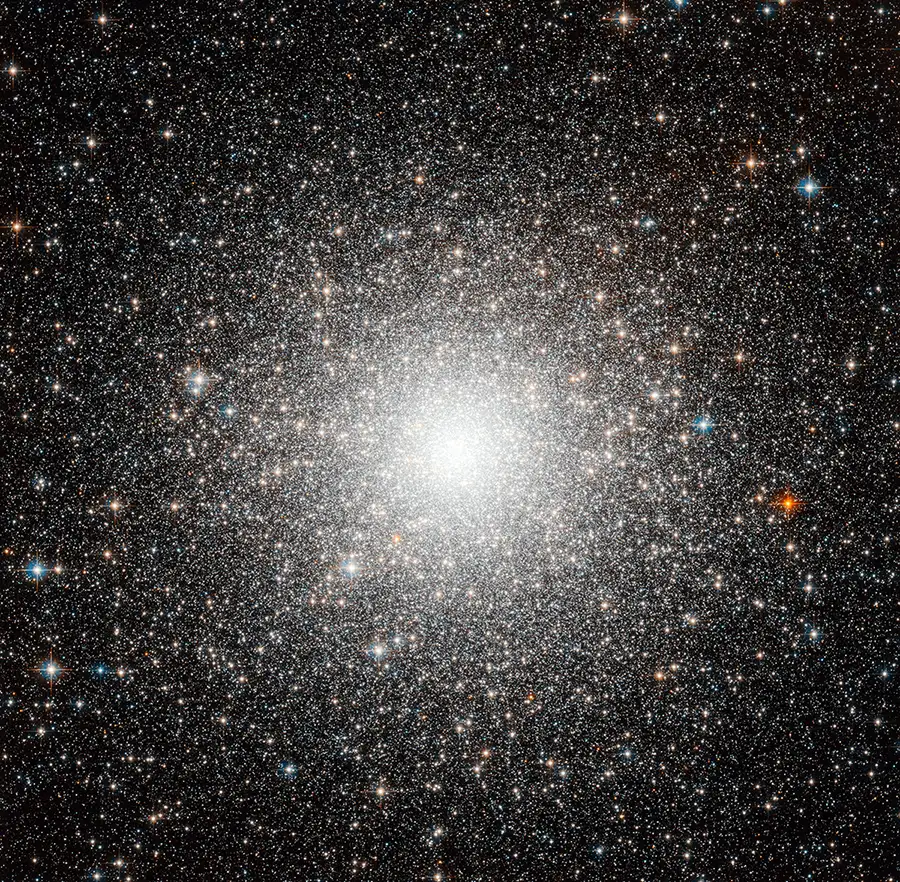
ESA / Hubble & NASA
After some spectacular viewing during galaxy season, we’re heading into prime time for some equally spectacular globular clusters. Somehow, “glob season” (my friend’s term for summer) doesn’t sound quite as magical.
In truth, I didn’t used to get excited about globular clusters. Yes, they are dazzling, with their countless stars jam-packed together into what resembles an exploding disco ball. But, with few exceptions, they all looked very much alike to me. I’d peer up at one or two globular clusters on a clear evening, cross them off my target list, and move on to something more dynamic like the Dumbbell Nebula (M27) or Sadr (Gamma Cygni) and its surroundings.
But a couple of months ago, I was reading Dr. Moiya McTier’s excellent “galactic autobiography,” The Milky Way, when I came across a bit of text that stopped me cold:
“. . . many globular clusters weren’t created by me at all but are instead the remaining cores of galaxies I devoured long ago.”
I had to re-read those words a few times to let the meaning sink in. Then I had to put the book down and pace around the house for 10 ten minutes. My mind was well and truly blown, and I felt like I was about to jump out of my skin.
Did everybody already know about this but me? It sure feels that way. I’d missed Bob King’s earlier article on “gobbled globs” — always bet on Bob King, by the way — and I learned that some of my favorite globular clusters have been traced back to host galaxies which were effectively eaten by the Milky Way. Messier 54, for instance, was the core of the Sagittarius Dwarf Elliptical Galaxy, whose merger with the Milky Way also gave us the clusters NGC 2419 and NGC 5824.
I’d long known about galactic mergers, but I hadn’t thought too much about what came from where in my backyard observations. Deep in middle age, I am still a novice. I’d been more interested in musing about the Milky Way’s likely collision and merger with M31 in 4.5 billion years, and what that far-future night sky might look like. It hadn’t occurred to me to consider that the globular clusters on my routine target list today weren’t all home-galaxy grown.
Honestly, I’m still trying to wrap my brain around this. Yes, it makes sense. Yes, this isn’t news (to anyone but me, apparently). But reviewing our galaxy’s history and the stellar remnants of its many mergers is awesome and mind expanding in the best possible way.
After all, this means I’ve unknowingly resolved whole galactic cores in my telescope. Some of those tight balls of stars were the nuclei of devoured dwarf galaxies; others were bonus contributions from these mergers — and I’d looked at them, said “meh,” and moved on. I felt chagrined by my dismissal of these stellar wonders.
No more. This glob season, I know better. I’m on an active hunt for any and all glob cores and gobbled globs I can find from my back patio. I’m greeting previous targets, like M13 and M5, with new appreciation. Globular clusters that formed inside the Milky Way are also worthy of wonder, but the “special guest” globs that joined us via galactic merger inspire an extra dose of awe. (I mean, have you seen Omega Centauri? I haven’t! I’m too far north!)
Now I’m making a spreadsheet of globular clusters to track my observing progress. In addition to listing catalog number, host constellation, magnitude, and viewing season for each target, I’ll need a separate “origin” category on my glob hunt. (But then, what to call those donated globulars? Extra-galactic, immigrant, expat?)
I’ll be paying special attention to Messiers 2, 13, 56, and 92, which came to the Milky Way through our merger with the smaller Gaia-Enceladus (or Sausage) galaxy. (Their sibling globs, M30 and M75, might be too low on my Portland horizon.) Later in the summer, when one of my favorite constellations, Delphinus, is high in the sky, I’ll try to find its special-guest globular clusters, NGC 6934 and NGC 7006.
It’s not merely the age and genesis of these clusters that capture my imagination. These globs are indeed ancient, but the idea that a galactic core can survive being swallowed stirs me. These former galaxies were wholly absorbed, yet their nuclei remain. That fact alone has me waxing philosophical: These galaxies refused to be destroyed, and their shining hearts live on.


Comments
You must be logged in to post a comment.