 SUNSET:

 0
0A successful rocket launch takes two innovative space science satellites — NASA’s SPHEREx and PUNCH missions — to orbit.

SpaceX
Two of the first astrophysics missions for 2025 took to orbit from Vandenberg Space Force Base in California on the evening of March 11th. A SpaceX Falcon 9 rocket carried the two NASA missions: the Spectro-Photometer for the History of the Universe, Epoch of Re-ionization and ices Explorer (SPHEREx) mission as well the Polarimeter to Unify the Corona and Heliosphere (PUNCH).
The launch from pad SLC-4E from Vandenberg went off as planned, with liftoff occuring at 11:10 p.m. EDT / 3:10 UT. SPHEREx deployed about 42 minutes after launch, and the four small satellites of the PUNCH mission separated as two pairs 52 and 53 minutes after liftoff, respectively.
Both PUNCH and SPHEREx deployed into a particular low-Earth orbit that’s Sun-synchronous, meaning that the spacecraft will match Earth’s rotation around the Sun and will always appear in the same position relative to our star. Entering this unique orbit is aided by launching from the U.S. West Coast, as the rocket needs to head westward into a high-inclination orbit, against Earth’s rotation.
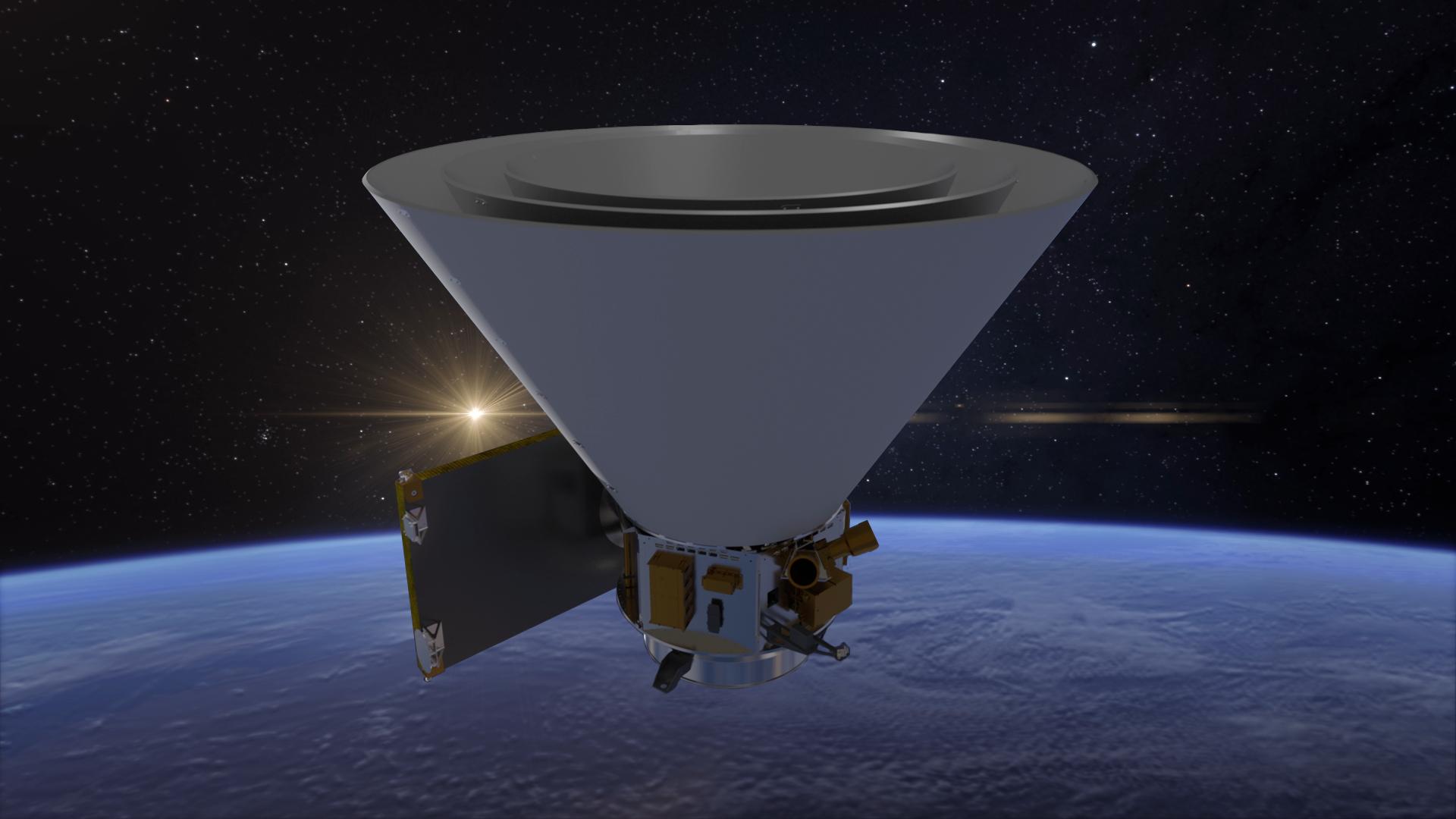
There’s also a specific advantage to putting both missions in this type of orbit: for SPHEREx, it means it can keep its solar panel in perpetual sunlight with its instruments at a stable temperature, while its shielded detectors point in the opposite direction. For PUNCH, it means the detectors on the four separate satellites can observe the Sun and space weather events simultaneously.
SPHEREx: An Epic All-Sky Survey
SPHEREx is designed to survey the entire sky over infrared wavelengths, collecting data on more than 100 million stars in the Milky Way, and more than 450 million galaxies beyond our own. Of primary interest is creating a 3D perspective snapshot of galaxies, effectively mapping the web-like large-scale structure of the universe.
To do this, SPHEREx will carry out its two-year, all-sky, wide-field survey in 102 color-bands. The survey will also help pinpoint galaxies for further scrutiny by the James Webb Space Telescope and the Nancy Grace Roman Telescope, launching in 2027.
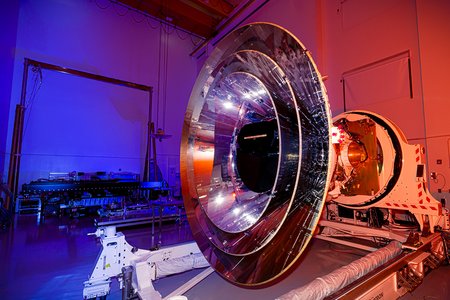
SPHEREx's detectors sit behind three nested, cone-shaped photon shields, designed to keep the instruments cold enough for operations. SPHEREx's detectors should reach -350°F (-210°C) within 37 days after launch so that science operations may begin.
NASA / JPL-Caltech
SPHEREx Science Goals
“SPHEREx has three core science themes,” says James Bock (JPL-Caltech). "One primary goal is to measure the amount of water and other ice species (such as carbon monoxide, carbon dioxide, and methanol) that exist within the cold clouds of molecular hydrogen that precede and feed early star formation. These ices form on the surfaces of interstellar dust grains."
It’s thought that water on Earth might have originally came from these sorts of icy reservoirs. “We (measure) this by absorption spectroscopy to a background star, where ice species give characteristic attenuation bands in the infrared,” says Bock. “SPHEREx will produce an unprecedented survey scale, and we have pre-selected over 9 million targets covering a wide range of environments.”
The second objective is to trace the evolution of galaxies. This will be achieved by measuring the brightness of extragalactic background. “The background light encodes the total light produced over cosmic history,” says Bock. “It also measures the total light of all emitting sources, including components that are hard to measure individually, such as dwarf galaxies, diffuse starlight in galactic halos, (and) anything else that emits light.”
Studying unresolved starlight opens up a new way to study galaxy evolution. “We measure the background light by studying spatial fluctuations (because galaxies cluster together),” says Bock. “It is akin to mapping the cosmic microwave background, but in 3D with multiple infrared color bands.”
Finally, and crucially, SPHEREx will work to understand the role of inflation in the universe's earliest moments. “Inflation expanded the observable universe from a sub-atomic volume, amplifying quantum fluctuations to coherent structures on cosmological scales,” says Bock. Those fluctuations and their expansion set the universe's large-scale structure that astronomers call the cosmic web.
“On large scales, there has not been enough cosmic time for gravity to substantially alter primordial structures,” says Bock. So by completing a large-volume, 3D survey of galaxy positions, SPHEREx will help astronomers test competing models of inflation. SPHEREx's wide field of view is uniquely suited to the task. While Webb’s Near-Infrared Camera has better resolution, its field of view is only 1% of a full Moon, while in a single image SPHEREx captures a visual area equivalent to 200 full Moons.
SPHEREx will survey the entire sky four times during its two-year nominal mission. “We want to make the data available to the public rapidly,” says Bock. SPHEREx will continuously release data two months after collection as calibrated images uploaded to NASA’s Infrared Processing and Analysis Center. A full analysis of the data is expected three years after launch.
NASA
PUNCHing for the Solar Corona
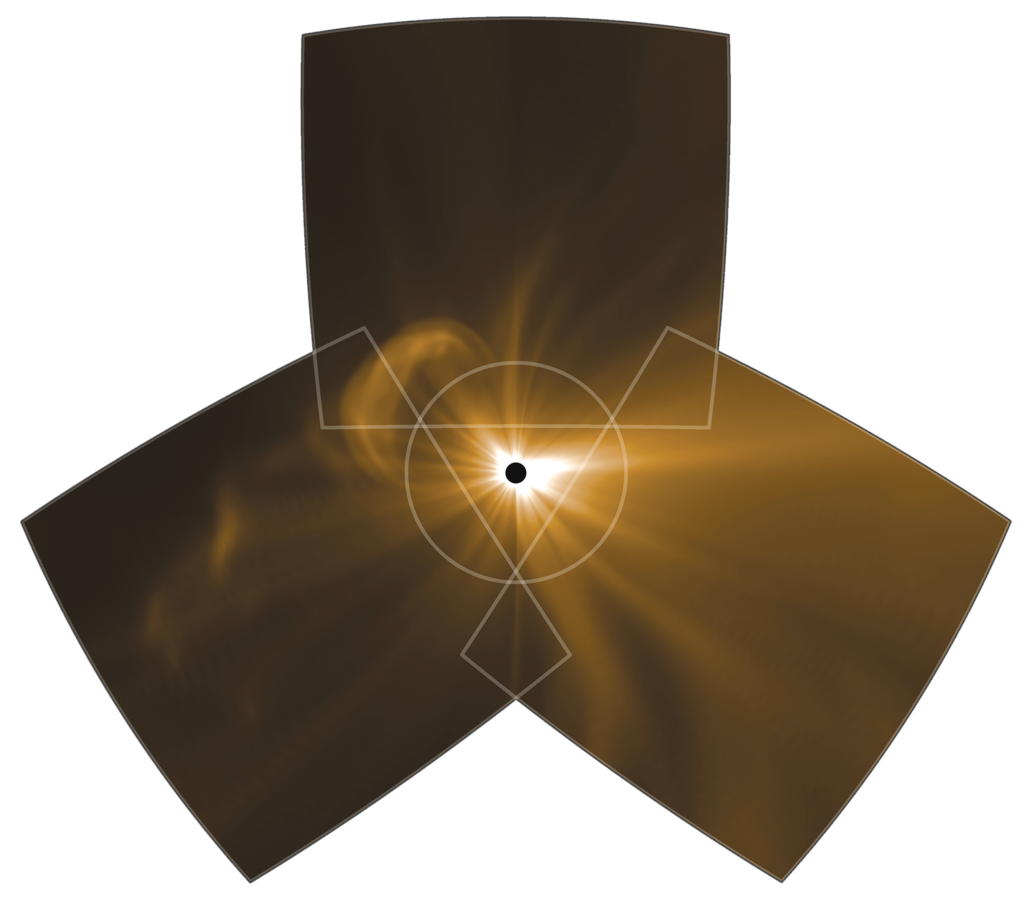
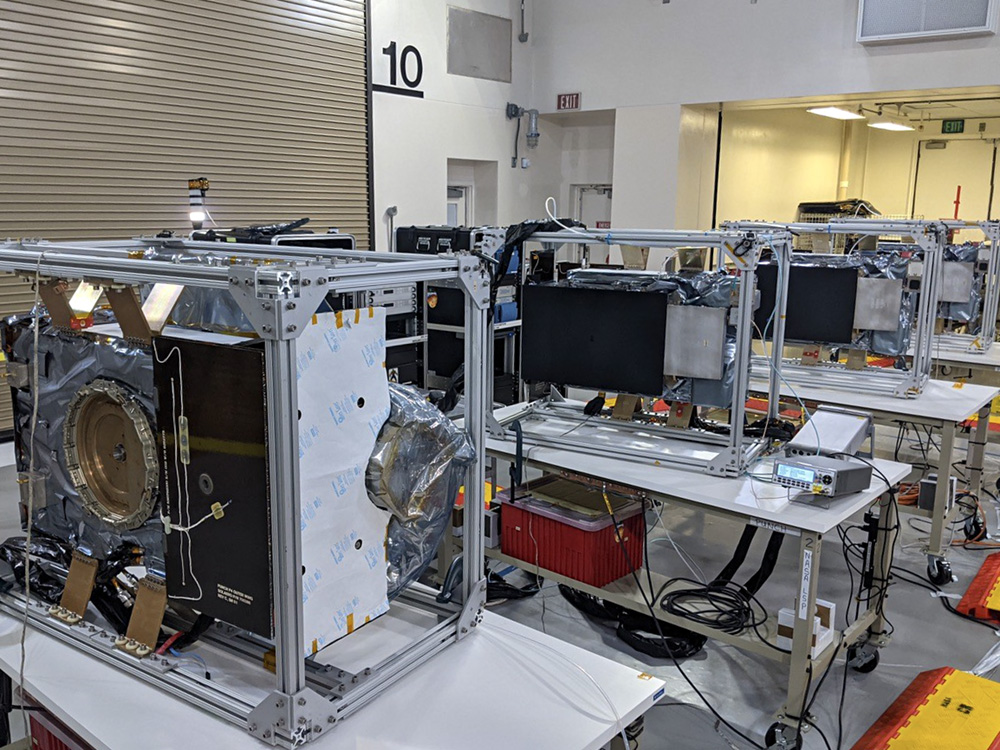
Launching alongside SPHEREx, PUNCH consists of four suitcase-sized satellites. Equipped with coronagraphs and wide and narrow-field imagers, PUNCH will give us the first continuous 3D view of the solar corona in an effort to understand the source of space weather and its impact on Earth.
“PUNCH will image the Sun’s corona and the solar wind that fills our solar system as a single unified system,” says Craig DeForest (Southwest Research Institute). “PUNCH is the first mission designed to track and monitor that wind across the entire solar system as it sweeps over Earth.” To this end, after a three-month c0mmissioning phase, PUNCH will capture images every four minutes in polarized visible light over a wide, 90-degree field of view.
SwRI
PUNCH is unique among coronagraphs, as the four separate spacecraft will function as a single 'virtual instrument' to produce a wide overall view. “Merging the data from those four cameras, and removing the far brighter star-field and zodiacal light from the very faint solar wind signal, requires extremely sophisticated post-processing,” says DeForest. “PUNCH has the most sophisticated ground processing pipeline of any NASA explorer mission to date.”
PUNCH will complement the Coronal Diagnostic Experiment (CODEX) now on the International Space Station, as well as the Electrojet Zeeman Imaging Explorer (EZIE), launching on the Transporter-13 rideshare mission on March 14th. EZIE will study magnetic field disturbances associated with high-altitude auroras, which researchers also expect to see in PUNCH’s wide field-of-view. The observations from PUNCH will also complement in-situ observations of the solar corona from NASA’s Parker Solar Probe.
It will be fascinating to follow these two very different astrophysics missions sharing a similar orbit, as they get down to work in the months to come.
About David Dickinson
David Dickinson is a freelance science writer, high school science teacher, retired enlisted U.S. Air Force veteran and avid stargazer. He currently resides with his wife Myscha in Bristol, Tennessee. David also writes science fiction in his spare time. He posts as @AstroDave on BlueSky about space news and sky-watching worldwide.


Comments
You must be logged in to post a comment.