 SUNSET:

 0
0This region is home to some of the finest globular clusters in the sky.
We’ve touched lightly on Tucana (the Toucan) in this column previously, when we took a look at the Large and Small Magellanic Cloud galaxies. This time we’ll have a closer look at some of the other inhabitants of this far southern constellation.
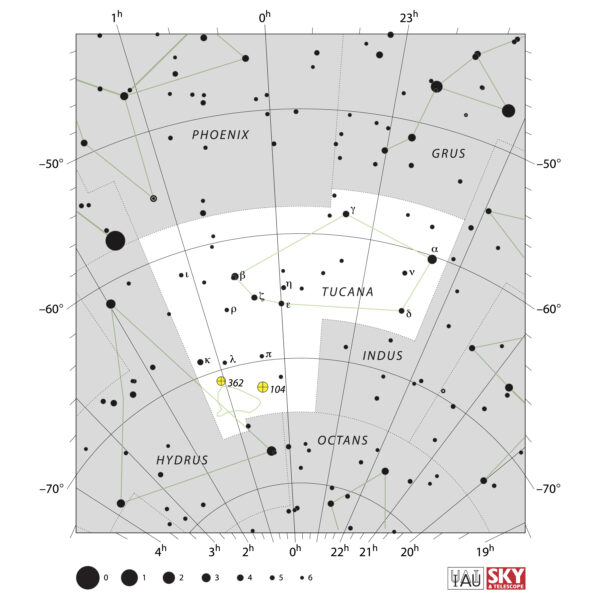
Tucana’s brightest light, Alpha (α) Tuc, is a spectroscopic binary, comprised of a bright primary star and a smaller, unseen companion whose presence is inferred from changes detected in the spectrum of the primary. The brighter star is a K3-type orange giant while the companion’s classification is unknown — possibly a brown dwarf. The two orbit each other with a period of 11½ years, and the system has a combined apparent magnitude of 2.9.
Another Tucana pairing is Delta (δ) Tuc, comprising two stars moving together through space, either gravitationally bound to each other or just heading in the same direction after forming in the same neighborhood. To the naked eye this system appears to be a single star of magnitude 4.5.
Kappa (κ) Tuc is a system of five stars — there are two visible pairs, and one of the stars in one of those pairs itself has a further unseen companion. Overall, this system has an apparent magnitude of 4.3.
Not to be outdone by Kappa, there’s Beta (β) Tuc, an intriguing system of six stars in three pairs. The β1 and β2 pairs are close together and appear as a single star to the naked eye. They also have very similar combined brightnesses — magnitude 4.4 for the β1 duo and 4.5 for β2. The β3 pair, on the other hand, shown as the smaller overlapping star on the chart above, is situated 9 arcminutes southeast of β1/β2, with a combined magnitude of 5. All three pairs are some 140 to 160 light-years from Earth and moving together in the same direction, so it’s a good bet that they’re at least loosely gravitationally bound to each other.
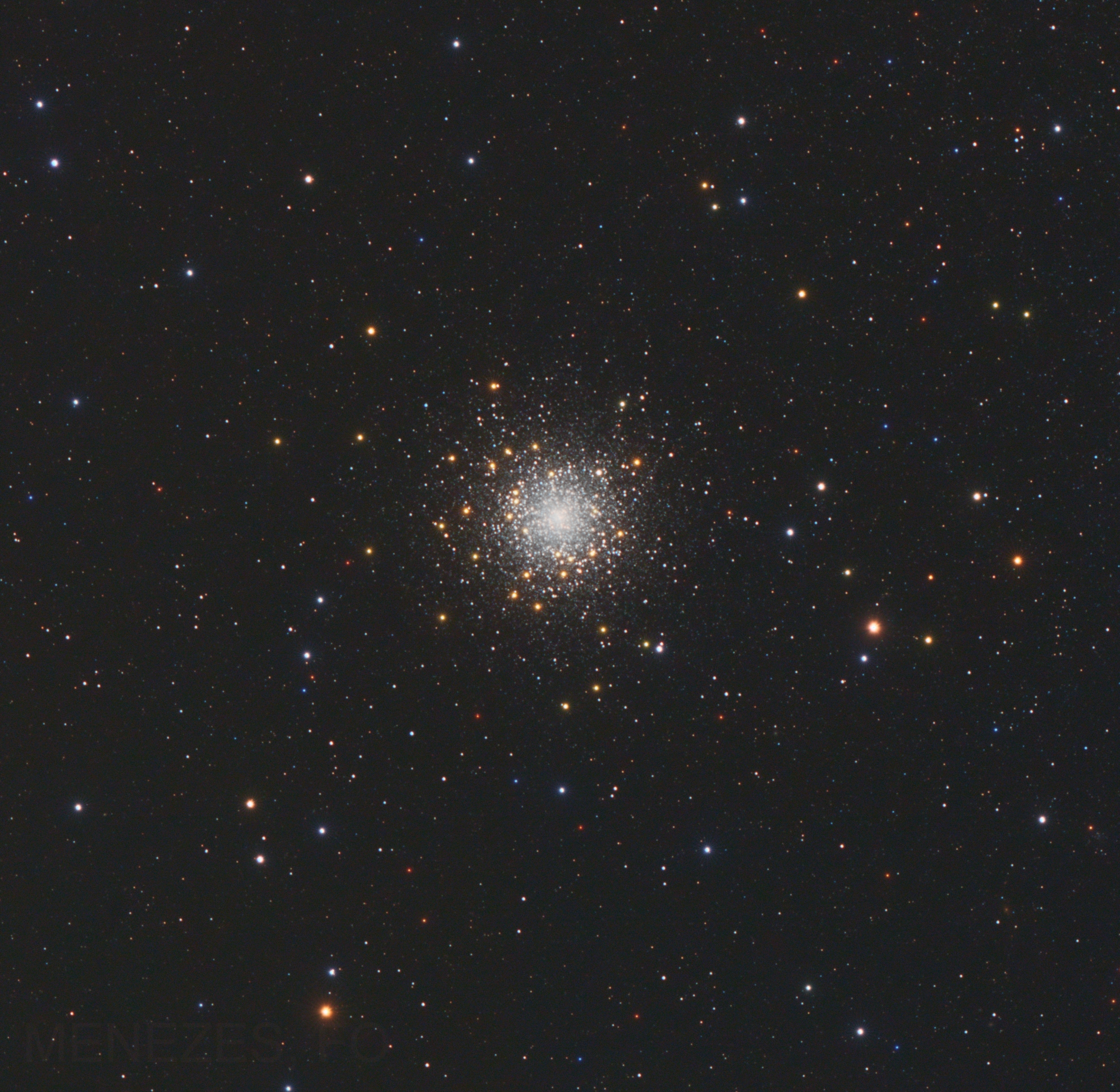
Now let’s take a look at a few of Tucana’s deep sky objects, beginning with the globular star cluster NGC 362, which lies just beyond the northern outskirts of the Small Magellanic Cloud (SMC). This stellar city was discovered in August 1826 by Scottish astronomer, James Dunlop, observing from the Australian town of Parramatta (now a suburb of Sydney). With an apparent magnitude of 6.4, it’s readily detectable with 10×50 binoculars, while a 4-inch telescope reveals a tight ball of light with a handful of resolved stars. Through a 6-inch, it shows as a condensed core with a wide scattering of outlying stars.
Now head around 3½° to the west-southwest and you’ll find what is perhaps Tucana’s most compelling deep sky object (sorry, SMC fans) — the mighty globular cluster 47 Tucanae. You simply can’t miss it — at magnitude 4.0 it is the second-brightest globular in all of the night sky. It’s super-easy to see at this time of year, perched about halfway up from the horizon and looking like a condensed, fuzzy patch — a bit like the head of a comet. In reality it’s a huge ball of millions of stars, about 14,500 light-years distant.
47 Tuc is the kind of astronomical object for which superlatives abound. Sir John Herschel described it as a “most glorious cluster” and a “stupendous object”. Dunlop called it a “beautiful globe of light,” Robert Burnham Jr. described it as a “shimmering globe of thousands of star points,” while Agnes Mary Clerke extolled its “sheeny radiance”.
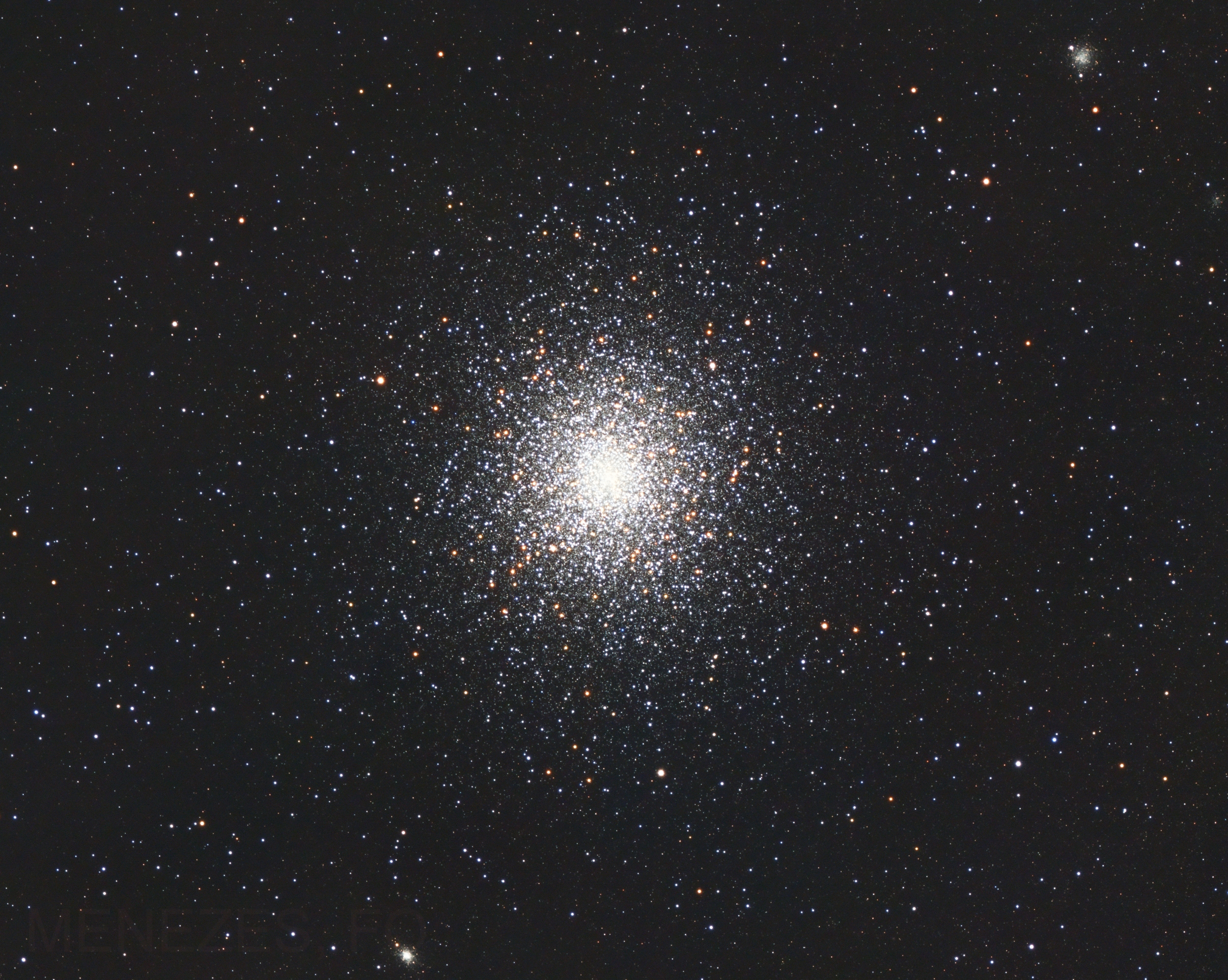
When seen from very dark skies, 47 Tuc has an apparent diameter almost equal to that of the full Moon. of the view through 10×50 binoculars gives it the appearance of having a bright core with a wider halo, while a 4-inch scope easily resolves many of its stars. As you go up in aperture, more and more stars are resolved, seemingly without end. It really is a stunning spectacle.
Our third and final deep-sky target this month is NGC 121, only a stone’s throw from 47 Tuc — you’ll find it just ½° north and slightly east. In fact, it fits within the same low-power field of view as its larger cousin. It’s a much harder target, however — at magnitude 11.2, you’ll need at least a 6-inch scope to see it; but it’s small and compact, so don’t expect to resolve any stars. You might detect its slightly elongated shape, however.
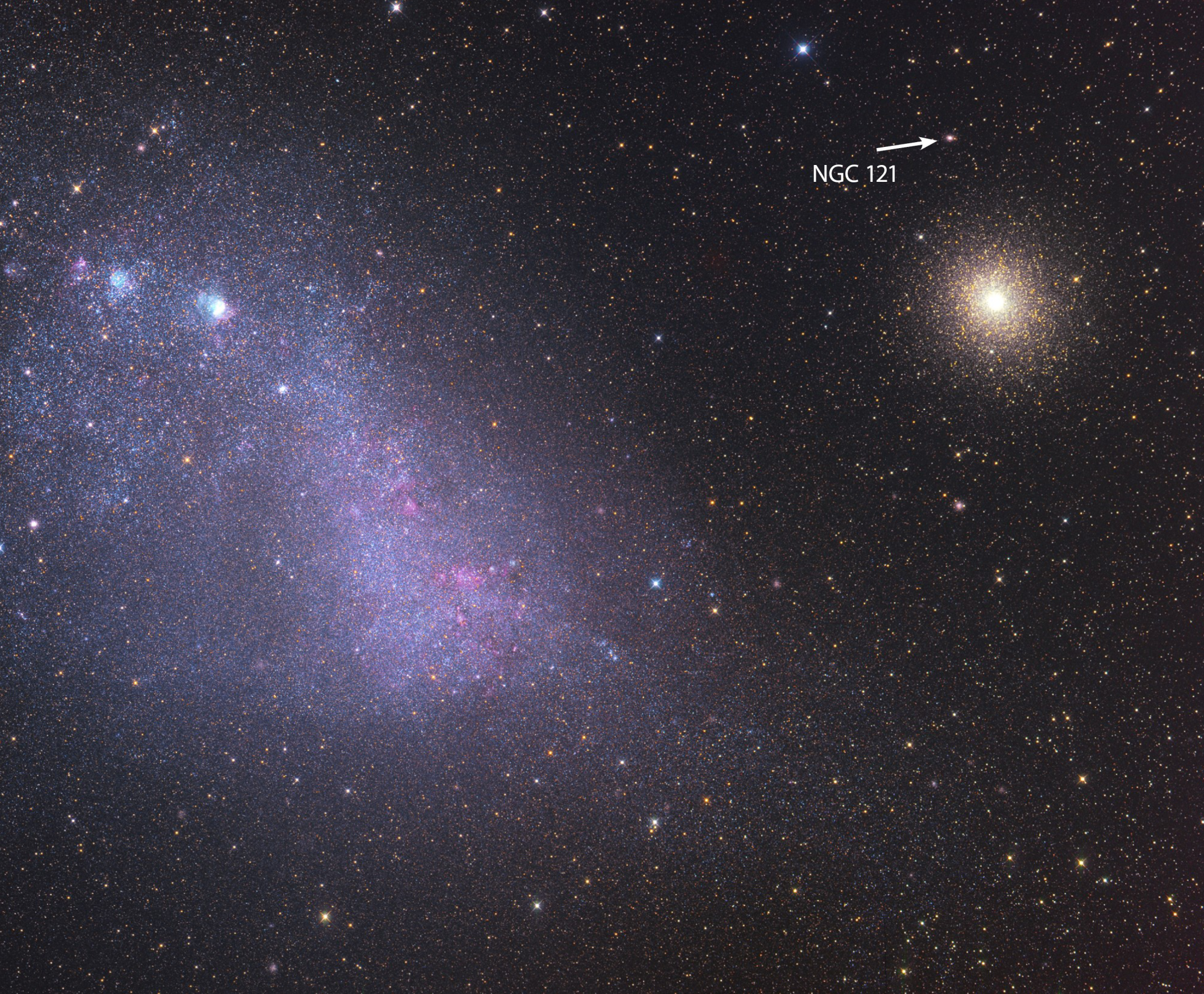
NGC 121 is estimated to be only about half the mass of 47 Tuc [SW1] [J2] but it is intrinsically much wider, with a diameter of 98 light-years versus 60 for 47 Tuc. The main reason for its dimness is that it’s much farther away — 47 Tuc is one of our galaxy’s globulars, whereas NGC 121 belongs to the Small Magellanic Cloud, residing about 200,000 light-years from us.
Tucana is a great place to visit, with some fascinating stars plus the three deep sky objects described above and many more besides. Take advantage of its prominence at this time of the year and enjoy sweeping through it with any optics.


Comments
You must be logged in to post a comment.