 SUNSET:

 0
0
Adam Block / Mount Lemmon SkyCenter / University of Arizona
October is my favorite month. Cooler nights are growing longer and daylight is waning with every rotation of the planet. The Sun traverses the sky at a lower angle, highlighting the changing leaves. We’re also fast approaching my favorite holiday: Halloween!
Halloween is (almost) an astronomical holiday, falling close to one of the four cross-quarter days that come between the solstices and equinoxes. Technically, the last cross-quarter day of the year isn’t until November 7th, but Halloween is a fun tie-in and resonates with the theme of transitions.
Near the halfway point between the autumnal equinox and the winter solstice, Halloween is associated with death and decay, a sad and messy necessity of life. Memento mori — “remember that you must die.” We embrace ghost stories and horror movies in celebration of our fear of death, or maybe to spite it. To remind ourselves that we are alive, for now. But endings also make possible new beginnings, just as generations of stars and supernovae fill the cosmos to make wonder possible. What was old will be renewed again.
So how can Halloween-loving amateur astronomers celebrate this most bewitching of cultural holidays?
I went looking for spooky-themed stars, constellations, and deep-sky objects in the Northern Hemisphere. And, boy! There are a lot of them in the autumn sky. So I’ve taken a stab at making a list of eerie targets to satisfy the season of the witch. I might even organize a low-key, spooky astronomy scavenger hunt — or whatever you want to call the low-stakes Halloween equivalent of a Messier marathon. This would be fun for a small star party, or a virtual adventure for stargazing friends over the course of the month. Prizes might include a red-light skull, a glow-in-the-dark space-themed t-shirt, or a warm witch’s hat for chilly nights under the stars.
Several creepy targets are already in the sky at a reasonable hour: The circumpolar constellation Draco, the Dragon, stretches out long around Ursas Major and Minor in the northwest, and sitting inside one of Draco’s curves is the Cat’s Eye Nebula (NGC 6543).
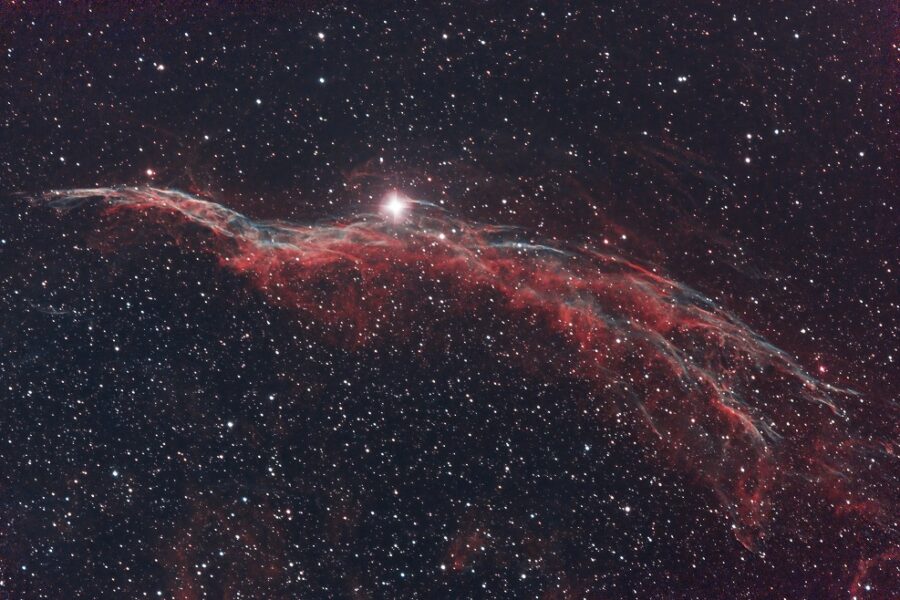
Kenneth Brassard / S&T Online Photo Gallery
Legends say the veil separating the worlds of the living and the dead is at its thinnest on Halloween, and the cosmic Veil Nebula (NGC 6974) — including the Witch’s Broom (NGC 6960) — can be found during prime trick-or-treating hours just past the meridian.
Things get even spookier the later you dare to stay outside. In the constellation Perseus, there’s Algol, the eclipsing binary star; also called the Demon Star. Algol represents the petrifying head of Medusa and will reach its minimum brightness earlier in the day on October 31st. And, with the right mindset, the Crab Nebula (M1) can look spectral (though at other times it looks more like a glowing pillbug).
To make things more interesting, you might switch up your location for spine-tingling stargazing. Dark-sky sites always feel mysterious and slightly unsettling to me. A Halloween astronomy camp-out would be the perfect time to share scary stories around red-light lanterns as the sun goes down, so everyone’s sufficiently haunted by the prospect of visiting spirits before the night’s observations begin.
But because I’m a spooky-loving scaredy-cat, Halloween night typically finds me sticking close to home. I love seeing all the neighborhood kids’ costumes, and I’ve been known to dress up myself, often as an astronaut, to hand out candy and fidget toys.
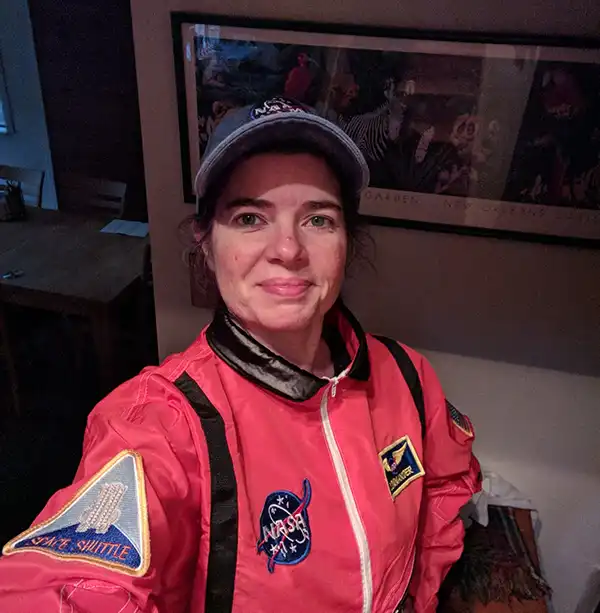
Jen Willis
But have you added sidewalk astronomy to your selection of Halloween treats? The American Astronomical Society’s Division for Planetary Sciences recommends handing out Mars bars, Moon Pies, and Starburst candies, and for decoration, you might even print some of NASA’s “Galaxy of Horrors” astronomy posters, ready for download.
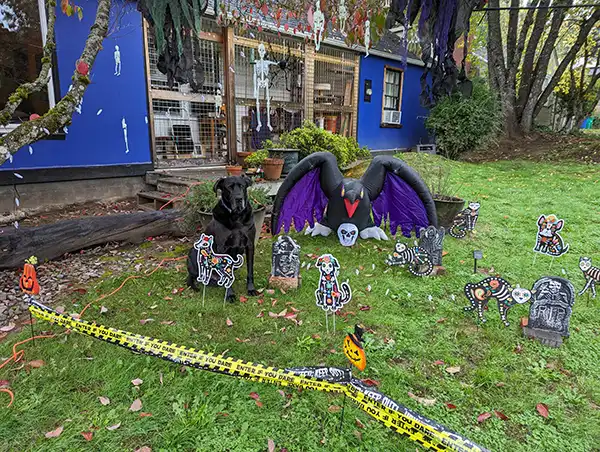
Jen Willis
Should the rain and clouds hold off, sometimes I get to do a little solo stargazing as the trick-or-treaters come and go. Even though the neighborhood amateur astronomer doesn’t fit so well with our usual “pet cemetery” front-yard decorations, the revelers don’t notice me, even if I’m sitting with a small telescope only a meter or two away from the fake tombstones, howling dog skeleton, and inflatable crow.
If I stay up late enough and brave any roving bands of witching hour pumpkin-smashers, I can enjoy one of my favorite asterisms riding high above: the Pleiades will be high in the East by around midnight on Halloween night (technically, November 1st). I might also linger on the ghostly supernova remnants of the Veil Nebula, which will still be sliding westward.
Stargazing is my favorite after-dark activity in any season, but there’s something delightfully eerie about positioning myself beneath the stars on the spookiest night of the year. I imagine ancient bonfires and earnest fear of the supernatural from ages past as storied stellar patterns dance across the sky.
Spooky season is the perfect time to muse on destruction and regeneration. Many of the wondrous sights in the deep dark sky are the remains of a fiery and explosive end. Of all nights to reflect on the progressive cycles of stellar birth and death, and birth again, Halloween is the most apt.


Comments
You must be logged in to post a comment.