 SUNSET:

 0
0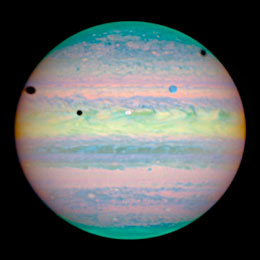
Like many amateurs in North America, the Hubble Space Telescope caught Jupiter last March 28th during a rare, 19-minute period when three of the planet's four large moons were casting their shadows onto its face at once. These colors are what you would see if your normal color vision were shifted to the infrared wavelengths of Hubble's NICMOS camera. Click image for labeled version. Movies of the rotating planet and orbiting moons are also available.
NASA / ESA / Erich Karkoschka / Zolt Levay.
Jupiter's cloud belts are always filled with spots, streaks, and swirls, but this image shows five spots of another kind. Three are the black shadows of Jupiter's moons Io, Ganymede, and Callisto. Two lighter dots are Io and Ganymede themselves. (Callisto is outside the frame, to the right.)
Triple shadow transits like this are rare. This one — the first and last this decade — took place on March 28th from 8:00 to 8:19 Universal Time, when Jupiter was in good view from the Americas and well-prepared amateur observers made a point of getting their scopes out. Hubble scientists chose this time to make an infrared movie of the planet, from which this frame is taken.
The imaging was done with Hubble's NICMOS infrared camera. In the rendering here, red, green, and blue represent near-infrared wavelengths of 1,900, 1,660, and 1,080 nanometers, respectively.
"In the near infrared, methane gas in Jupiter's atmosphere limits the penetration of sunlight," explains a NASA press release, "which causes clouds to appear in different colors depending on their altitudes. Studying clouds in near-infrared light is very useful for scientists studying the layers that make up Jupiter's atmosphere." Yellow clouds are high, red ones are lower, and blue ones are lower still. The green near the polar limbs is thin haze very high in the atmosphere. The blue tint of Ganymede arises from the absorption of longer infrared wavelengths by water ice on its surface. Io's white comes from its bright sulfur compounds.
The diagram below shows the positions of Jupiter's moons in their orbits at the time.
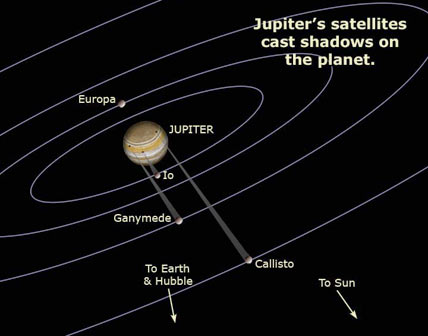
Like many North American amateurs, the Hubble Space Telescope caught Jupiter last March 28th during a rare, 19-minute period when three of Jupiter's large moons were casting their shadows onto the planet's face at once. These colors are what you would see if your normal color vision were shifted to the infrared wavelengths of Hubble's NICMOS camera. Click image for labeled version. Movies of the rotating planet and orbiting moons are also available.
NASA / ESA / Ann Feild / C. Klicka.
About Alan MacRobert
Alan M. MacRobert became an avid Sky & Telescope subscriber in 1966 at age 14, joined the editorial staff in 1982, and is now a senior contributing editor, semi-retired. He played a role in practically every part of the magazine and the company's other products for more than a generation, both on the amateur-observing side and the science-reporting side. In 1994 a book collection of his observing how-tos and telescopic sky tours was published as Star Hopping for Backyard Astronomers. He has produced This Week's Sky at a Glance online every week since 1989.


Comments
You must be logged in to post a comment.