 SUNSET:

 0
0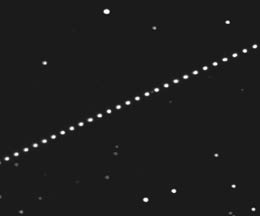
Among the sky photographers who caught Rosetta zipping past Earth were Gianluca Masi, Franco Mallia, and Roger Wilcox. They made 33 fifteen-second exposures using a remote-controlled 14-inch telescope at Las Campanas, Chile. Click here for movie (animated gif file).
Courtesy Gianluca Masi.
The night sky is full of visible Earth satellites; you can often count half a dozen creeping across the stars in the hour after dark, just by keeping watch with your unaided eyes. But rare indeed is the interplanetary spacecraft that's visible from Earth.
On March 4th, following publicity by the European Space Agency (ESA), many telescope users succeeded in spotting and tracking the ESA's Rosetta probe as it flew by Earth. An example is shown here. The spacecraft brightened to 8th or 9th magnitude. In the coming years it will make two more flybys of Earth, and one of Mars, to gain the velocity needed to match orbits with Comet 67P/Churyumov-Gerasimenko in 2014. It will go into orbit around the nucleus of the comet and drop a probe to land on its surface.
About Alan MacRobert
Alan M. MacRobert became an avid Sky & Telescope subscriber in 1966 at age 14, joined the editorial staff in 1982, and is now a senior contributing editor, semi-retired. He played a role in practically every part of the magazine and the company's other products for more than a generation, both on the amateur-observing side and the science-reporting side. In 1994 a book collection of his observing how-tos and telescopic sky tours was published as Star Hopping for Backyard Astronomers. He has produced This Week's Sky at a Glance online every week since 1989.


Comments
You must be logged in to post a comment.