 SUNSET:

 9
9A new image from the Gemini Observatory might show a stellar companion to Betelgeuse, but the discovery is tentative.
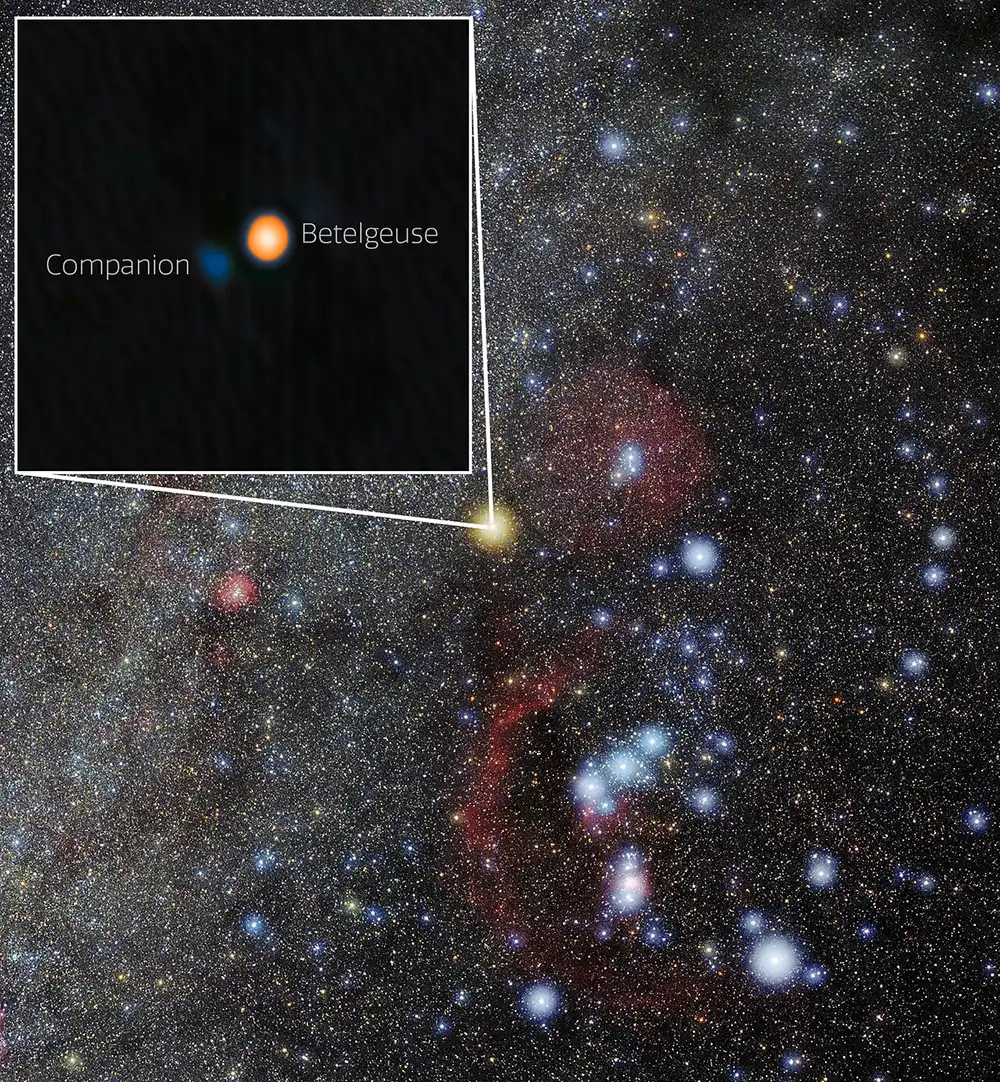
International Gemini Observatory/NOIRLab / NSF / AURA; Image Processing: M. Zamani (NSF NOIRLab)
Astronomers may have finally spotted a close companion to Betelgeuse, the bright red star at Orion’s shoulder. Long suspected, this elusive partner could help explain the supergiant’s recent brightness dips and hint at a turbulent future. That said, it’s still a highly tentative discovery.
The suspicion that Betelgeuse is not alone dates back decades, but it has never been confirmed. Last year, a team led by Morgan MacLeod (Center for Astrophysics, Harvard & Smithsonian) argued that a companion would help explain Betelgeuse's position on and speed across the sky as well as its brightness. Yet this was a theoretical prediction, not observational evidence. In fact, there was doubt such a companion could ever be found after searches with the Hubble Space Telescope and Chandra X-ray Observatory came up empty.
Now a team led by Steve Howell (NASA Ames Research Center) claims to have found it. The team used the Gemini North telescope in Hawai‘i and a technique called speckle imaging, which uses ultra-short exposure times to cut through the blurring effects of Earth's atmosphere.
“This detection was at the very extremes of what can be accomplished with Gemini in terms of high-angular resolution imaging, and it worked,” says Howell. “This now opens the door for other observational pursuits of a similar nature.”
The discovery is on a weak footing, however. Orbital motion has not been observed, meaning we need follow-up studies to confirm whether this object really circles Betelgeuse. Perhaps more tellingly, there’s a roughly 10% chance the companion isn’t there at all. That’s much more doubt than astronomers usually allow before announcing a discovery.
“It is certainly intriguing to consider the possibility that a companion is detected, but the fact of the matter is that the signal-to-noise of this effect is quoted to be 1.6,” says René Oudmaijer (University of Leeds, UK), who was not involved in the research. “Such values are widely regarded as non-detections.”
If the companion does exist — and right now that remains a big “if” — what could we learn about it?
Based on the observations, the object appears six magnitudes fainter than Betelgeuse. Weighing in at 1.5 Suns, it’s likely a pre-main-sequence star — once it finishes amassing gas and turns on fusion in its core, it could become an F-type star.
The putative protostar orbits Betelgeuse at a distance of just 4 astronomical units, placing it inside Betelgeuse's extended outer atmosphere. It would be the first time a stellar companion to a supergiant has been found this close in. But that intimacy is a death sentence. The twin threats of drag from Betelgeuse’s diffuse atmosphere and extreme tidal forces would see the companion spiral into Betelgeuse, perhaps in as little as 10,000 years — an astronomical heartbeat away.
Howell’s team speculates that the result could be an exotic object, perhaps resembling a Thorne–Żytkow star, where a dense stellar core becomes embedded in a bloated outer envelope. The collision between the object and Betelgeuse could lead to powerful eruptions of gas and dust, which would likely alter the brighter star’s appearance in the night sky and potentially shift its evolutionary path.
Seeing Betelgeuse as part of a tight binary could also reframe the Great Dimming of 2019–2020, when the star dramatically faded for several months. At the time, theories ranged from dust clouds to surface cooling. A close stellar companion stirring up Betelgeuse’s outer layers could be another plausible contributor.
Big question marks remain, for now. Howell’s team will seek to monitor Betelgeuse in the coming years for more concrete evidence of a star in tow. Astronomers have long warned that Betelgeuse is a ticking time bomb. The discovery of a close-in companion might just shorten the fuse.
Editorial note (August 14, 2025): The text has been corrected to reflect the following: Astronomers have proposed a candidate for Betelgeuse since the 1990s, and the companion star, if it exists, corresponds to a pre-main-sequence star of spectral type F.
About Colin Stuart
Colin Stuart (@colinstuartspace) is an astronomy author and tutor. He also runs a free online astronomy club.


Comments
Anthony Barreiro
July 25, 2025 at 9:23 pm
The Astrophysical Journal Letters article "The Probable Direct-imaging Detection of the Stellar Companion to Betelgeuse" is available here:
https://iopscience.iop.org/article/10.3847/2041-8213/adeaaf#apjladeaafs5
Here are the last two paragraphs of the concluding summary:
<< The results presented here are not definitive as the detection is at the limit of the instrument capabilities. However, the results do present the most direct and substantive evidence for the existence of a stellar companion to Betelgeuse, as well as the properties of that companion. The next predicted greatest elongation for the stellar companion is UT 2027 November 26 (J. A. Goldberg et al. 2024); we recommend that the community observe Betelgeuse prior to and during that event to better constrain the nature of the companion.
<>
You must be logged in to post a comment.
Andrew James
July 26, 2025 at 5:16 am
"...it’s likely a pre-main-sequence star" How? If the age is 8-14 million years old for Betelgeuse A a pre-main-sequence star is unlikely using stellar evolution theory unless the companion was radically stripped.
You must be logged in to post a comment.
alphapsa
July 26, 2025 at 11:58 am
The pre-main sequence phase duration is a strong function of stellar mass and a companion doesn't have to be stripped if it started out small. A solar-mass star takes 40 million years to reach the main sequence, and lower-mass stars even longer.
I am a bit surprised they decided to publish a signal of such minuscule significance, even with other indirect evidence available. The qualifier "probable" in the title is too strong IMO, "tentative" or "possible" would be more appropriate.
You must be logged in to post a comment.
Andrew James
July 27, 2025 at 12:49 am
"The pre-main sequence phase can last anywhere from a few hundred thousand to several million years, depending on the mass of the star being formed." [1] This assumes it is a Class III weak T-Tauri star. The rarity of them makes 40 million years a bit of a stretch, and because of the proximity to the primary star it will be incredibly unlikely to exist in this form for very long. For example, the stability and longevity of the creation disc would be greatly influenced by the primary star. In actuality, the small of the star mass is the faster it will evolve (IMF v. SFE), and not the other way round as you state. It is is independent of the mass of the protostar. Worst. Time for it to become a ZAMS is already poorly defined, and it makes a lot of assumptions depending on your definition.
As for your evaluation of the qualifier, I do agree.
You must be logged in to post a comment.
alphapsa
July 27, 2025 at 3:46 am
Yes, I was referring to the zero main-sequence time for isolated stars, where a 10 Myr old solar-mass star still is quite some distance from the ZAMS. This is seen in theoretical evolution tracks, e.g. Palla & Stahler (1993): https://ui.adsabs.harvard.edu/abs/1993ApJ...418..414P/abstract
Timescales to reach ZAMS are listed in Table 1 as 32 Myr for 1 Msun, 12 Myr for 2 Msun, down to 40 000 yr for 6 Msun. This is the timescale decrease with mass I was referring to. You seem to imply that the evolution of PMS stars is significantly different when companion to a massive primary. I don't doubt it and it is very interesting, but do you have a reference to a study for that specific scenario? I found your claim that smaller stars evolve faster than more massive stars particularly intriguing, since that is contrary to how stars normally evolve.
You must be logged in to post a comment.
Andrew James
July 27, 2025 at 5:32 am
Reference is a bit out of date, but the unknowns here are also still diabolical. Scenarios are so complex that it's nearly impossible to give a specific example. Any PMS star is going to be greatly influenced by the primary. At 4 AU the evolution of a massive primary, especially if it is overly involved, means any scenario would be unusual. If you look at other red giants, such as Antares, which has a blue companion and main sequence star, then the separation between the two components shows that the PMS must've evolved very quickly.
Also because of the low mass stars having to gather up enough material to start to shine by the fusion process, is likely the reason why the PMS period is more rapid than largest star that still has to gather in more material in the initial nebula. The problem we have is that we can't see when the star and the core ignite, made especially problematic as the largest star is still enveloped in nebulosity. We have to define that the PMS start to ZAMS differs from the nebula collapse to ZAMS. As both ends of the phases are uncertain, means that it is unlikely we can determine the exact time period of any PMS star. Our constraint on the age of this star system is ultimately based on the primary, and why it is having a mass that has placed it in its evolutionary place. It does seem fairly odd to me that the primary has almost finished its evolution well its companion hasn't even started.
Comment: Not knowing the depth of knowledge that you have makes the details discussing this a little difficult. I don't know all the answers, my gut feeling is that further research may need to be done to resolve this enigma.
You must be logged in to post a comment.
alphapsa
July 27, 2025 at 7:55 am
You can also look at the more current MIST evolutionary tracks they refer to in the paper, e.g. Choi (2016) https://ui.adsabs.harvard.edu/abs/2016ApJ...823..102C/abstract
In particular in Fig. 13 they show the pre-MS, MS, and post-MS lifetimes for stars 0.1-9 Msun. The trend is clear, where sub-solar mass stars have very long pre-MS lifetimes indeed, up to 1 Gyr. A Sun in their model seems to stay about 40 Myr on the pre-MS. Massive stars, on the other hand, spend less than 1 Myr. In fact, massive enough stars reach the post-MS phase before low-massive stars have had time to reach the MS.
If a companion formed from the same collapsing cloud through free fall and fragmentation, then the clock for the two stars started essentially simultaneously and the time to ZAMS is dictated by the thermal (KH) timescale. If the companion instead formed in the accretion disk of the primary, then the companion could have been formed later – but that would only make it even later to the ZAMS.
So from a stellar evolution point of view, that two stars in the same system can be at very different evolutionary stages is not surprising, if they have very different masses. Granted, there will likely be second-order considerations due to the stars being in each others proximity, but without a more detailed study it is unclear in what direction that would affect the time scales.
You must be logged in to post a comment.
Andrew James
July 27, 2025 at 12:51 am
This excellent online paper may help too... https://www.astro.ru.nl/~onnop/education/stev_utrecht_notes/chapter9-11.pdf
You must be logged in to post a comment.
Anthony Barreiro
July 28, 2025 at 6:29 pm
Betelgeuse means "hand of the giant" in Arabic. Elgeuse is a historical Arabic name for Orion, and a feminine name in old Arabic legend. Given that if this star exists it orbits around Betelgeuse, Howell et al. propose naming it Siwarha, or "her bracelet."
You must be logged in to post a comment.
You must be logged in to post a comment.