 SUNSET:

 0
0Astronomers puzzled over why a gravitationally lensed quasar was missing one of its images — then the Chandra X-ray Observatory found it.
If an object appears in the sky in four places at once, it might seem greedy for astronomers to ask for more. In the case of a distant galaxy called HE0230-2130, however, the absence of a fifth image was unexpected — leaving astronomers to try and explain the puzzle.
But there’s nothing to explain, says David Pooley (Trinity University). There is a fifth image after all, once you know how to look for it. He presented his findings at the 246th American Astronomical Society meeting in Anchorage, Alaska.
HE0230-2130 hosts a supermassive black hole in its center, known as a quasar. The black hole is capturing gas from its surroundings, generating prodigious amounts of light in the process. The light we see from it now has traveled 10.6 billion years to reach Earth.
ESA/NASA
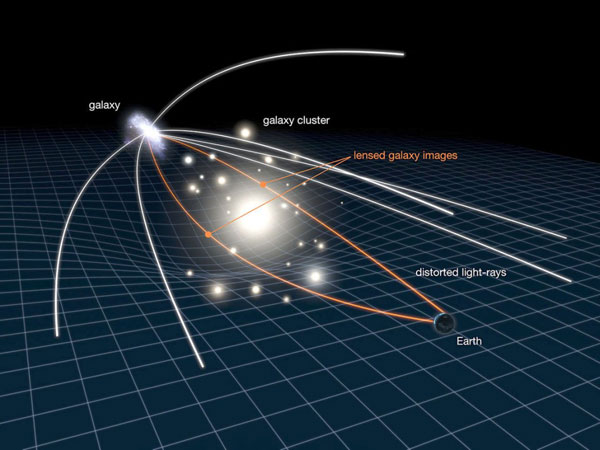
From our vantage point, this objects in the distant universe lines up just so with a massive object directly in front of it: two merging foreground galaxies. The foreground mass acts as a gravitational lens, steering the light from the more distant quasar along various paths to create multiple images.
Observations have showed four images, but that number puzzled astronomers. “It's almost impossible to develop a mass model [for the two galaxies] that gives you images A, B, C, and D, and does not also give you a fifth image,” says Pooley. Nevertheless, the lack of a fifth image led researchers to do just that.
In an article last year in Astronomy & Astrophysics, a team led by Sebastian Ertl (Max Planck Institute for Astrophysics, Germany) presented observations of the quasar using the pair of 6.5-meter Magellan Telescopes in Chile. The team rejected several reasons why a fifth image might have evaded detection: Among the possibilities they considered were microlensing, the further gravitational deflection of the quasar’s light by stars in an intervening galaxy. Another possibility was natural variations in the quasar’s brightness. Either scenario could have dimmed the fifth image — and only the fifth image.

Magellan Telescopes
However, Ertl and colleagues concluded that no such effects would be strong enough to completely hide the fifth image from the sensitive telescopes’ view. Instead, they sought to explain the missing image by a peculiar distribution of mass — including both normal matter and dark matter — in and around the foreground galaxies. After trying 12 different mass distributions, sometimes even including an additional dark matter clump, they found some that produced only four images.
But it turns out, the fifth image was there all along, Pooley says. It just wasn’t visible in the Magellan observations.
And Now There are Five
He had been following the quasar’s behavior using the Chandra X-ray Observatory. “I kept noticing that there seemed to be this clump of photons just at the top right of image D,” he explains.
To obtain a better view, he aligned and combined his observations, in effect adding together the exposure times. That technique at last revealed the fifth image.
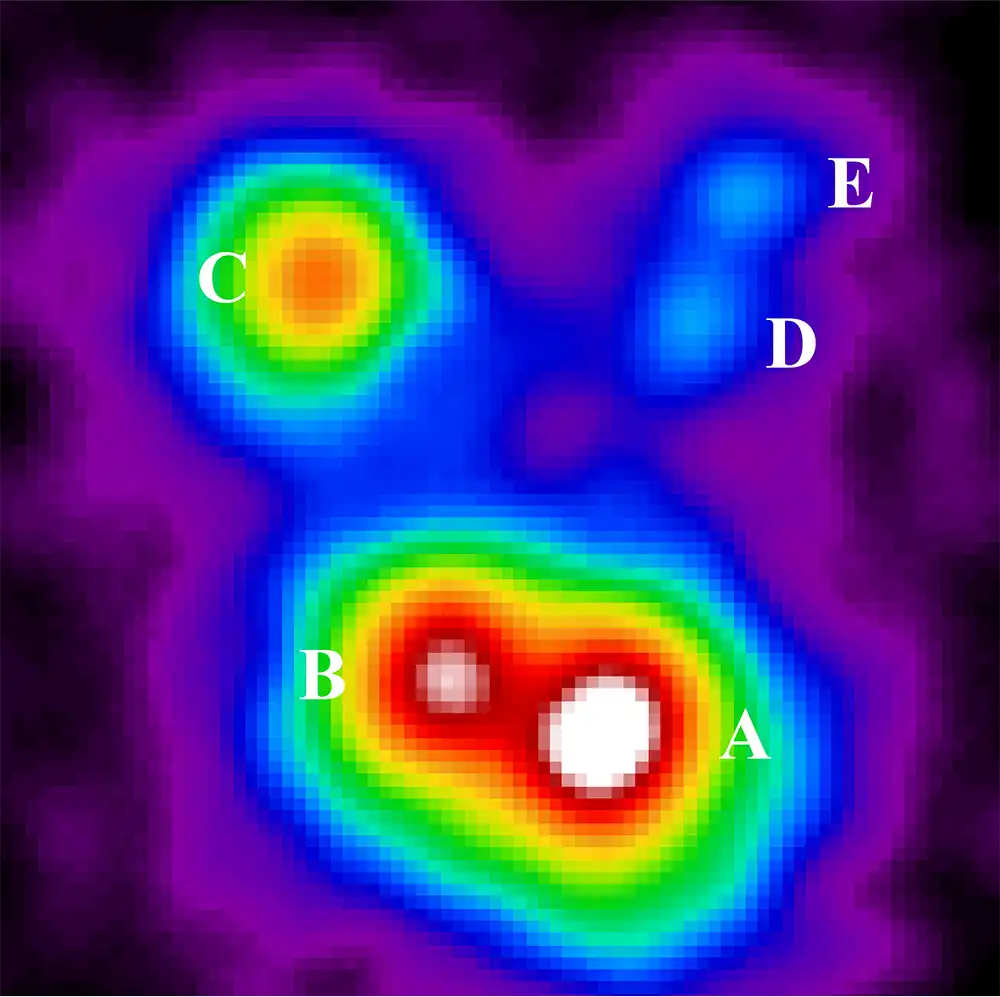
Paul Schechter (MIT), who participated in Ertl’s study, praises Pooley’s work, writing in an email, “What Pooley has found is without question an image of the quasar.”
Most of the X-ray photons are the most energetic that Chandra can observe, suggesting to Pooley that dust between us and the quasar is blocking the passage of less energetic X-ray photons as well as all visible light. Schechter points out that James Webb Space Telescope observations, which cover a span of infrared wavelengths, could test that scenario.
But until follow-up data are obtained, that interpretation is still open for discussion.
Even with the fifth image found, Schechter still thinks HE0230−2130 requires special circumstances to explain: “The fifth image can only be where it is (and as faint as it is) if the dark [matter] halos of the lensing galaxies are very unusual.”


Comments
You must be logged in to post a comment.