 SUNSET:

 0
0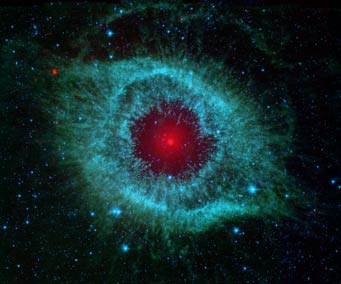
In this near- and mid-infrared image, the center of the familiar Helix Nebula is aglow with emission from newly discovered dust and debris. Wavelengths around 4 microns are shown blue, 7 microns green, and 24 microns red.
NASA/JPL/Caltech/Univ. of Arizona
Colliding solid bodies, probably icy comet nuclei, have created a dusty debris disk near the center of the Helix planetary nebula in Aquarius, as revealed in infrared images from NASA's Spitzer Space Telescope.
The nebula's central star is a hot, 110,000°C white dwarf that blew off its outer layers to form the nebula. That event must have blown away any dust near the star. But Spitzer found abundant dust forming a disk 35 to 150 astronomical units (Earth-Sun distances) from the star. The central red circle in the image at right is glare from this disk, which is too small to be resolved.
Astronomers believe the fresh dust is debris from collisions between solid bodies that once followed stable orbits like those in the solar system's outer Kuiper Belt. If several massive planets originally orbited the star closer in, they could be thrown into chaos by the star's loss of mass. They would then sow chaos in turn through the star's version of the Kuiper Belt — leading to relatively frequent collisions there.
In addition, some of the stirred-up debris would eventually fall onto the white dwarf itself — and this would explain its excess X-ray emission, a mystery up to now. A team led by Kate Su (University of Arizona) presents its analysis of the situation in Astrophysical Journal Letters for March 1st.
About Alan MacRobert
Alan M. MacRobert became an avid Sky & Telescope subscriber in 1966 at age 14, joined the editorial staff in 1982, and is now a senior contributing editor, semi-retired. He played a role in practically every part of the magazine and the company's other products for more than a generation, both on the amateur-observing side and the science-reporting side. In 1994 a book collection of his observing how-tos and telescopic sky tours was published as Star Hopping for Backyard Astronomers. He has produced This Week's Sky at a Glance online every week since 1989.


Comments
You must be logged in to post a comment.