 SUNSET:

 1
1A rare meteorite recovered from the Sahara Desert could be a fragment of a Moon-size body that met an early, violent end.
John Kashuba
A rare meteorite recovered from the Sahara Desert could be a fragment of a planetary body as large as the Moon. It would have formed rapidly and met a violent end in the earliest days of the solar system.
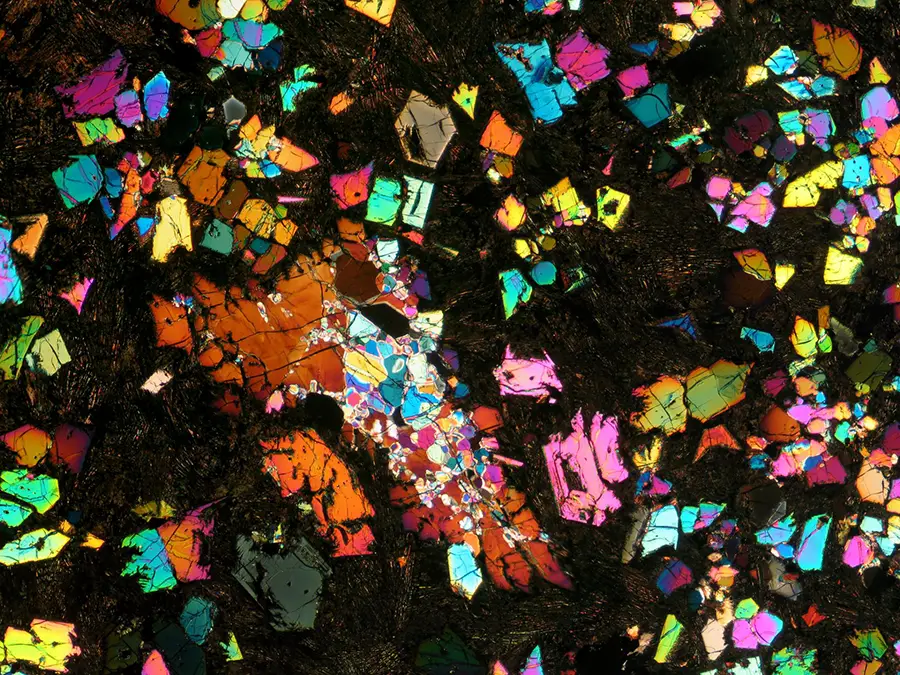
The meteorite, dubbed Northwest Africa (NWA) 12774, was purchased in 2019 from a Mauritanian dealer. It belongs to a rare group called angrites, volcanic space rocks of which only 68 specimens have been found. For a while, scientists assumed most angrites originated from a moderately sized asteroid, maybe a few hundred kilometers in diameter, similar to how eucrite meteorites are likely linked to the 500-kilometer-wide main belt asteroid 4 Vesta. This assumption was based on mineral chunks embedded in the meteorite, which indicate that the rocks must have formed under considerable pressure.
But a new analysis by Aaron Bell (University of Colorado Boulder) and his colleagues, published in Earth and Planetary Science Letters, reveals that these crystals are incredibly rich in aluminum, which is packed into an extremely tight structure. Such high densities could have only been achieved if the rocks formed at a much greater pressure than previous estimates had suggested.
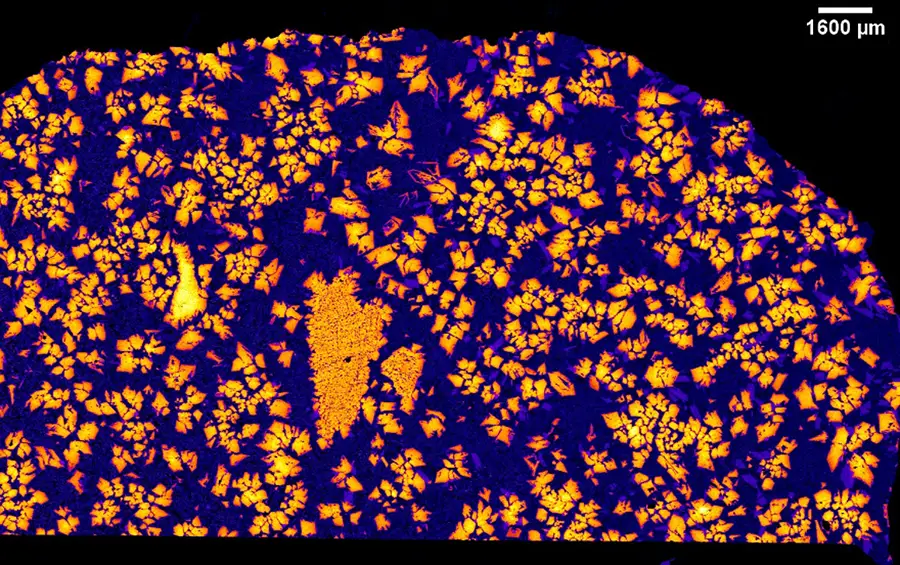
Aaron Bell / CU Boulder
These pressures, the researchers estimated, must have been reached 17.56 kilobars, which is the pressure found at a depth of about 50 to 60 kilometers under Earth’s continental crust — vastly exceeding the internal pressure at the center of a body like 4 Vesta, estimated to be about 1 kilobar. The angrite parent body couldn’t have been a puny kilometer-size asteroid, but had to be something much bigger: a layered world at least 2,000 kilometers (1,200 miles) in diameter.
Moreover, the crystals in the rock appear sharp, showing little signs of deformation. This suggests that, while the rock formed in a high-pressure environment, it traveled quickly to the surface. It didn’t sit around in the deep underground for too long before it hitched a volcanic ride to the near-surface, where it was erupted as a basaltic magma, Bell explains.
The rapid ascent points to an origin in the upper mantle of the parent body, likely less than 200 kilometers (120 miles) deep. To achieve the necessary pressures at this relatively shallow depth, the planet´s gravity must have been large. The conclusion: The parent body must have been as large as our Moon — spanning about 3,600 kilometers.
A Compositional Conundrum
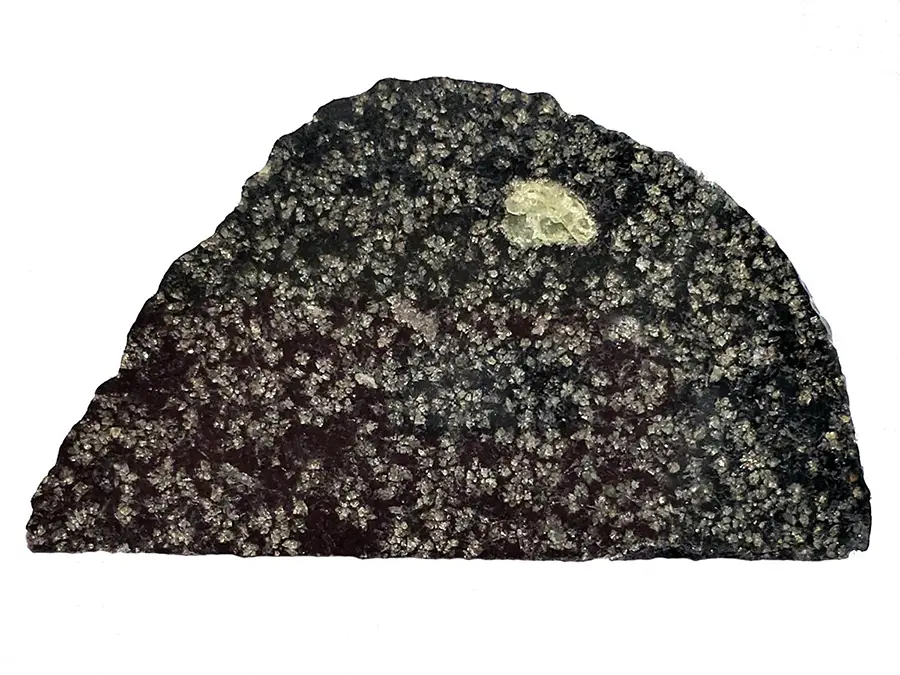
John Kashuba
“That these samples even exist and have fallen to Earth — that's just luck, to some degree,” Bell says. He ponders the fact that a Moon-size planetoid existed, was eventually blasted to pieces, and 4 billion years later chunks of it continue to rain down on Earth — it boggles the mind.
But the birthdate of this putative baby planet is a puzzle. Angrites are among the oldest known materials in the solar system, formed just 4 million years after the first solids coalesced from the solar nebula. The parent body must have built up extremely quickly. This timeline challenges traditional planetary formation models, most of which do not predict that planets of this size were roaming the solar system so early on, Bell says. Relatively new theories, such as pebble accretion, suggest that planet formation was faster than suggested in previous models. As a result, this finding supports the express train of planet formation.
The meteorite adds to previous analysis of at least 15 other groups of metallic meteorites that also might have belonged to planetary embryos destroyed during the consolidation of the planets, more than 4.5 billion years ago. “NWA 12774 is just one more piece of that puzzle that, little by little, we are completing,” says Josep Maria Trigo-Rodríguez (Spanish National Research Council and Institute of Space Studies of Catalonia).
Angrites contain almost no silicon dioxide, or silica — the primary component of beach sand and a major building block of most terrestrial planets. Instead, angrites are made of unusual, high-temperature minerals, thought to have condensed directly out of the early solar nebula. For this angrite’s parent body to have formed so soon after the solar system’s birth, those minerals might have made up a much larger chunk of the solar system’s early budget than scientists had imagined. “This implies that they formed from a different mixture of accretionary feedstock,” Bell says.
But Trigo-Rodríguez is more cautious about this point. “This meteorite is only one piece; we would have to retrieve many more to understand the overall composition of its progenitor planetary body,” he says.
We might already have that information at our fingertips: Understudied meteorite collections are dispersed in universities and museums around the world, Bell notes. A new look at these collections might even reveal a previously unrecognized crowd of lost early planets.
About Javier Barbuzano
Javier Barbuzano is a bilingual Spanish-English science writer and communicator. He graduated from Boston University with a master’s degree in Science Journalism. He writes about many topics, but astronomy and technology are his favorites.


Comments
Roger-Keith
June 14, 2026 at 11:20 pm
Have we found part of the impactor that eventually caused our Moon?
You must be logged in to post a comment.
You must be logged in to post a comment.