 SUNSET:

 0
0A small but unique mission to Mars is taking an innovative path to reach the Red Planet in late 2027.
Kirby Kahler
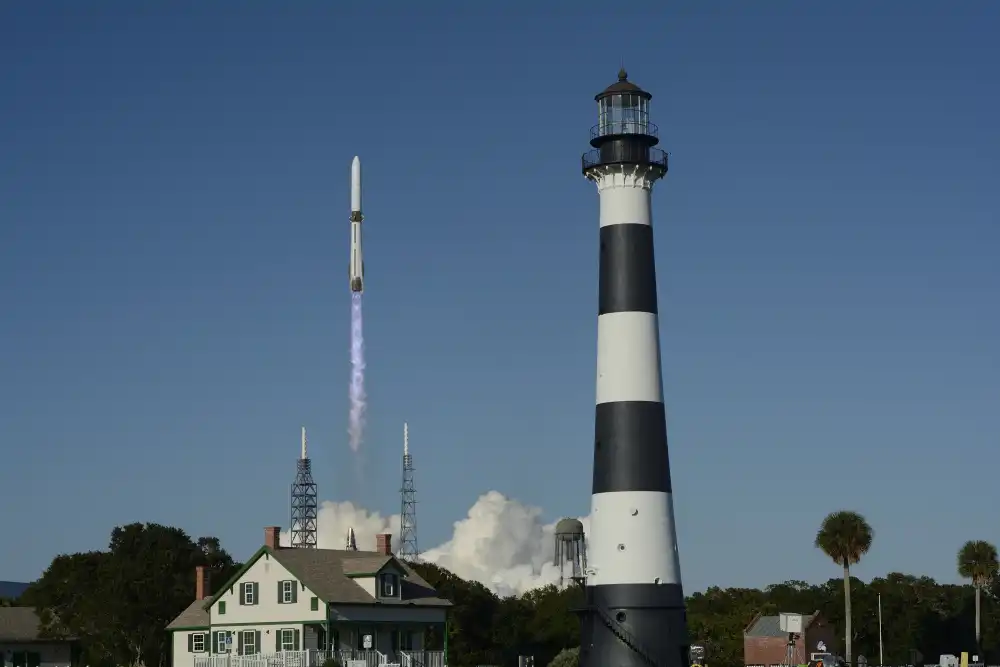
They’re finally on their way. After a long series of delays and launch schedule shuffles, the Escape and Plasma Acceleration and Dynamics Explorers (ESCAPADE) are on their way to Mars.
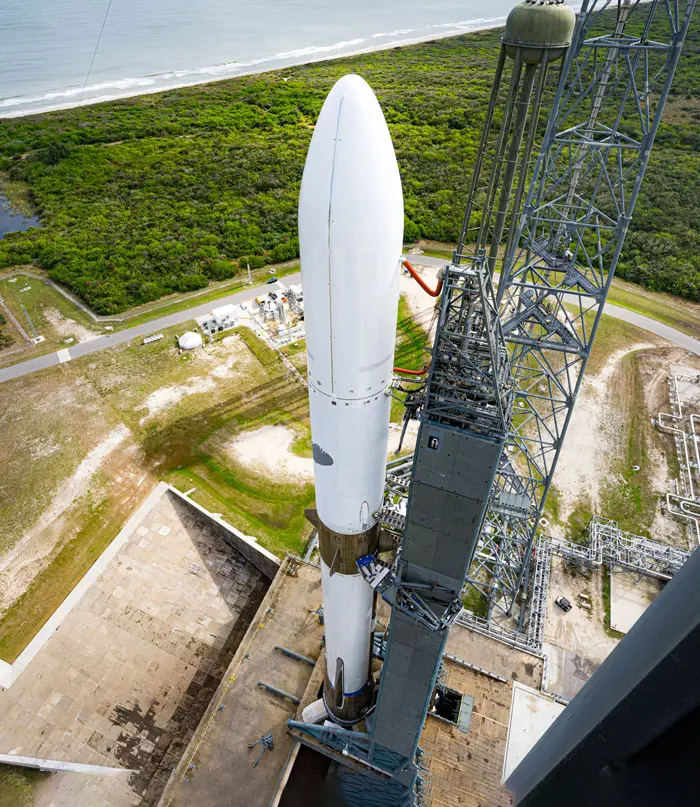
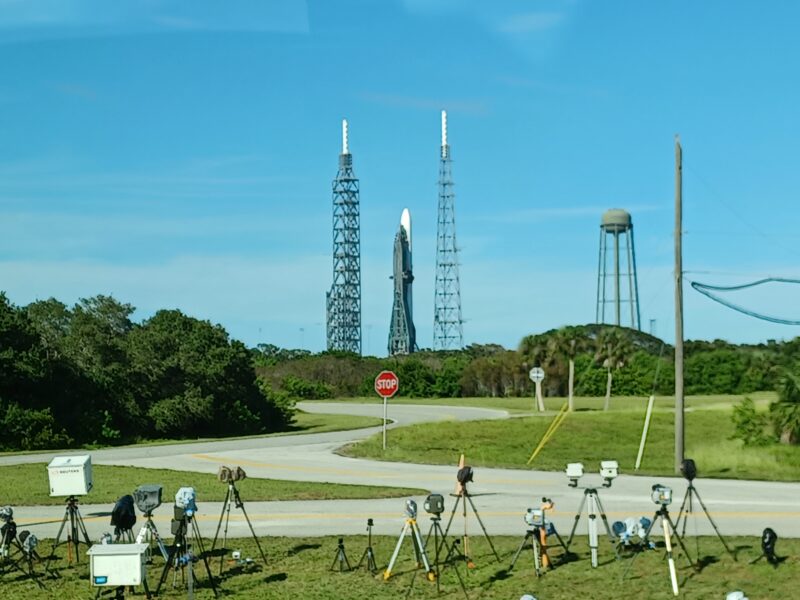
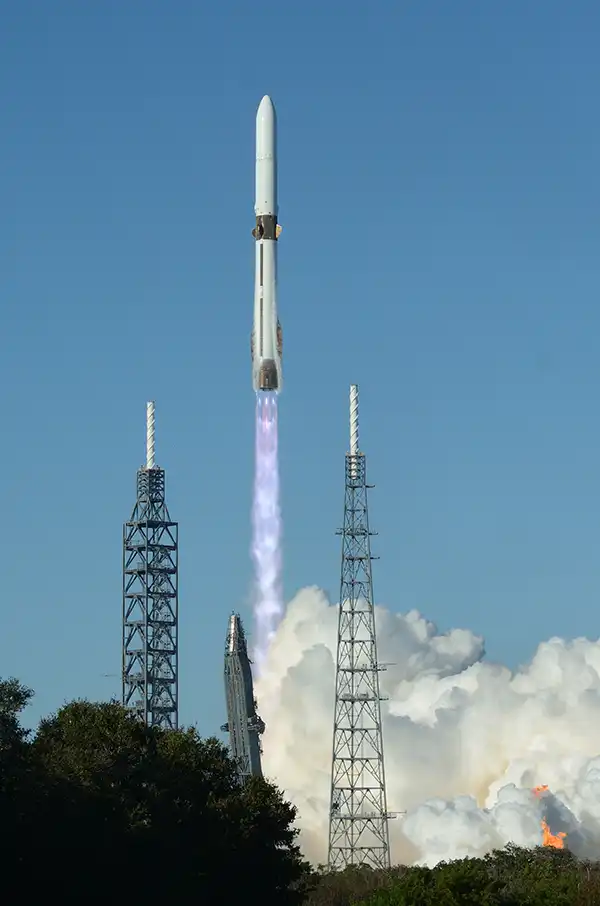
The pair of small satellites launched on Blue Origin’s New Glenn rocket from the Cape Canaveral Space Force Station in Florida on Thursday, November 13th at 3:55 p.m. Eastern Standard Time (EST)/20:55 Universal Time (UT).
This flight made it out on the third try this week: an initial launch attempt on November 9th was scrubbed due to multiple issues. The U.S. government shutdown also impacted the launch, as the Federal Aviation Administration called for a restriction on daytime launches starting November 10th. Although Blue Origin applied for and got an exemption, the proton ground level event on November 11th which also resulted in Tuesday night's auroral storm resulted in yet another cancellation. It wasn't just a 'weather scrub,' but a 'space weather scrub'.
ESCAPADE is the fourth mission for NASA’s Small Innovative Missions for Planetary Exploration (SIMPLEX) program, which to date has included Q-PACE, LunaH-Map, and Lunar Trailblazer — all of which were unsuccessful. ESCAPADE will arrive at Mars in 2027, beginning its mission shortly after the two spacecraft enter orbit.
Blue Origin
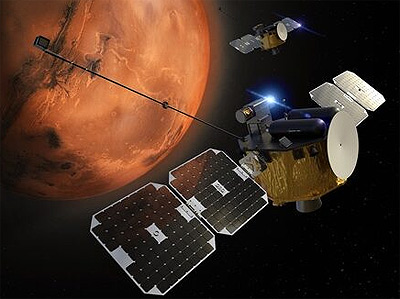
The two ESCAPADE spacecraft are nicknamed Blue and Gold, taking their name from the school colors of the University of California, Berkeley, which operates the mission. Blue separated from the launch upper stage at T+33:18, and Gold separated 30 seconds later.
Today’s launch is the second flight for New Glenn, after the inaugural launch earlier this year, on January 16th. This mission saw the successful deployment of Blue Ring Pathfinder, an adapter which will hoist small satellites and other technology. In a first for Blue Origin, the New Glenn booster landed successfully on the Jacklyn sea platform shortly after launch.
Kirby Kahler
Scientific Objectives
ESCAPADE is designed to study the interactions between particles coming from the Sun and the Martian magnetic field and atmosphere. The pair of spacecraft will follow each other in Mars orbit, allowing for separate but simultaneous measurements.
As part of this overall goal, Blue and Gold will be studying the planet's changing ionosphere, which will also aid communications on and around Mars. Those lessons will be important for future missions, including the newly revived Mars Telecommunications Orbiter mission.
“ESCAPADE is unique, in several respects,” says mission lead Robert Lillis (University of California, Berkeley). “It's the first coordinated multi-spacecraft science mission to Mars and only the second to another planet.” The first multi-spacecraft science mission to another planet is BepiColombo, which will arrive at Mercury in 2026. (The Mars Cube One CubeSats, launched in 2018 alongside the INSIGHT mission, didn't coordinate with each other.) By making simultaneous observations, ESCAPADE’s twin spacecraft will give us a stereo perspective on the Martian upper atmosphere and magnetosphere and their response to space weather.
“With a single orbiter, we have to wait at least four hours to visit the same region again to see how it changed, but we know the magnetosphere changes on minute timescales,” says Lillis. “With ESCAPADE’s Campaign A, both spacecraft will be following each other in the same orbit, between 2 and 30 minutes apart, so we can actually observe the changes in Mars’ highly dynamic space environment.”
The Mars space weather environment is similiar to Earth’s: to accurately measure it, you need to be where it’s actually blowing. "With a single orbiter, if I see something change in the data (e.g. magnetic field), I don’t know whether 1) it changed everywhere or 2) the spacecraft just entered a new region where the conditions are different,” says Lillis. “With two orbiters, those changes in space and time can be separated.”
NASA’s MAVEN and the European Space Agency’s Mars Express take magnetometer readings similar to what ESCAPADE will measure, and researchers hope to compare those measurements with ESCAPADE’s. JAXA’s Mars Moons Explorer (MMX), possibly launching late next year, could also aid in that science. ESCAPADE has a three-year nominal mission.
Rocket Lab
Construction and Trajectory
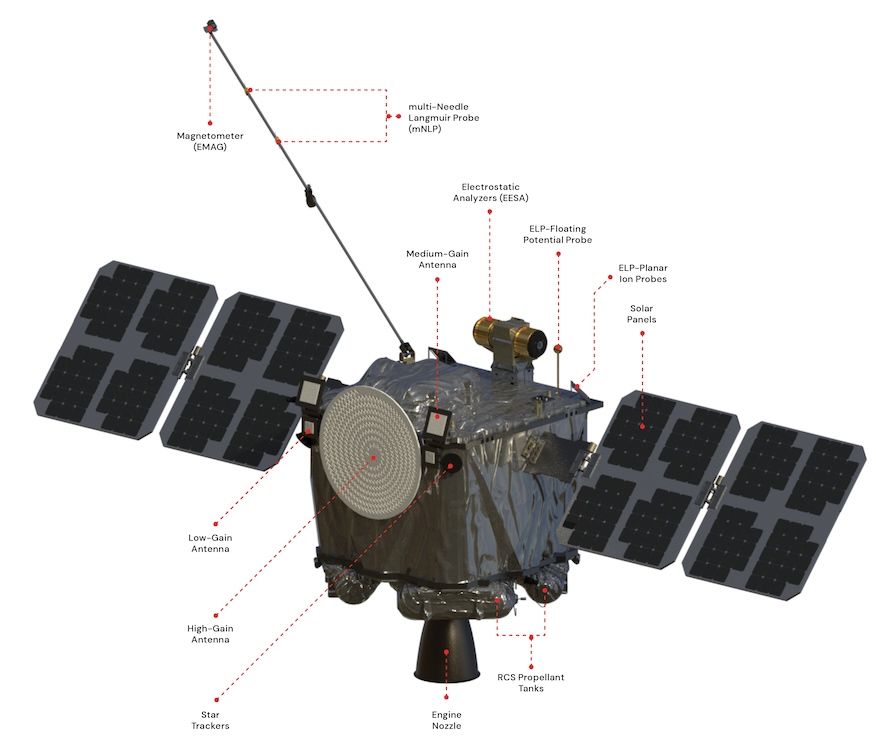
The spacecraft, which cost $60 million to design and build, are built around Rocket Lab’s Photon Explorer satellite bus, which proved itself on the CAPSTONE CubeSat that launched to the Moon in 2022. Lessons learned will be paid forward to the Rocket Lab’s Venus Lifefinder mission, due to launch next year.
Rocket Lab
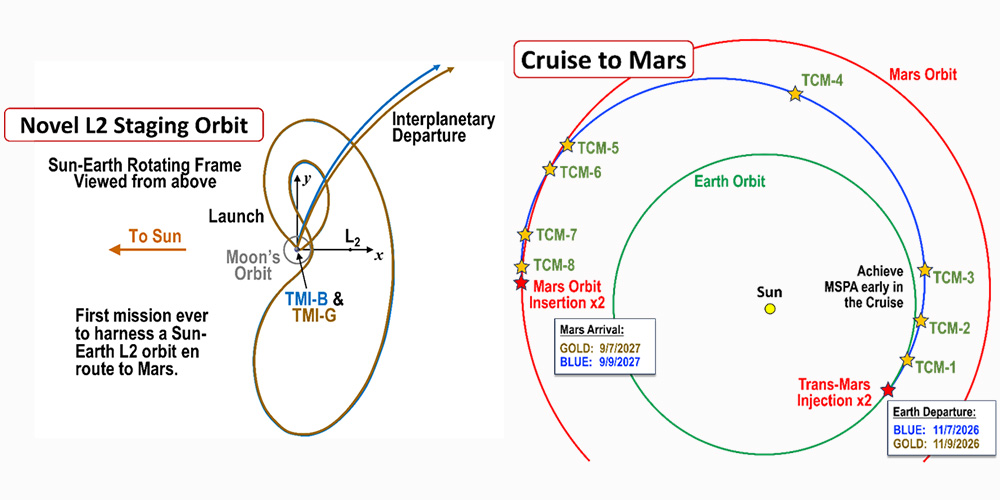
ESCAPADE launched outside the usual Mars launch window. Usually, missions to the Red Planet launch several months prior to opposition, allowing for the shortest transit time and thus minimizing the fuel used. ESCAPADE instead launched after opposition, heading to the L2 Lagrange point, 1.5 million kilometers (930,000 miles) from Earth in the anti-sunward direction. Once there, ESCAPADE will loiter in a halo orbit, monitoring space weather and waiting for the Mars transfer window to open in November 2026.
Watch for the trans-injection burn late next year, when ESCAPADE will depart L2 and swing around Earth in an Oberth maneuver that will accelerate it on to Mars. We could see some of the initial science data from the mission’s space weather monitoring effort by mid-2026. ESCAPADE will arrive in an elliptical orbit around Mars in the fall of 2027, and start its official science mission in mid-2028.
Space Sciences Laboratory / University of California, Berkeley
What’s Next for New Glenn
Kirby Kahler
Blue Origin’s rocket might also launch two lunar missions in 2026. The company’s Blue Moon Pathfinder lander should fly in January. Then, in mid-2026, New Glenn will launch Firefly Aerospace’s Elytra Dark lunar transfer orbiter, which will carry both Firefly’s Blue Ghost Mission 2 lander and ESA’s Lunar Pathfinder orbiter. The latter is the first mission in the agency’s Moonlight constellation.
Congrats to Blue Origin, Rocket Lab, and the University of California, Berkeley, on a successful launch that will ultimately send ESCAPADE on its way to Mars.
About David Dickinson
David Dickinson is a freelance science writer, high school science teacher, retired enlisted U.S. Air Force veteran and avid stargazer. He currently resides with his wife Myscha in Bristol, Tennessee. David also writes science fiction in his spare time. He posts as @AstroDave on BlueSky about space news and sky-watching worldwide.


Comments
You must be logged in to post a comment.