 SUNSET:

 0
0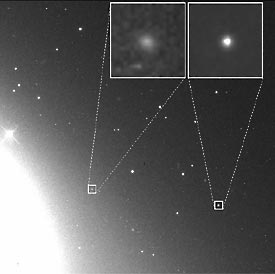
This deep Hubble Space Telescope image shows the fringe of the galaxy NGC 1023 with a 'faint extended cluster' (left inset) and a normal globular cluster (right inset).
Soeren Larsen / NASA
As amateur telescope users well know, star clusters in our Milky Way come in two basic types: open clusters and the much richer, denser globulars. But astronomers surveying other galaxies have found that some of them contain a third kind: "faint extended clusters" somewhat like globulars but larger, dimmer, and more spread out.
Jean Brodie and Soeren Larsen (University of California, Santa Cruz) first reported these objects almost two years ago. Now, using the 10-meter Keck I telescope in Hawaii, they have succeeded in recording spectra for some of them, confirming and extending the discovery.
The new class of clusters eluded detection for so long because they don't seem to exist in our Milky Way, and because their surface brightnesses are so low that only the most powerful, modern instruments can find them anywhere else. In fact, archival Hubble Space Telescope images of only four galaxies go deep enough to show the objects at all. Two of the four galaxies have them; two don't. Like globulars, the faint extended clusters appear to be made of numerous, old, relatively red stars. But unlike globulars, they seem to be associated with a galaxy's flat disk rather than its more spherical halo. The researchers have submitted their work to the Astronomical Journal.
About Alan MacRobert
Alan M. MacRobert became an avid Sky & Telescope subscriber in 1966 at age 14, joined the editorial staff in 1982, and is now a senior contributing editor, semi-retired. He played a role in practically every part of the magazine and the company's other products for more than a generation, both on the amateur-observing side and the science-reporting side. In 1994 a book collection of his observing how-tos and telescopic sky tours was published as Star Hopping for Backyard Astronomers. He has produced This Week's Sky at a Glance online every week since 1989.


Comments
You must be logged in to post a comment.