 SUNSET:

 1
1Athena landed in the lunar south pole region but fell on its side. After its batteries quickly depleted, the mission ended.

Intuitive Machines
Intuitive Machines' Nova-C lander Athena landed in the lunar south pole region of the Moon, but less than a day later the lander is dead.
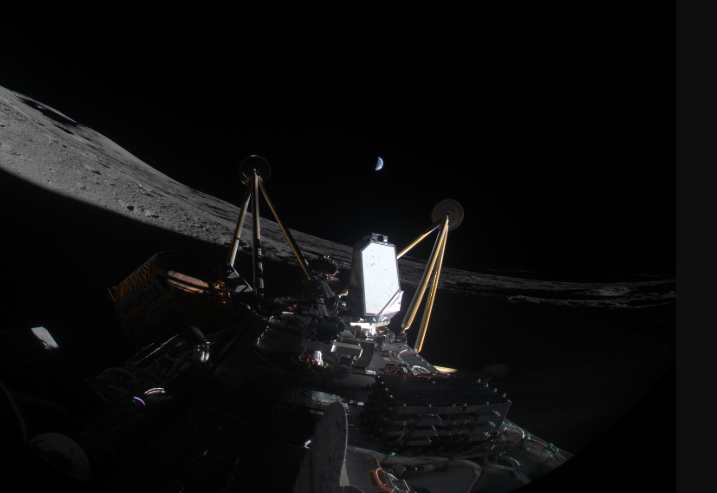
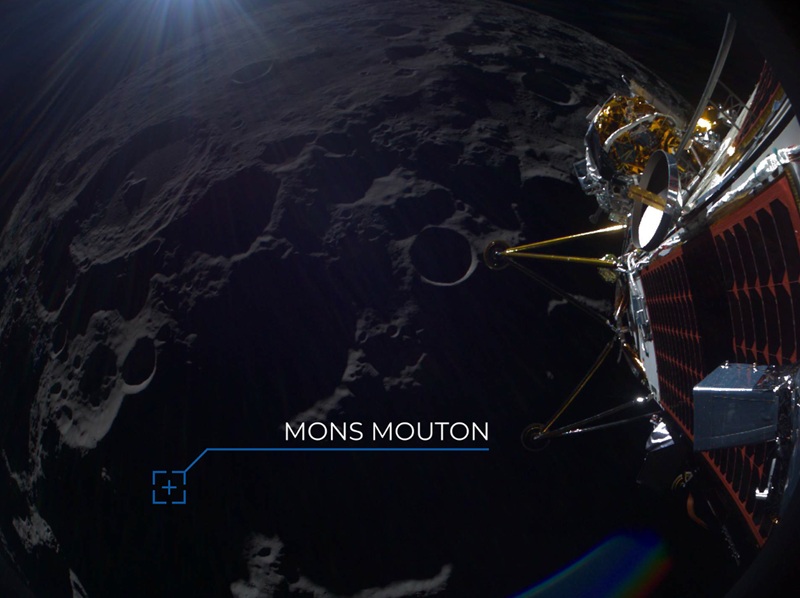
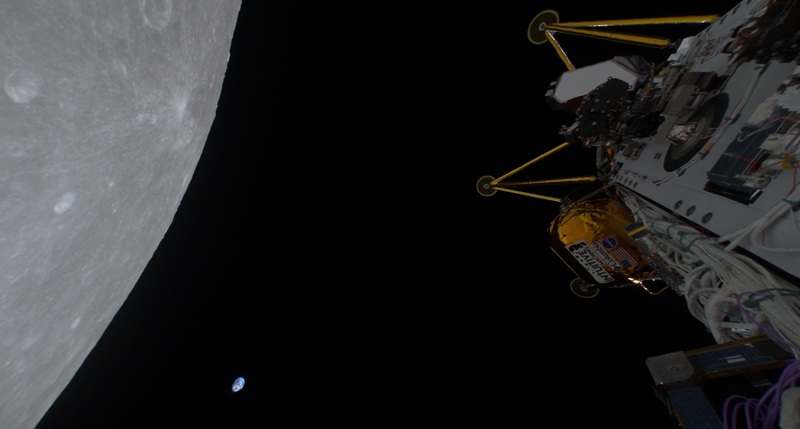
Athena entered lunar orbit on March 3rd and initiated an initial descent orbit insertion (DOI) burn on March 6th at 5:33 a.m. EST / 10:33 UT, snapping images as it went. It touched down in the Mon Mouton region at 12:30 p.m. EST / 17:30 UT. There were a few tense moments on final descent and some initial confusion until telemetry resumed from the lunar surface. Athena successfully phoned home with uplink and downlink telemetry shortly after landing and began charging its batteries with solar power.
However, early indications showed that the Nova-C lander was once again "not in the correct attitude," said Steve Altemus, CEO of Intuitive Machines, in a press conference Thursday afternoon. Indeed, a later image from the spacecraft confirmed it had landed on its side.
Intuitive Machines
Intuitive Machines issued an update on the morning of March 7th, stating that Athena landed 250 meters from its intended landing zone, inside a crater. The lander did receive a brief charge, and some programs and payload milestones (including for NASA’s PRIME-1 suite) were completed in the brief time after landing, but the batteries quickly depleted.
"With the direction of the sun, the orientation of the solar panels, and extreme cold temperatures in the crater, Intuitive Machines does not expect Athena to recharge," the company said in the statement. "The mission has concluded and teams are continuing to assess the data collected throughout the mission."
The landing attempt comes just four days after Firefly Aerospace’s successful landing of Blue Ghost in Mare Crisium on Sunday. Both are part of the Commercial Lunar Payload Services program, in which NASA contracts private companies to deliver ride-share payloads and experiments to the lunar surface.
At 84.6°S, the landing has the distinction of being the closest to the lunar south pole, within 62 miles (100 kilometers), breaking the Indian Space Research Organization’s Chandrayaan 3 record — though NASA’s Lunar Crater Observation Sensing Satellite (LCROSS) did strike Cabeus A in 2009 at about the same latitude. The polar region is of special interest for NASA’s Artemis initiative to send humans to the Moon, as it is known to harbor water ice.
Intuitive Machines
The mission launched just last week on a SpaceX Falcon 9 rocket, and entered lunar orbit about 100 kilometers (60 miles) above the surface of the Moon. Athena reached the landing site right around local sunrise, a timing intended to give the solar-powered mission a two-week span to operate. The timing was also intended to help with obstacle avoidance on approach, as boulders and craters stand out in stark contrast across the terrain at sunrise. Details on what went wrong in the landing haven't yet been shared.
Intuitive Machines
The IM-2 launch also dispatched missions to lunar orbit and beyond. Unfortunately, the AstroForge team only briefly received telemetry from its Odin asteroid mission, before it, too, fell silent. The same fate seems to have befallen NASA’s Lunar Trailblazer, although teams are still trying to establish contact with the spacecraft.
Intuitive Machines IM-1 mission made it to the Moon in early 2024, but was less than successful. The Nova-C lander Odysseus landed at Malapert A crater 30° off vertical, and had a tough time attaining enough of a charge for its solar panels. Issues with the laser range finding system are thought to have led to Odysseus’ hard landing; the same issue may have plagued Athena, too, despite improvements made to the system.

Intuitive Machines
Payloads Onboard ATHENA
The lander had several payloads and experiments onboard, including:
NASA’s Polar Resources Ice Mining Experiment (PRIME 1) with the Regolith and Ice Drill for Exploring New Terrain (TRIDENT) and Mass Spectrometer for Observing Lunar Operations was aboard. It was intended to search for water ice in the lunar soil. In the March 7th update, Intuitive Machines did note that they were able to accelerate some oeprations, including for NASA's PRIME 1, but there's no word yet just how far they got.
Lunar Oupost’s Mobile Autonomous Prospecting Platform (MAPP) was also onboard, along with the tiny AstroAnt rover perched on top. MAPP is part of NASA's Tipping Point Program to promote new technologies.
A micro hopper named Grace (after computer scientist and mathematician Grace Hopper) was set to carry out five rocket assisted hops out to a range of 16 miles (25 kilometers) from the landing site. Grace will target a nearby permanently shadowed crater dubbed 'Crater-H' which will receive a formal name after exploration.
Finally, Japan-based Dymon Corporation’s two-wheeled, half a kilogram micro-rover Yaoki was also onboard, set to roll onto the lunar surface as a proof of concept.
Firefly Aerospace's Blue Ghost remains operational, and hopes to catch next Friday's eclipse from the surface of the Moon.
Next up, iSpace’s Hakuto-R2 lander Resilience will head for its own landing at Mare Frigoris (Sea of Cold) on June 6th. Resilience hitched a ride to the Moon along with Blue Ghost and separated shortly after launch.
It’s rare to have two landing attempts on the Moon in one week, and we'll provide updates as we learn more about the fate of Athena.
About David Dickinson
David Dickinson is a freelance science writer, high school science teacher, retired enlisted U.S. Air Force veteran and avid stargazer. He currently resides with his wife Myscha in Bristol, Tennessee. David also writes science fiction in his spare time. He posts as @AstroDave on BlueSky about space news and sky-watching worldwide.


Comments
Gordon Telepun
March 8, 2025 at 8:35 am
I wonder where the center of gravity was on this spacecraft. It fell over, I imagine, from landing on a slanted surface in the crater. Or perhaps it touched down while still having some lateral velocity. But when looking at images of the craft on Earth, it looks top-heavy. If so, there may not have been a lot of leeway for anything other than executing a perfectly vertical landing on a level surface. It's unfortunate that the mission failed.
You must be logged in to post a comment.
You must be logged in to post a comment.