 SUNSET:

 0
0The sub-Neptune TOI-421b is made of much the same stuff as its star — matching predictions, but bucking the trend among other similarly sized planets.
The commonest size of exoplanet is one that doesn’t exist in our own solar system, and they have maddening variety. Figuring out how they formed is key to understanding how planets of any kind formed, but they’re too small to be studied in any detail even with the Hubble Space Telescope. That makes the James Webb Space Telescope time a hot commodity among exoplanet astronomers.
A paper published yesterday in the Astrophysical Journal by Brian Davenport (University of Maryland) and collaborators examined features in the spectra of starlight that passed through the atmosphere of sub-Neptune planet TOI-421b. The hydrogen-rich atmosphere of TOI-421 b looks different from any other sub-Neptune JWST has examined so far, but it matches theoretical predictions exactly. How can TOI-421b be so unique, yet so predictable?
To set the scene, let’s look at what sub-Neptunes are. Our solar system contains four big planets and four much smaller ones. There’s a large size gap between Earth and the ice giants Uranus and Neptune, which are 4 times Earth’s diameter. Among the stars beyond our Sun, however, the vast majority of exoplanets have sizes between Earth and Neptune. Still, even in the Kepler data, there is evidence for a diameter gap at about 1.8 times Earth’s span, splitting this field into super-Earths (heavy planets dominated by rocky components) and sub-Neptunes (which are presumed to have rocky cores surrounded by an envelope of gas). TOI-421b is a sub-Neptune.
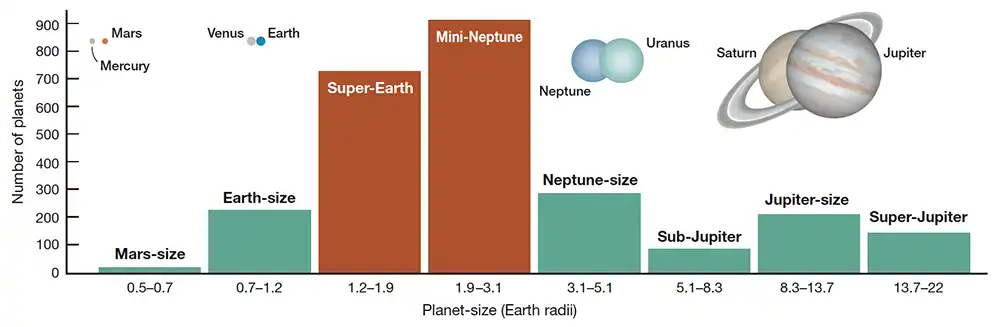
NASA Ames / Wendy Stenzel
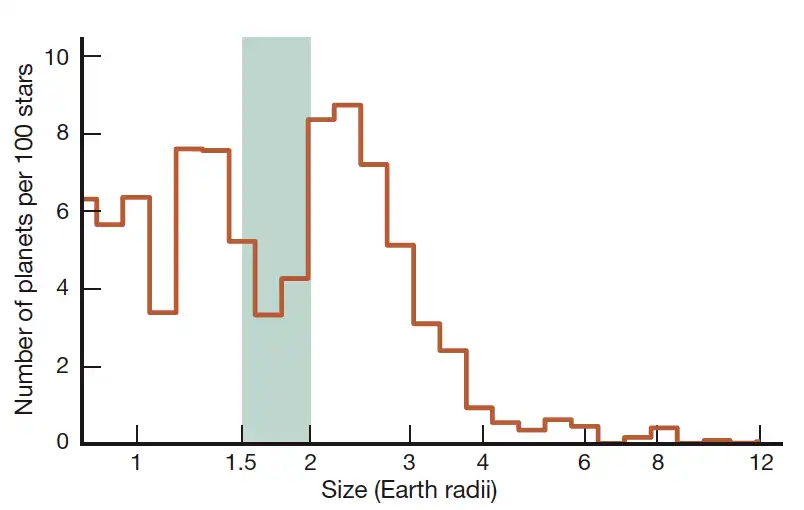
NASA Ames / Caltech / University of Hawai'i / B. J. Fulton
The currently accepted theory for planet formation says that all planets are born rocky. The ones that become big enough – a bit less than twice Earth’s diameter – have high enough surface gravity that they can hang on to lighter gaseous material as well. The diameter of the young planet balloons rapidly as it collects a gassy envelope, causing the observed gap in the diameter distribution between super-Earths and sub-Neptunes. Therefore, the composition of sub-Neptune atmospheres should be like those of the giant planets in our own solar system — similar to the compositions of their host stars.
In fact, that’s exactly what Davenport and his collaborators saw at planet TOI-421b. But it’s not what JWST has seen at the other five sub-Neptunes it has observed to date. (Those other five: K2-18b, GJ 1214b, TOI-836c, TOI-270d, and GJ 9827d.) These others had flat spectra, suggesting the presence of haze. Haze comes from compounds with high molecular weight, made when lighter materials like methane and sulfur dioxide are broken up and recombine into bigger molecules.
The predominance of high-molecular-weight atmospheres among sub-Neptunes observed by JWST has been a puzzle. Why, then, does TOI-421b match predictions, when the others don’t?
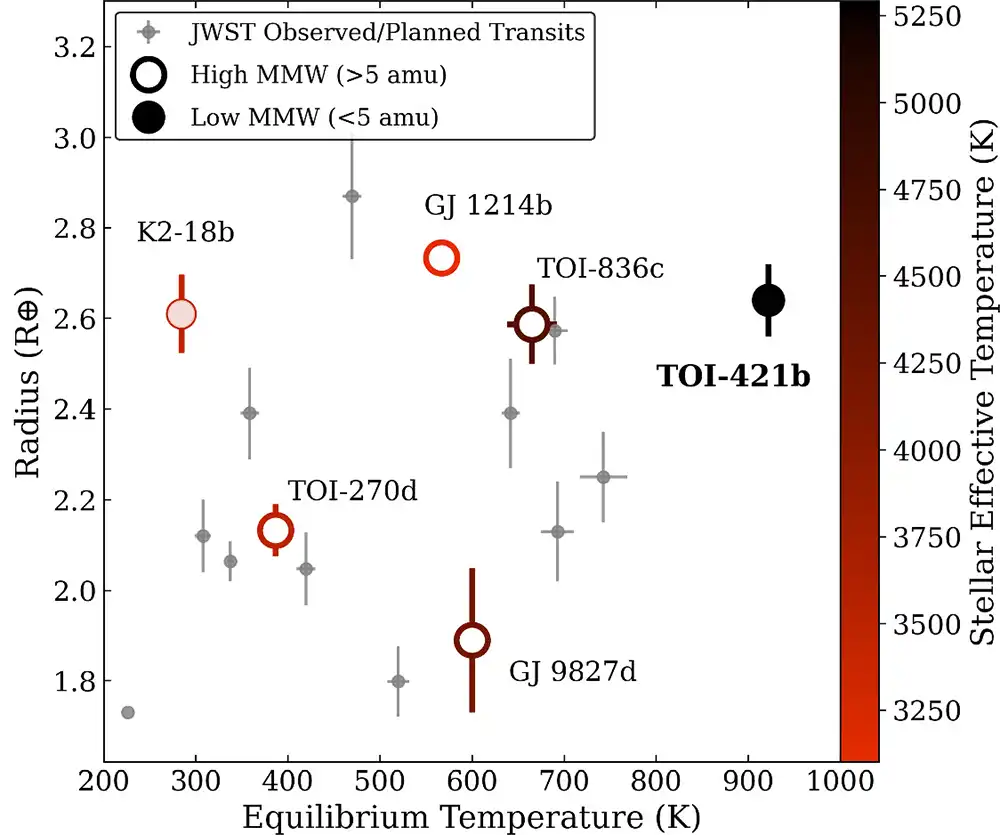
Davenport et al. / Astrophysical Journal Letters 2025
The answer is maddeningly familiar to scientists of all kinds: It’s probably a selection effect. Those first five exoplanet atmospheres studied by JWST are hosted by small, cool, old stars: K and M dwarfs. The stars are cold; their planets are, too, with temperatures below 700 kelvins (800°F). That’s not the kind of star around which Kepler searched for planets. The Kepler star field contained Sun-like main-sequence stars, of the spectral types F, G, and K.
The planet in this study, TOI-421b, orbits a G-type star – the kind Kepler planets orbit – and it’s much hotter, at 920 kelvins. The planet is too hot for methane to be stable in its atmosphere. Without methane, there are no building blocks for the larger haze molecules. The resultingly clear sky can be probed with spectroscopy, revealing a hydrogen-rich composition that matches its star, perfectly in line with predictions.
It’s nice when predictions match observations, but it’s only one exoplanet. Do all hot sub-Neptunes orbiting Sun-like stars have star-like compositions? Why do sub-Neptunes at cool stars look so different? Those are the kinds of questions Davenport and his collaborators want to answer with JWST next.
About Emily Lakdawalla
Sky & Telescope contributing editor Emily Lakdawalla is a freelance planetary scientist, space artist, and author of The Design and Engineering of Curiosity: How the Mars Rover Performs Its Job. Find her on Bluesky at elakdawalla.bsky.social and explore her space-inspired, ultra-nerdy art and jewelry on Etsy.


Comments
You must be logged in to post a comment.