 SUNSET:

 2
2Stars have a hard time forming in the extreme environment around our Milky Way’s black hole. New data promise to explain why.
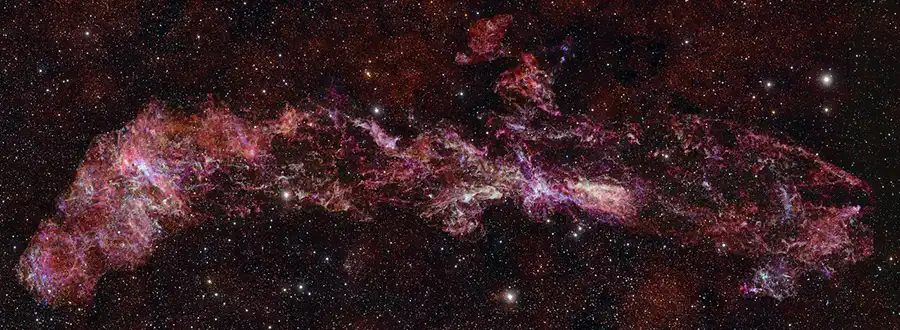
ALMA (ESO / NAOJ / NRAO) / S. Longmore et al. Background: ESO / D. Minniti et al.
The center of our galaxy is a turbulent place, where stars are born and die amid the forces that swirl around the supermassive black hole lurking at the Milky Way’s center. Now, scientists have taken a detailed look at this region, providing a comprehensive picture of our galaxy’s most extreme environment.
The new data focus on the central molecular zone (CMZ), the innermost 700 light-years of the Milky Way which are unlike anywhere else in our galaxy. Despite spanning less than 1% of the Milky Way’s disk, the CMZ contains 60 million solar masses of material, or 80% of dense gas in the Milky Way. These heated, high-pressure gas clumps can be up to hundreds of degrees hotter than the star-forming clouds in the Milky Way’s outskirts. They’re also denser, more turbulent, and more frequently bombarded with cosmic radiation. Oh, and there’s a supermassive black hole nearby.
Using the Atacama Large Millimeter/Submillimeter Array (ALMA) in Chile, an international collaboration put together the ALMA CMZ Exploration Survey (ACES), released February 25th. The image spans a whopping 650 light-years deep within the Milky Way’s center and offers incredible resolution. ALMA is able to resolve structures only 0.15 light-years across; previous surveys focusing on individual clouds could only make out features twice that size. The data reveal details at all scales, from stellar nurseries where individual stars are born to the curves of vast filaments tens of light-years across.
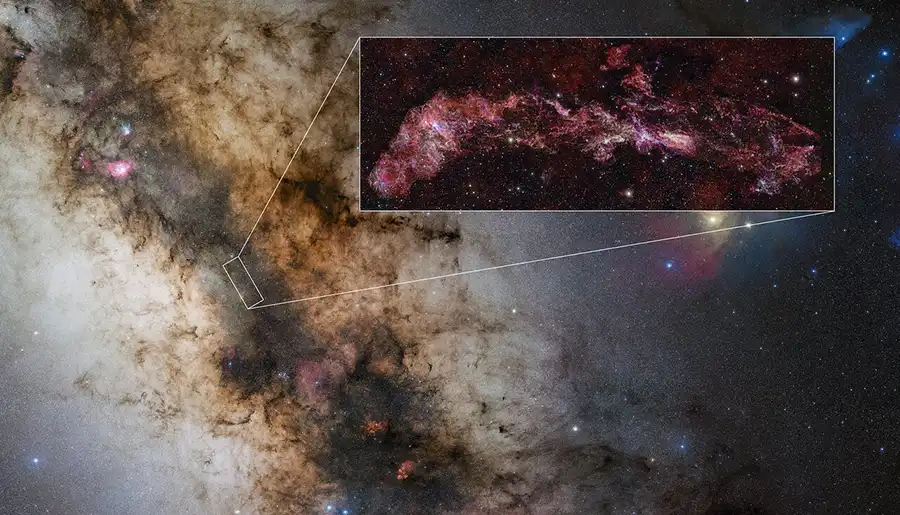
ALMA (ESO / NAOJ / NRAO) / S. Longmore et al.; Stars in inset: ESO / D. Minniti et al.; Milky Way: ESO / S. Guisard
“Before ACES, we had detailed observations of individual clouds in the center of the Galaxy, but we’d never been able to see the whole region at this level of detail in one go,” says Steve Longmore (Liverpool John Moores University, UK), principal investigator of ACES.
“It's a bit like the difference between having a few holiday snapshots of a city versus having a complete, high-resolution aerial photograph,” he explains. “With the full picture, you can see how everything connects.”
With ACES, astronomers can track gas as it flows into star-forming clouds and gets disrupted in the chaotic environment. The data promise to reveal the forces that drive or hinder star formation in these extreme ecosystems, providing a close-up view on the dynamic processes that shape the innermost regions of galaxies.
Mapping the Galactic Center
“I think of the CMZ as the central engine that drives the growth and change of our galaxy,” says Cara Battersby (University of Connecticut), who helped lead the ACES team. “From the supermassive black hole at the center to the exotic star formation and dynamic flows of swirling gas, the CMZ is the central hub of it all.”
The ACES observations resulted in the largest image ever taken with ALMA, spanning the length of three full Moons in the sky. By mapping out different facets of gas streams and clouds, astronomers can understand how gas streams, star formation, supernovae, and gravitational effects from the black hole all come together to shape the CMZ. “With ALMA, we have that unique and complete view for the first time,” Battersby says.
The data map out interstellar chemistry, revealing the formation of dozens of different molecules across the region, says Ashley Barnes (European Southern Observatory, Germany), another ACES team lead. “For example, certain molecules are enhanced in shocks, others in dense, shielded gas, and others in regions exposed to strong radiation.”
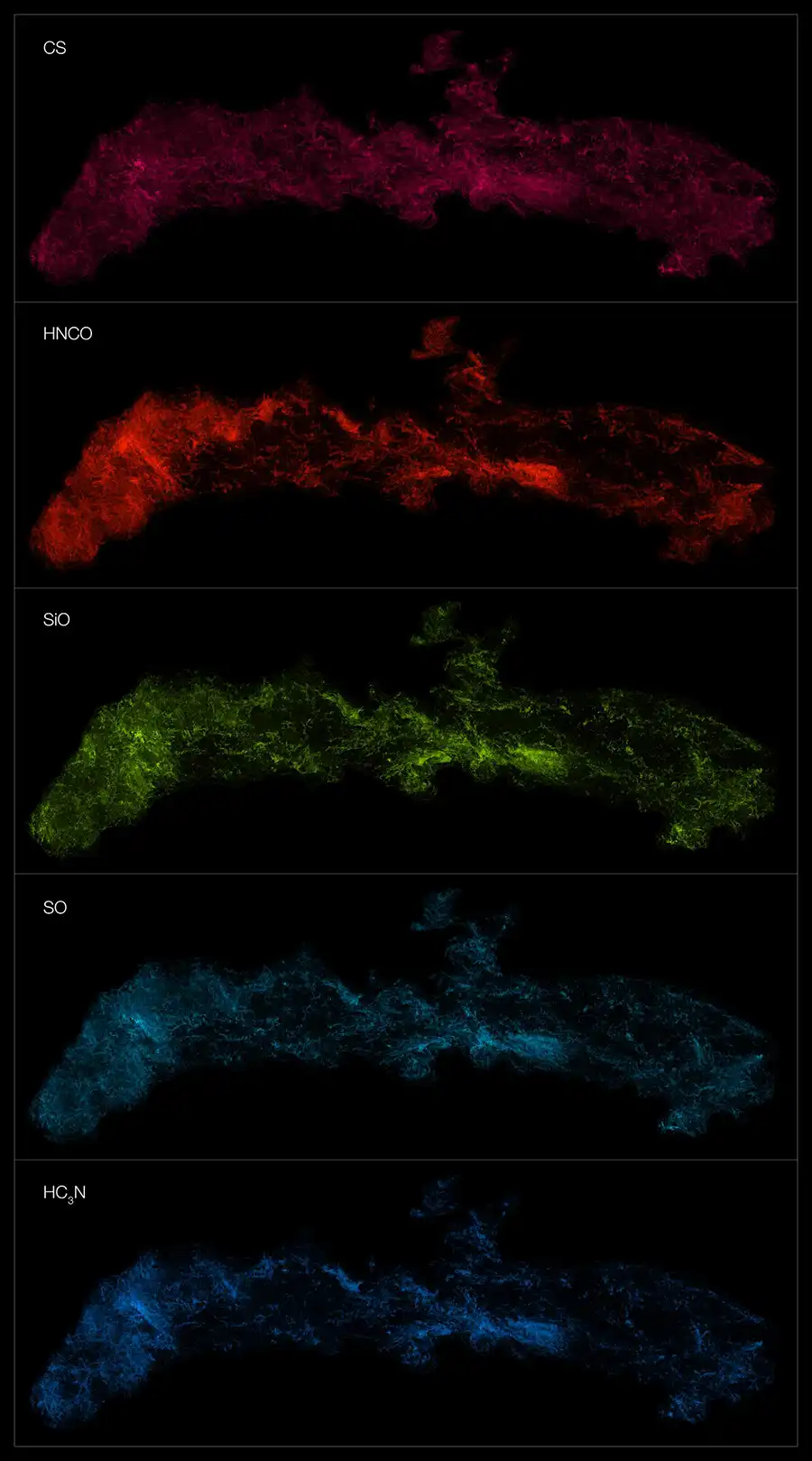
ALMA (ESO / NAOJ / NRAO) / S. Longmore et al.
The data have already uncovered some surprises. “We expected to see some structure, but the data revealed an incredibly intricate web of filaments at all scales, far richer than anyone anticipated,” Longmore says.
A Lack of Stars
A key question the ACES data are poised to answer is why, given the plethora of dense gas in the CMZ, stars are forming at a rate 10 times slower than expected.
“ACES gives us the data to finally understand why [this is the case],” Longmore says, allowing astronomers to test what’s holding back star formation.
In our corner of the Milky Way, gas collapses and forms stars fairly predictably. But star formation is different in the CMZ, where turbulence, gravitational force from the nearby black hole, and ambient magnetic fields can prevent the gas from collapsing.
“The stars that do manage to form tend to be among the most massive in the entire galaxy,” Longmore says. These stars burn bright and fast, eventually going supernovae in spectacular bursts that send matter and energy into the environment, stirring up gas and making it even harder to form the next stellar generation.
“It’s a much more violent and dynamic cycle than what happens in the quieter neighborhoods of the galaxy,” Longmore says. Studying the CMZ helps astronomers see how star formation occurs in extreme conditions — a useful analog for similarly turbulent environments that existed in earlier epochs of the universe.
The Road Ahead
With ACES complete, research is just beginning. “Because we’ve made the data publicly available, we expect teams around the world will use it for studies we haven't even thought of yet,” Longmore says.
And there’s more to come. ALMA’s Wideband Sensitivity Upgrade will enable astronomers to see more complex chemistry and fainter structures, while the European Southern Observatory’s upcoming Extremely Large Telescope can provide a high-resolution view of young, embedded stars in the gas. The team is also collaborating with astronomers using the James Webb Space Telescope to track 10 million stars in the galactic center.
“We have more than a dozen projects planned and in preparation to capitalize on the rich ACES dataset,” Battersby says. “I do believe that we will be unraveling this incredibly rich and textured ACES dataset for many years to come.”
About Arielle Frommer
Arielle Frommer is a science writer for Sky & Telescope and astronomy PhD student at Yale, where she studies exoplanets. In her free time, she enjoys hiking, crocheting, drinking coffee, and reading and writing fiction.


Comments
Hal Heaton
March 7, 2026 at 6:35 am
The article's 2nd paragraph states that "the CMZ contains 60 million masses of solar material ...." Instead, I believe this should say 60 million solar masses of material.
You must be logged in to post a comment.
Monica Young
March 9, 2026 at 8:47 am
Thanks, Hal, we've fixed that typo!
You must be logged in to post a comment.
You must be logged in to post a comment.