 SUNSET:

 0
0A new study has found that the 260-day ritual calendar is the key to understanding how the Maya predicted solar eclipses.
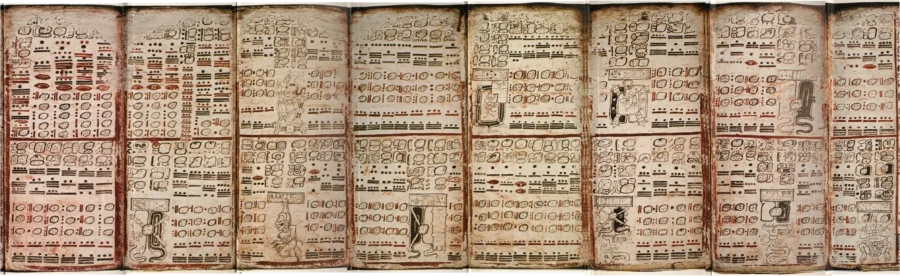
Die Maya Handschrift der Königlichen öffentlichen Bibliothek zu Dresden
Prior to the modern era, people around the world viewed eclipses as frightening times of portent. The ability to predict when they would occur offered societies a means of keeping the forces of darkness and chaos at bay.
Of all the world’s cultures who attempted to understand the phenomenon, the Late Classic and Postclassic Maya, who inhabited southern Mexico and Central America in the 6th through early-16th centuries, are perhaps best known for their sophisticated mechanisms for eclipse prediction. But few records are left to us to puzzle out how they developed these tools.
The most important of those records, an eclipse table in a hieroglyphic book known as the Dresden Codex, has provided researchers with vital clues as they’ve explored it over the past 125 years following its publication in an accessible format. Building on this scholarship, John Justeson (University at Albany) and Justin Lowry (SUNY Plattsburg) have published a study in the October 22nd Science Advances with new insights. According to Justeson, this work “illuminates how ancient Mayan diviners came to understand and devise an accurate predictive model for dates on which they might experience a solar eclipse.”
The Ritual Calendar
The key, the authors explain, involves the Maya ritual calendar of 260 days — a calendar still in use by ritual specialists in a number of communities in the Guatemalan highlands. After studying 145 solar eclipses visible in the Maya area between 350 and 1150 AD, Justeson and Lowry concluded that the original function of the table in the Dresden Codex was to record a succession of 405 lunar months, each consisting of 29 or 30 days, It wasn’t initially used to predict eclipses. Only later was the table repurposed, following the discovery that the lunar cycle and the 260-day ritual calendar dovetailed after 405 lunar months, equivalent to 46 260-day periods. That’s likely when the Maya discovered that successive eclipses tended to recur on the same named day in the 260-day cycle.
Although eclipse prediction would have been possible centuries earlier based on these discoveries, Justeson and Lowry propose that the final version of the Dresden table recorded dates when eclipses were possible over a 32¾-year period that began either 1083 or 1116 AD.
The eclipse table spans eight pages in the Dresden Codex, one of four hieroglyphic books known to have survived from the time period archaeologists refer to as the Postclassic period (about 1100-1521 AD). It is one of several tables used to track celestial and seasonal events, including Mars’ and Venus’ cycles through the sky and thesolstices and equinoxes. These events were pinpointed within interlocking calendrical cycles of 260 days and 365 days that were anchored in linear time through the Long Count calendar, with its count of days, 20-day “months”, 360-day “years”, 7,200-day k’atuns, and 144,000-day bak’tuns.
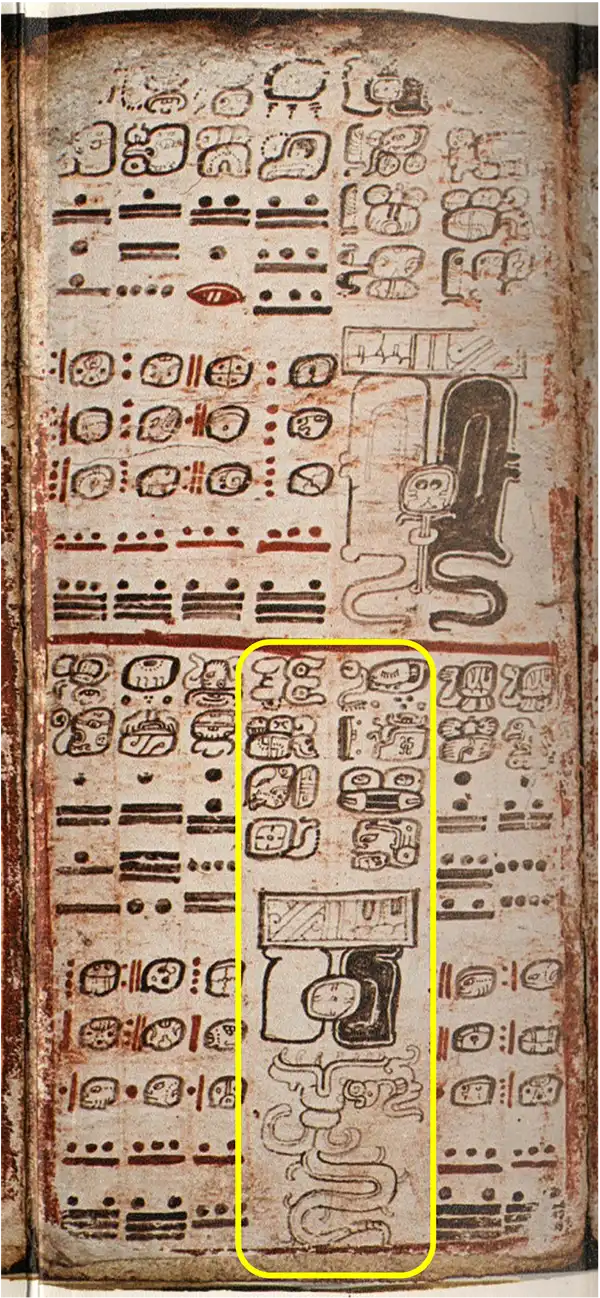
Die Maya Handschrift der Königlichen öffentlichen Bibliothek zu Dresden, with labels made by the author
Following a preface that situates the table in linear time are 69 columns of data, each of which includes a brief hieroglyphic caption at the top, intervals of 148, 177, or 178 days expressed in a bar-and-dot numbering system (dots represent “1” and bars “5”), cumulative totals, and a series of three dates in the 260-day calendar on which an eclipse might occur.
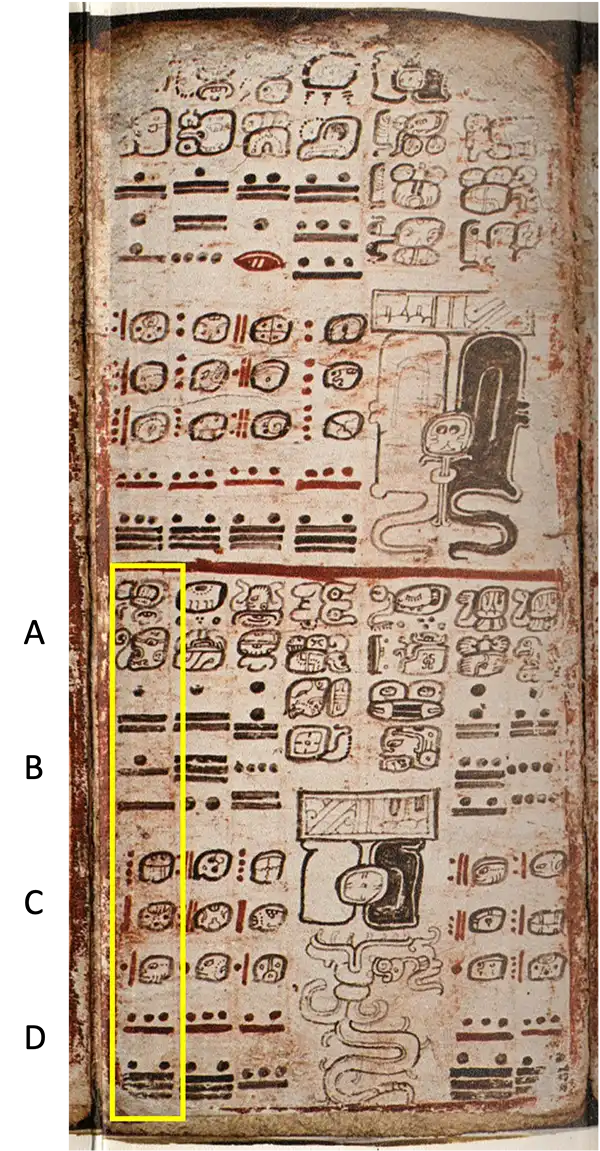
Die Maya Handschrift der Königlichen öffentlichen Bibliothek zu Dresden, with labels made by the author
On nine separate occasions, the columns are followed by longer captions and images. Most of these images and their captions refer to solar eclipses or to eclipse “seasons” — that is, the approximately 35-day period during which a solar or lunar eclipse can occur. (A few warn of other times of danger, such as the last appearance of Venus as evening star.)
As researchers demonstrated more than a century ago, the intervals of days recorded in the table are roughly half-year periods of six (or occasionally five) new Moons, calculated based on lunar months alternately 29 and 30 days long — the inconstant months were a necessity to maintain an average lunation of 29.530589 days, since the Maya did not use fractions. Justeson and Lowry note that 55 of the 69 new Moon dates in the table served as dates on which an eclipse might possibly occur, with the other 14 presumably included to maintain the table’s structure.
Researchers have devoted years to teasing out the origins of this ingenious table. Justeson and Lowry’s new study suggests that it developed out of earlier tables recording lunar months, likely used to track seasonal events. By making and documenting observations over many generations, Maya daykeepers found that 405 successive new Moons were equivalent to 46 260-day periods. Knowing this, they were able to accurately predict dates corresponding to full and new Moons during that full period.
Over time, the daykeepers noticed a striking pattern — that solar eclipses tended to recur on the same day in the 260-day calendar in their lunar tables of 405 months. They continued to fine-tune their observations at sites throughout the Maya lowlands. Eventually, they could even pinpoint dates in the lunar calendar that might correspond to solar eclipses visible to local communities. (Total solar eclipses occur roughly once a year, but the Moon’s shadow touches only a small strip of Earth each time, making them a rare occurrence for any given region.)
But there would eventually have been slippage between the dates predicted and actual eclipse dates — and the Maya knew this. One of the seminal contributions of Justeson and Lowry’s study is the realization that a new table, rather than starting after 405 new Moons, would instead have to be restarted at earlier points, taking advantage of the most reliable overestimate (at the 358th new Moon) and the most reliable underestimate (the 223rd new Moon).
Reactions to Justeson and Lowry’s proposals have varied, with some specialists supporting them enthusiastically and others suggesting the need for further evaluation in light of models previously proposed for dating and recycling the table. They generally agreed, however, that the study provides new insights into how the Maya constructed and initially used the table. It offers a window to the practices of skywatchers and calendar specialists from as early as 350 AD to the Postclassic period.
For those of us who use telescopes and mobile apps to understand and appreciate the night sky, it’s difficult to understand how the Maya developed such sophisticated models without technology. Cultural astronomer Anthony Aveni (Colgate University) stresses that naked-eye astronomy advances by way of repeated observations and long-term time averaging.
Aveni also observed that studies such as this one bring home to us the awareness that Maya peoples, both in the past and today, don't necessarily think as we do. For example, no where else in the world has the 260-day period been used for eclipse prediction. As Aveni so aptly remarked, “Culture recognizes different aspects of nature.”
About Gabrielle Vail
Gabrielle Vail is affiliated with the Department of Anthropology at UNC, Chapel Hill. Her doctoral and subsequent research has been focused on analyzing the calendrical, hieroglyphic, and iconographic content of the Postclassic Maya codices. Her publications include Códice de Dresde (2022) and Re-Creating Primordial Time: Foundation Rituals and Mythology in the Postclassic Maya Codices, with Christine Hernández (2013).


Comments
You must be logged in to post a comment.