 SUNSET:

 4
4During a close flyby on April 20th, NASA’s Lucy spacecraft surprised its science team by revealing an asteroid that was once two smaller pieces that have been conjoined into a larger whole.

NASA-Goddard / SwRI / Johns Hopkins APL
NASA’s Lucy spacecraft, heading outward toward Jupiter’s orbit, captured a new addition to the menagerie of asteroids visited at close range when it flew within 1,000 kilometers (600 miles) of 52246 Donaldjohanson on Sunday, April 20th. Lucy zipped by at a relative speed of 13.4 kilometers per second (30,000 mph) at 17:51 Universal Time.
This dark, main-belt body was aptly named after American paleoanthropologist Donald Johanson, who discovered the “Lucy” hominid fossil in 1974. Scientists weren’t quite sure what they were going to find in the spacecraft’s photos. Seen as an unresolved point of light from Earth, Donaldjohanson has an unusually variable brightness, hinting that it’s either a binary body or an extremely elongated one.
It turned out to be both. Lucy perfectly framed the asteroid as it flew past, revealing a heavily cratered, lumpy world with two prominent lobes conjoined at a relatively narrow neck. This contact-binary shape is common among small bodies in the solar system. Its rocky, carbon-rich surface is covered with craters of varying crispness with the occasional isolated boulder, and it bears linear features, especially in the neck area, that might have resulted from landslides. Such features have likewise been seen asteroids during close visits in the past, like 243 Ida (which is larger) and 4179 Toutatis (which is smaller).
But Donaldjohanson held another surprise for the Lucy team: It’s much larger than had been estimated from Earth, about 8 kilometers (5 miles) long at the widest point. All of Lucy’s photos were captured within 30 minutes of its closest approach, and this unexpected breadth made the asteroid spill beyond the frame in most of the images returned so far. But many more photos are in the queue to be returned to Earth over the coming days to weeks.
The apparent rotation in the animation above is caused by Lucy’s motion past the asteroid. Actually, Donaldjohanson is an unusually slow rotator, taking 251 hours to complete a single spin. It’s one of a family of fragments cleaved off much-larger 163 Erigone during an asteroidal collision roughly 130 million years ago.
The spacecraft came at Donaldjohanson from a direction almost straight away from the Sun, a challenging encounter geometry. Had the spacecraft tracked the asteroid throughout the flyby, its sensitive instruments would have pointed directly back at the Sun. So the spacecraft turned away from its target just before closest approach, abruptly ending its observations.

Southwest Research Institute
Lucy’s previous asteroid flyby, of binary asteroid 152830 Dinkinesh on November 1, 2023, provided a successful test of the spacecraft’s autonomous target-tracking system — and revealed the presence of a small satellite, now named Selam. With that test under its belt, Lucy’s team used the Donaldjohanson pass as a dress rehearsal of a complete science encounter, similar to the plan for its eventual targets among Jupiter’s Trojan asteroids.
All three of Lucy’s science instruments captured detailed data across Donaldjohanson’s lumpy surface, including the sensitive Lucy-Long Range Reconnaissance Imager (L’LORRI) and two spectrometers, one in the L’Ralph instrument suite as well as Lucy’s Thermal Emission Spectrometer (L’TES). And the encounter was all targeted based on the spacecraft’s knowledge of the asteroid’s position. Such autonomous instrument targeting is a dramatic upgrade not previously used for outer-solar-system encounters.
Flyby missions cruise across interplanetary space for years and then get only one chance to see targets up close. By then they’re so far from Earth that long light-time communication delays make it impossible to fix any pointing errors in real time. In the past, targeting long-focal-length imagers has depended on predictions of the objects’ locations based on their measured orbits.
But the farther away a target is, the less precise our understanding of its orbit tends to be. To make sure not to miss a target, past missions like Voyager, Cassini, and New Horizons had to take many extra images centered on all likely positions of a world to ensure that at least one of those images will actually capture the target — at a major cost in precious encounter time and data volume.
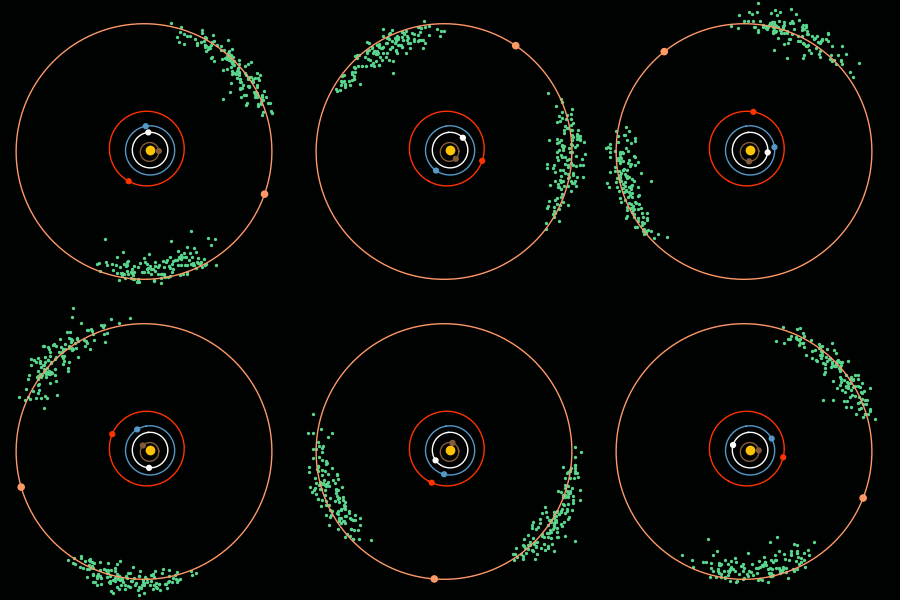
Now that Lucy has demonstrated that it’s capable of updating its own knowledge of a target object’s position in space well enough to aim its science instruments, its science team knows it can make the most of those upcoming Trojan asteroid encounters without having to waste precious data on empty space.
Lucy’s next encounter will be with its first Trojan asteroid, the 3548 Eurybates-Queta binary system, in August 2027.
About Emily Lakdawalla
Sky & Telescope contributing editor Emily Lakdawalla is a freelance planetary scientist, space artist, and author of The Design and Engineering of Curiosity: How the Mars Rover Performs Its Job. Find her on Bluesky at elakdawalla.bsky.social and explore her space-inspired, ultra-nerdy art and jewelry on Etsy.


Comments
Donald
April 23, 2025 at 10:05 am
Surely some AI can take feedback from images and determine when said images are pointing to empty space and thereby release the data storage back to a list of available data storage. Don Mayfield, Retired computing professional.
You must be logged in to post a comment.
J. Kelly Beatty
April 25, 2025 at 11:14 am
hi, Don. Yes, of course. In fact, for a long time now, interplanetary probes have used onboard processing to exclude black areas in images to optimize what’s sent back to Earth. The advantage of autonomous targeting is that the spacecraft doesn’t rely on preprogrammed pointing but instead makes its own decisions as to where to point the cameras. (Otherwise there’s the danger of missing the target altogether because the trajectory and/or arrival timing were slightly off.)
You must be logged in to post a comment.
Gg
April 25, 2025 at 6:28 pm
What are the theories that would explain the fusing of the 2 bodies, especially with such a thick neck?
You must be logged in to post a comment.
J. Kelly Beatty
April 29, 2025 at 9:10 pm
Two-part answer: binary asteroids appear to be common; mostly likely these pairs formed as two fragments ejected from a collision close enough together to "pair up" by mutual gravity. how they merged is less clear; maybe subsequent impacts from other bodies caused them to lose angular momentum and join.
the thick neck is easier to explain. the neck is nearer to the center of gravity than either end. so when little impacts occur and briefly mobilize rocks on the surface, they'll preferentially "roll downhill" to the neck, and that makes the neck thicken over time. if the neck were really small (the two lobes just touching), then by this logic the contact must have occurred very recently.
You must be logged in to post a comment.
You must be logged in to post a comment.