 SUNSET:

 2
2As winter fades into spring, the old guard of winter constellations — Orion, Gemini, and Taurus — almost literally sail away into the sunset, as the Sun hides their stars with its increasing glare. In their place the spring constellations creep into the evenings. Leo, the Lion, is one of the best examples, with its large size, distinctive shape, and plentiful bright stars.
The Stars of Leo
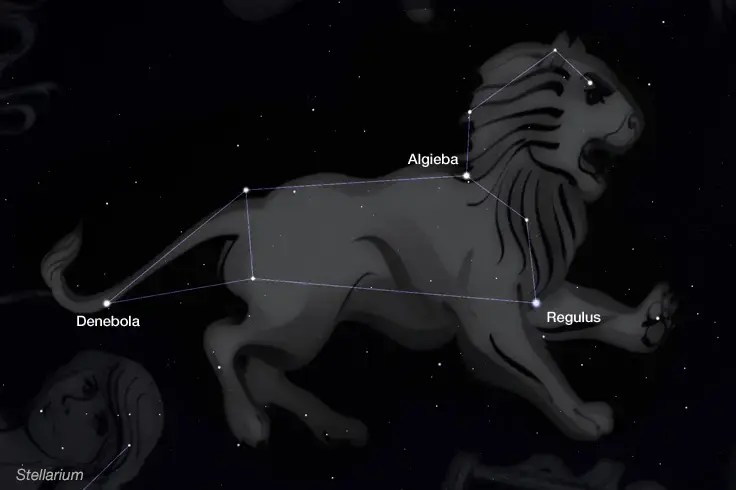
Stellarium
The constellation’s stars create a nice portrait of the big cat, with the front half forming a distinctive sickle shape that’s easy to find in the sky. Some of the most interesting individual stars in Leo include:
- Alpha (α) Leonis — Meaning the “Little King” in Latin, Regulus is Leo’s most famous star as well as its brightest. It’s notable for its position almost directly on the line of the ecliptic — the orbital plane of the solar system that the planets follow. As a result, Regulus is one of only four 1st-magnitude stars that can be occluded (hidden by) the planets and occasionally the Moon. Regulus is a little more than three times the Sun’s radius and 3.5 times the Sun’s mass — and since it’s a hot blue star with a surface temperature over 12,000 K, about twice as hot as the Sun, it’s emitting a lot of energy. Regulus is typically taken to represent the Lion’s front foot.
- Beta (β) Leonis — You can find Denebola — a 2nd-magnitude gem — marking the tail of Leo. (The name Denebola comes from the Arabic phrase “dhanab al-asad,” or “the tail of the lion”). Denebola is just a bit larger than the Sun but spins rapidly, reaching speeds of about 125 kilometers per second (280,000 mph) at its equator and distorting its shape.
- Gamma (γ) Leonis — Algieba, the bright star marking Leo’s shoulders or withers area, is a binary star that you can easily split in an 80mm telescope. The system contains a pair of red giant stars (discovered by William Herschel). One of these has an exoplanet named Gamma Leonis b, a gas giant just a bit larger than Jupiter but with about nine times its mass.
- CW Leonis — Going very deep for something different: CW Leonis is a gigantic yet very diffuse star in Leo. It would span more than 300 Suns, yet it has less mass than our star. This carbon star is a red giant that’s fusing helium into carbon in its core. Though it’s highly luminous, CW Leonis glows at a woefully dim 10th magnitude, making it tough to target visually; however, photos can easily pull its light out of the darkness.
Mythology
The myths and tales behind many Greek constellations are very old, often pre-dating the written Greek language that came into use around 750 BC. Ancient Greek characters such as Cassiopeia, the Gemini twins, Demeter, etc., all existed prior to Greek literature. Leo belongs to this group as well, from the story of Hercules.
That hero’s jealous stepmother, Hera, created all kinds of strife for Hercules, eventually resulting in his famous Twelve Labors. The first of these Labors was a battle with the extremely dangerous Nemean Lion, which was immune to arrows. So Hercules faced it in a wrestling match instead. The Nemean Lion is depicted in the night sky — as you’ve guessed — as Leo. Yet the constellation Hercules is nowhere nearby. Hercules and Leo (Nemean) are on opposite sides of the sky from each other, perhaps in a playful attempt to restrict further violence.
The Greek tale aside, the concept of the stars around Leo representing a lion of some kind are very ancient and widespread. Ancient Arabic astronomers also identified a lion, though much larger, incorporating stars all the way over in Gemini. Ancient Babylonians and Sumerians also used the stars surrounding the modern-day Leo to depict a lion. Of course, our modern name for the constellation is simply the Latin word for lion.
In North America, the Ojibwe of the Great Lakes region likewise used the stars of Leo to portray a cat — but this time a cat native to their continent, the panther or cougar. The sickle portion of what we call Leo formed the panther’s long tail, and the head of the nearby Hydra constellation made up the cat’s face. This Great Panther was said to live in lakes (particularly Lake Superior), and the constellation’s rise in the spring signified the impending snowmelt and rising water levels, marking a time to begin maple sap collection.
How to See Leo
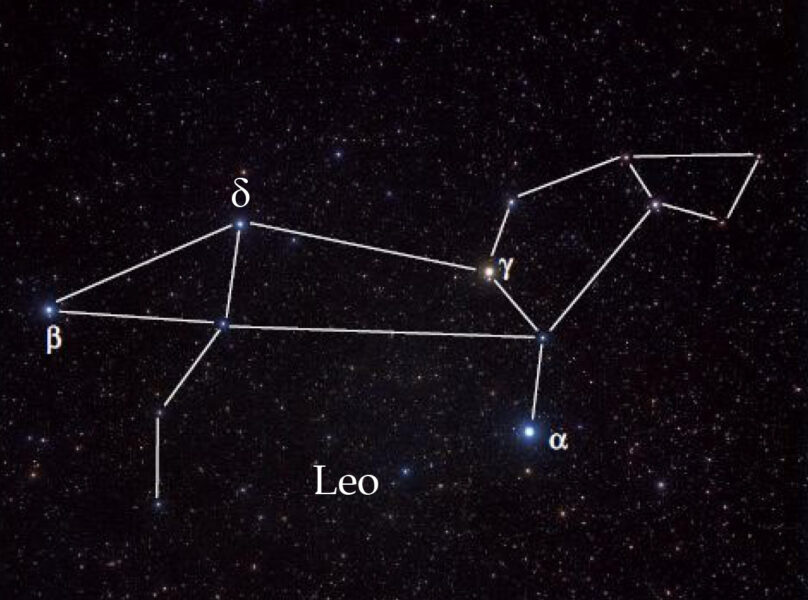
Akira Fujii
Spring is Leo’s time to shine. It’s a large constellation with enough satisfyingly bright stars to make it easy and fun to pick out its general shape. Almost directly overhead, Leo big cat’s paws are pointing toward the south and his head looks west toward the just-set Sun. Leo makes a nice target for group settings, especially when you’re explaining a new constellation to beginners.
On spring evenings, look for Leo overhead, slightly toward the southeast. As we get into early summer, Leo slides westward. If you’re new to this and having trouble pinning Leo down in a sea of stars, focus on finding Regulus. Not only is it the brightest of Leo’s stars, it’s really the only super bright star in this region. Once you find Regulus, you’ll more easily find the somewhat fainter stars that make up the sickle shape above it. Also, remember that Leo is right on the ecliptic, so the Moon comes through (or nearby) once a month. A quick check of an astronomy app or chart will show you when the Moon will swing by and provide a definite guide. Hopefully, your experience with the Lion is more relaxing than it was for Hercules.
About Daniel Johnson
Daniel Johnson is a Wisconsin-based freelance writer and professional photographer and the co-author of over a dozen books. He’s a longtime amateur astronomer and fortunate enough to live in a rural region with excellent seeing conditions. You can view some of Dan’s photography at www.foxhillphoto.com.


Comments
Anthony Barreiro
May 6, 2026 at 6:00 pm
I prefer to see Regulus as Leo's heart (as depicted in the Stellarium image at the top of this article), rather than his paw. In Arabic Regulus is called Qalb al-Asad, the heart of the Lion. Regulus has the name Kardia Leontos in Greek, and Cor Leonis in Latin. Even Regulus, "little king" evokes a regal heart.
https://en.wikipedia.org/wiki/Regulus#Etymology_and_cultural_associations
You must be logged in to post a comment.
Anthony Barreiro
May 6, 2026 at 6:06 pm
In the ancient Babylonian star catalog MUL.APIN, Regulus is listed as Lugal, meaning king, described as "star of the Lion's breast".
I wonder who first demoted Regulus to Leo's paw. H.A. Rey's "The Stars: A New Way to See Them" makes this mistake, along with many others!
You must be logged in to post a comment.
You must be logged in to post a comment.