 SUNSET:

 0
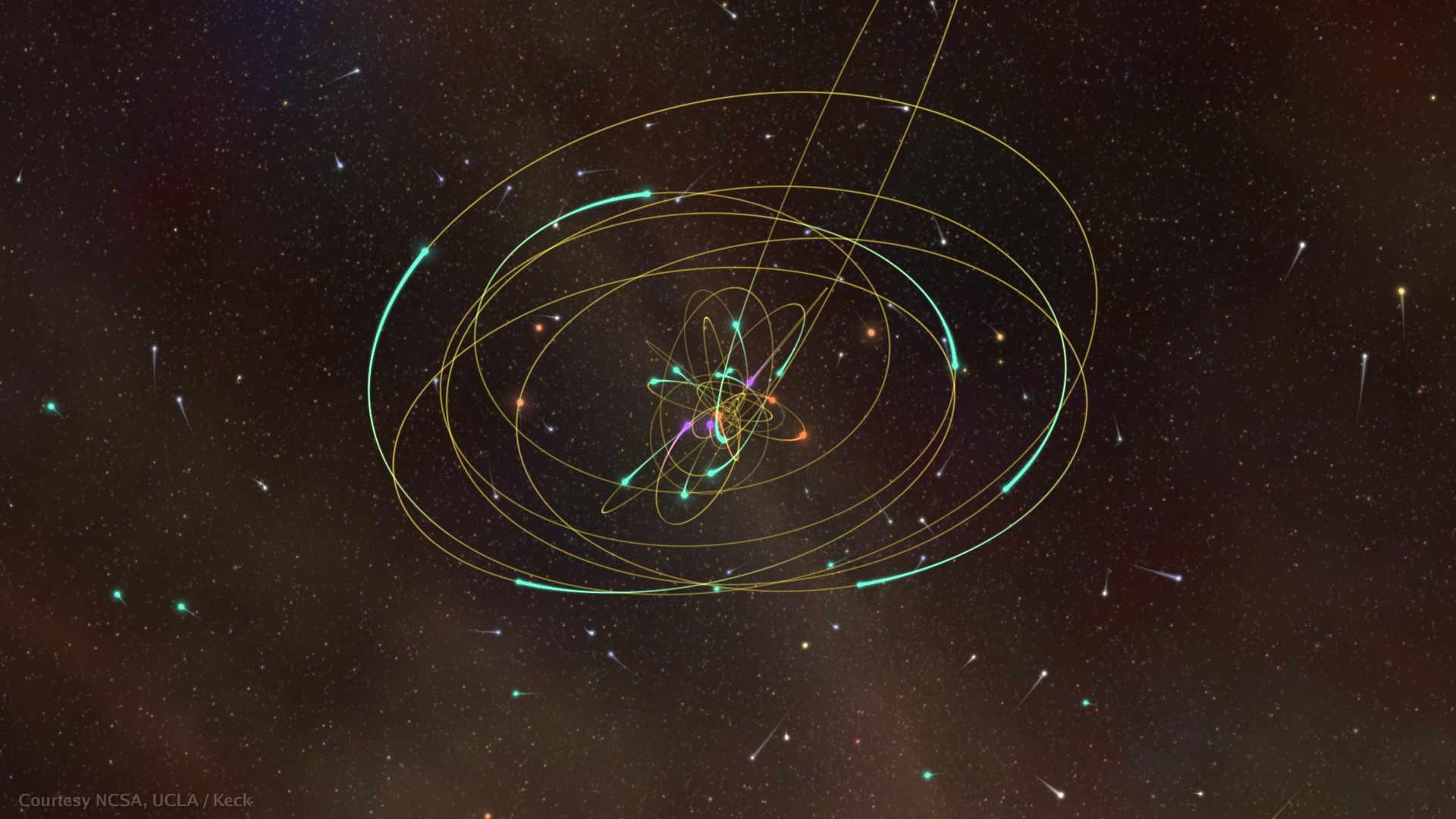
0The dusty remnants of stellar mergers may orbit the Milky Way’s central, supermassive black hole.
NCSA / UCLA / Keck
The merged remnants of stellar smash-ups may orbit our Milky Way’s central black hole, according to new computer simulations by Czech astronomers.
Astronomers have long tried to explain the origin of young, massive stars that orbit the galactic center — termed S-cluster stars. Astronomers have used these stars (which include S2, with an orbital period of just 16 years) to weigh Sagittarius A*, the 4.3-million-solar-mass black hole at the Milky Way’s heart. Yet the stars’ very existence is puzzling: So near the black hole, the extreme gravitational field should make it difficult for gas clouds to collapse into such massive stars.
“At least some of the S-cluster stars are probably merged binaries,” says Michal Zajaček (Masaryk University, Czech Republic), who presented the result at the 22nd meeting of the High Energy Astrophysics Division of the American Astronomical Society in St. Louis. His team has advanced this previously proposed possibility in new simulations that include the contribution of the young nuclear stellar disk, which surrounds the galactic center at distances of up to a few light-years.
Keck / UCLA Galactic Center Group
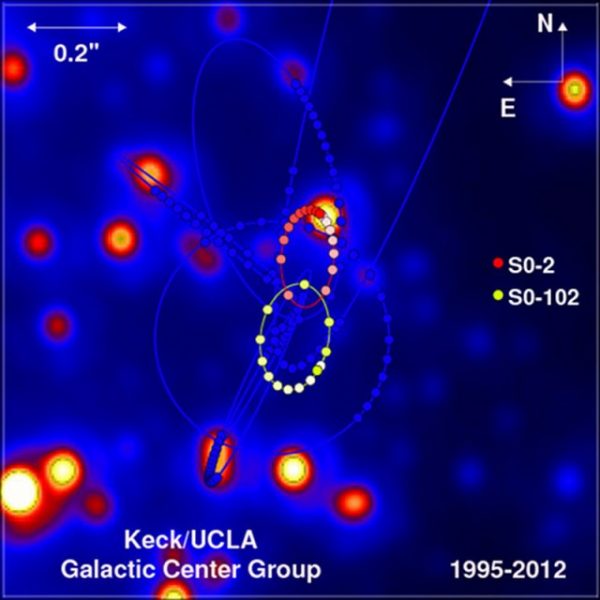
Dust Clouds in the Galactic Center
Supporting the binary merger idea is the claimed discovery reported in Nature last year of a not-yet-merged binary star close to Sagittarius A* and enshrouded by a cloud of dust, called D9. The team inferred the binary nature of the hidden star system from spectroscopic measurements by the European Very Large Telescope in Chile. “At a distance of just 0.1 light-year, it would be the closest binary star ever found to a supermassive black hole,” says Zajaček, who was part of that discovery team.
Those binary components, which are now orbiting each other about once a year, will likely merge within a million years or so. Their demise is hastened by the proximity of the black hole. Its gravity slowly elongates the binary’s orbit through a resonance effect known as the eccentric Kozai-Lidov mechanism. The surrounding dust cloud might have been ejected during the two stars’ periodic close encounters, although other explanations have also been put forward.
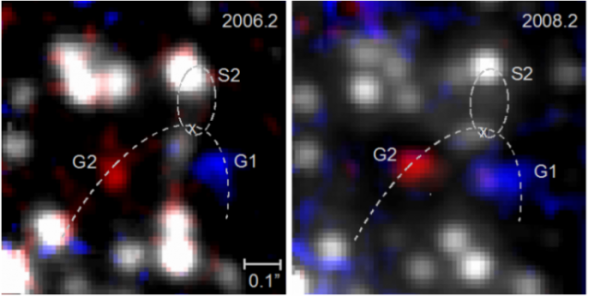
Astronomers have found about a dozen similarly dust-enshrouded stars (called dusty S-cluster objects, or DSOs) since 2012. That year, Stefan Gillessen (Max-Planck-Institute for Extraterrestrial Physics, Germany) led a team that found the first of these, called G2. As G2 moved perilously close to Sagittarius A* in 2014, the black hole’s tidal forces stretched out this particular dust cloud. Yet it remained intact, already hinting at the presence of a more compact object at its core.
NASA / SOFIA / Lynette Cook
Gillessen says that the discovery of a binary star in the dust cloud D9 was “surprising, to a degree that I remain skeptical about the observational result.” But if confirmed, it could suggest that all DSOs harbor massive stars. And as the D9 binary will eventually merge, the other DSOs — which do not show spectroscopic evidence of binary stars within — may very well harbor the remnants of past mergers. In the future, when the dust dissipates, those merger remnants could become visible as members of the S-cluster.
Central baby boom
This hypothetical scenario now has further support from computer simulations conducted by a team led by Zajaček’s colleague, Myank Singhal (Charles University, Prague), and submitted for publication to Nature Communications. According to the team’s simulations, which have not been published yet, the original binaries formed some five million years ago, during a burst of star formation in the Milky Way’s central region. That birth wave resulted in the young nuclear stellar disk.
According to the simulations, the most massive binaries born in that stellar boom drifted closer to the central black hole because of gravitational interactions with other stars and with Sagittarius A* itself. In the meantime, the binary components also spiraled in toward each other and merged, temporarily enshrouding themselves in clouds of dust during the process.
Earlier simulations by other astronomers already showed how binary stars could merge in the Milky Way’s center. “[But] the new aspect, which I find exciting here, seems to be the inclusion of the stellar disk and the gravitational interactions with the neighboring stars in the disk,” says Smadar Naoz (University of California, Los Angeles).
According to Naoz, “there is a lot of potential in the approach taken by the authors, but there is still some more work to be done.” For one, she notes that the simulations do not include the effects of general relativity, which can suppress the Kozai-Lidov mechanism.
Meanwhile, Zajaček thinks the new simulations are convincing. “We now present an all-encompassing hypothesis that neatly explains what’s happening close to the central black hole,” he says. “It all nicely fits together.”
About Govert Schilling
Sky & Telescope Contributing Editor Govert Schilling lives in The Netherlands but loves to explore his home planet. In May 2022, Harvard University Press published The Elephant in the Universe: Our Hundred-Year Search for Dark Matter. His latest book is Target Earth - Meteorites, Asteroids, Comets, and Other Cosmic Intruders That Threaten Our Planet.


Comments
You must be logged in to post a comment.