 SUNSET:

 6
6The asteroid that will now definitely not hit Earth has the highest odds ever for a predicted lunar impact — but a miss is still more likely.

Tomasz Kluwak
Earth has been given the all-clear from a possible impact by the asteroid 2024 YR4 in 2032. But now that we know Earth is safe, a second target has been looming larger: With recent observations, the odds of this object hitting the Moon instead have now climbed to about 3.8% — the highest odds ever for a lunar impact by any natural body.
In fact, only one other object as large as this — and in fact much larger — has ever been predicted to strike any solar system object. That was the predicted impact of Comet Shoemaker-Levy 9, which hit Jupiter in July 1994. Telescopes all round the world and above it witnessed the spectacular results, as they will if 2024 YR4 hits the Moon.
The new refinement of this asteroid’s orbit and odds of impact come from ongoing observations of the rapidly fading object, especially those made in March by the James Webb Space Telescope (JWST), led by Andy Rivkin (Johns Hopkins University). Those observations also helped refine the asteroid’s diameter, leading to a size estimate between 53 and 67 meters. Previously, the estimates ranged from about 40 to 90 meters.
In combination with ground-based observations from the Very Large Telescope in Chile and other observatories, Rivkin’s team found that the object is likely a stony (S-type) asteroid. Its surface probably has chunks of rock at least a few inches across and possibly much larger, as opposed to a sandy or dusty surface.
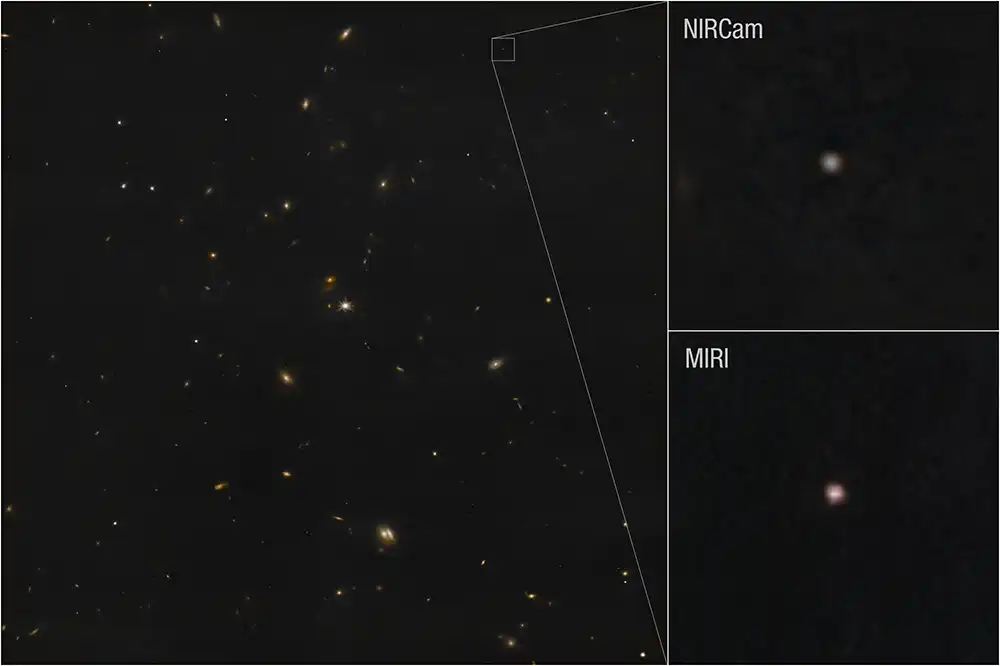
NASA / ESA / CSA / STScI / Andy Rivkin (APL)
If It Hits the Moon, Will We See the Impact?
An impact still isn’t likely, even though the nominal center of the current predicted path is only about 1,400 kilometers (900 miles) above the lunar surface. But if a lunar impact does happen, it would be an exciting day for science, for astronomers, and for skywatchers in general.
“This would be by far the largest thing that we have seen hit the Moon,” Rivkin says. It’d be some 100 times larger than lunar impacts previously observed by astronomers, amateur and professional alike. The hit would provide a strong seismic signal that could probe structures deep in the lunar interior, he adds.
Rivkin tells Sky & Telescope that the lunar impact of such an object would almost certainly be easily observable from Earth, as long as it strikes the Moon’s Earth-facing side — which is likely according to the present predicted track.
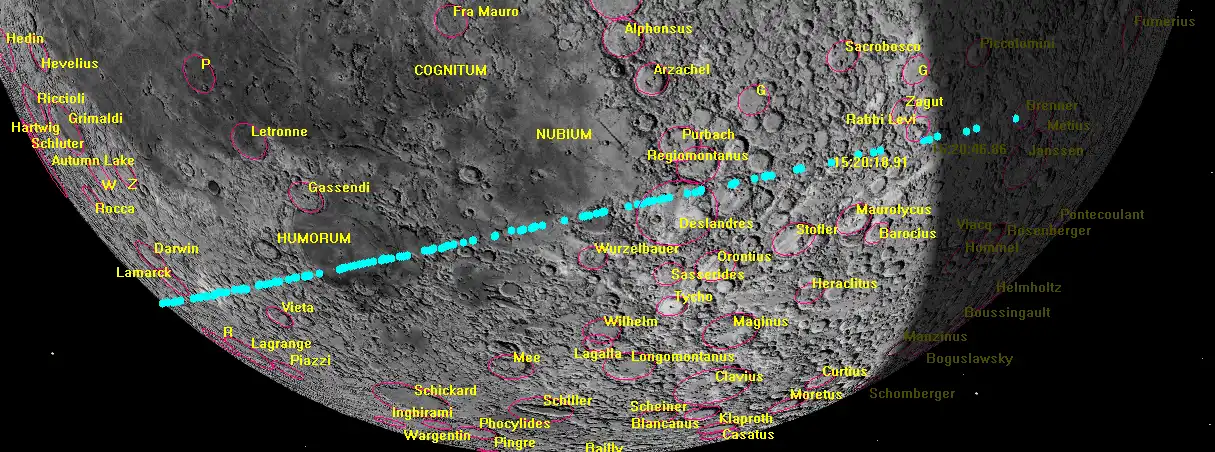
Bill Gray / Project Pluto
But amateur astronomer Daniel Bamberger (Northolt Branch Observatories, UK) points out that the Moon will be about three-quarters illuminated on the predicted date of impact (December 22, 2032). So, if there is an impact, “it’s probably going to hit in a part that’s in direct sunlight.” While he had initially predicted that the sight would be “spectacular and impossible to miss,” he’s not sure anymore due to the potential difficulty of the observation.
Besides some additional JWST observations in May, we may not get the chance to improve the predicted path or lunar impact odds for about a year. Even if an impact is in fact inevitable, these new observations wouldn’t be able to raise the impact odds to more than about 7%, Rivkin says.
The next close approach to Earth comes in 2028, and at that point it should be possible to nail down the orbit with greater precision.
“I am rooting for a lunar impact,” Rivkin says. “I think it would be a great demonstration of why we do planetary defense, and the science that would come out of it for the impact community, the lunar community, and the asteroid community would be great.”


Comments
Collin
April 8, 2025 at 10:53 am
How cool! Is there a month in 2032 when this might occur? I realize it's hard to plan that far out in advance, but this is worth putting on the calendar. Thanks for the interesting article, David Chandler.
You must be logged in to post a comment.
Kevin Heider
April 8, 2025 at 3:57 pm
A Moon impact would occur on 22 December 2032 around 15:19 UTC.
You must be logged in to post a comment.
theArborist
April 13, 2025 at 2:11 am
Rats! This puts it about 1 hour after moonset US Eastern time zone. I'm hoping it gets revised.
You must be logged in to post a comment.
Kevin Heider
April 8, 2025 at 11:51 am
The statement on the lunar surface needs updating.
Using JPL #77 the nominal approach is about 3100 km from the center of the Moon, which makes it about **1,400 km from the surface of the Moon**.
You must be logged in to post a comment.
Anthony Barreiro
April 10, 2025 at 1:09 am
The caption for the first illustration is incorrect:
" ... the Moon will be a waxing crescent on December 22, 2032."
The Moon will be in her waning gibbous phase.
You must be logged in to post a comment.
Monica Young
April 17, 2025 at 12:04 pm
That was an editorial slip — thanks for letting us know, it has since been fixed!
You must be logged in to post a comment.
You must be logged in to post a comment.