 SUNSET:

 0
0New findings reveal that Io likely has no subsurface magma ocean but rather a rigid, partially molten interior much like Earth’s.
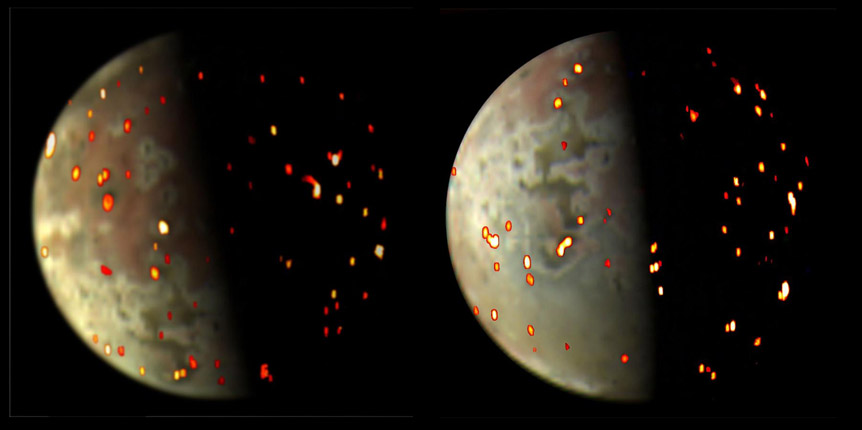
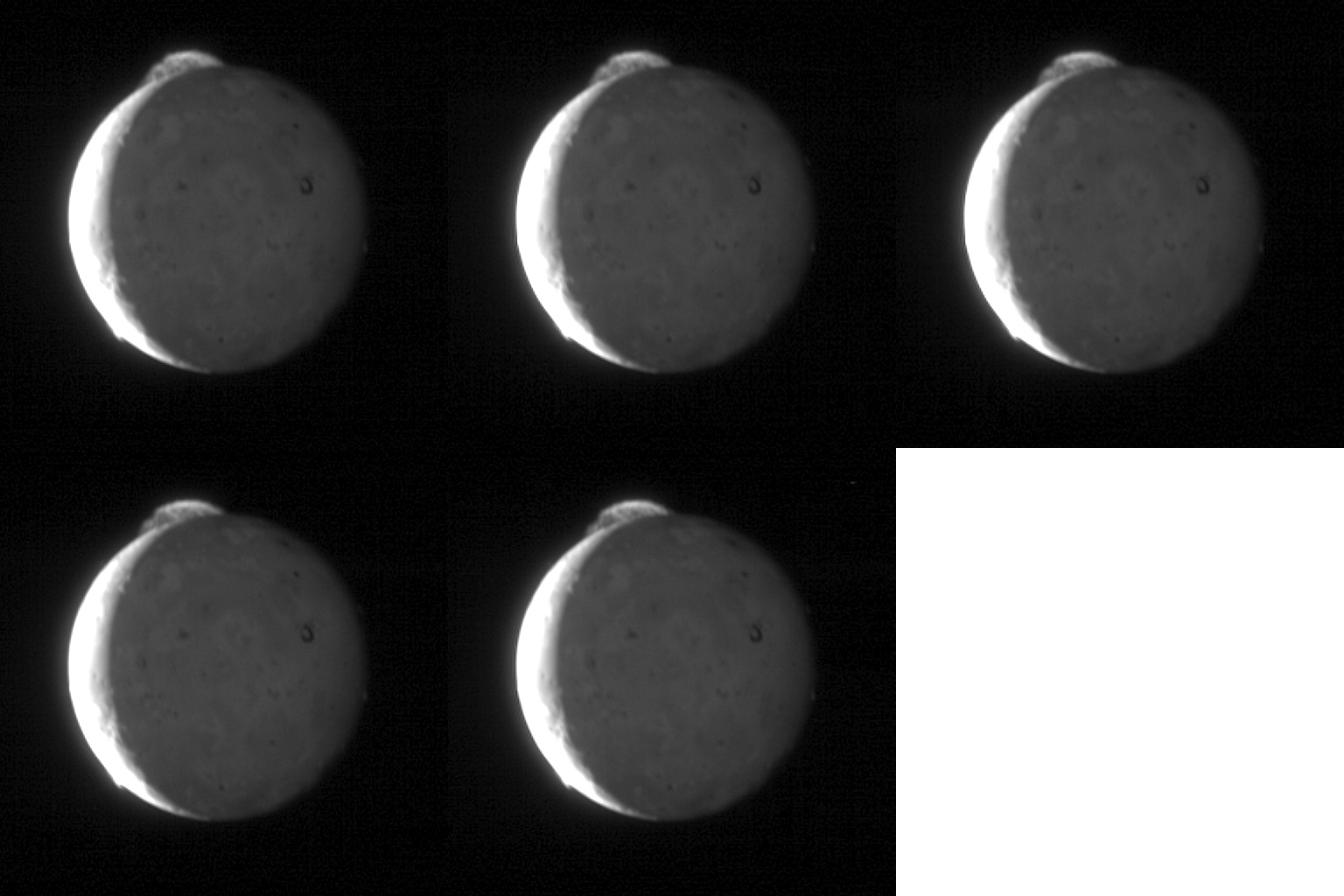
Io, the innermost of Jupiter’s four largest Galilean moons, is covered with hundreds of volcanoes, some shooting lava fountains dozens of miles high. But what kind of interior could drive this magma fury? After NASA’s Juno orbiter made two close flyovers of Io, planetary scientists now think they know.
Ever since Voyager 1 discovered erupting volcanoes on Io during its historic 1979 flyby, scientists believed that a global magma ocean could exist just below the surface of Io, powering its lively volcanic activity.
NASA / JPL / SwRI / ASI / INAF
NASA / JHU-APL / SWRI
However, at a press conference hosted by the American Geophysical Union, planetary scientists shared new findings — that Io likely has no magma ocean, but rather a rigid, partially molten interior much like that of Earth’s. Their results were based on new data from NASA’s Juno orbiter, which has been exploring Jupiter and its Galilean moons since its arrival in 2016.
“Io is orbiting a monster,” says Scott Bolton (Southwest Research Institute), principle investigator of the Juno mission. Io’s path around Jupiter is slightly elliptical, forced off a perfect circle by orbital resonances with neighboring Europa and Ganymede. As this elliptical orbit periodically brings Io closer and farther from the behemoth planet, Jupiter’s immense gravitational force repetitively tugs Io’s surface back and forth, much like how the Moon’s pull creates tides in Earth’s oceans.
“This process of tidal flexing will produce enormous energy that can lead to producing enough heat to melt Io’s interior,” says Ryan Park (NASA Jet Propulsion Laboratory), a member of the Juno science team. Bolton compares it to squeezing a rubber exercise ball until it gets warm.
No Magma Ocean For Io
To determine whether Io in fact has a near-surface shell of molten rock, the team measured just how much these tidal effects were deforming Io’s surface. “If Io has a global magma ocean or liquid layer between the crust and inner layer, this crust is going to be a lot easier to deform, just like a water balloon,” Park says.
The team calculated Io’s tidal deformation by combining gravitational measurements obtained by tracking Juno’s motion during its recent flybys with historic observations from the Galileo spacecraft. Their results, published in Nature on December 12th, reveal that Jupiter’s tidal heating isn’t enough to generate a global magma ocean. Rather, Io’s extreme volcanism is likely powered by a more rigid, partially molten but mostly solid interior.

NASA / JPL / SwRI
The question of Io’s magma ocean had implications beyond its own source of volcanism. Many worlds were theorized to possess a magma ocean early in their evolution. This includes the Moon, whose the dark maria resulted when massive flows of lava erupted from its interior. And tidal forcing occurs on other giant-planet satellites, such as Europa and Enceladus, which are believed to have a liquid water oceans beneath their icy crusts.
Lakes, Mountains, and Lava Flows Galore
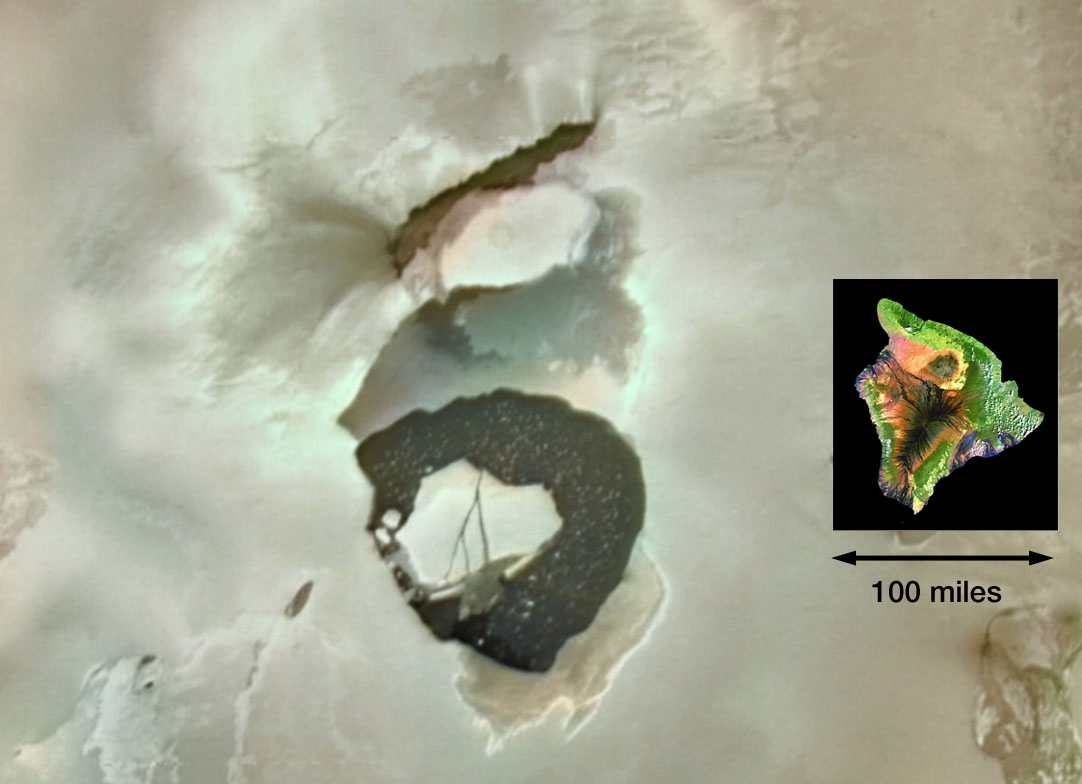
One possible reason that Io might lack a magma ocean is the hundreds of volcanic eruptions occurring on its surface, which dissipate much of the heat generated down below. The Juno team also took the opportunity to observe Io’s unusual surface features during the flybys. Using the Jovian Infrared Auroral Mapper (JIRAM), scientists observed Io’s largest lake, Loki Patera. Spanning 120 miles, Loki would fill the center of the Mediterranean Sea if it were on Earth. But, unlike the Mediterranean, Loki is made up entirely of lava.
“It’s a unicorn in the solar system,” says Alessandro Mura (National Institute for Astrophysics), a member of the Juno science team who led the Loki study. Even more remarkable is that the lake hosts at least 20 islands, which miraculously have stayed intact since Voyager’s observations nearly a half century ago.
NASA / JPL / Andrea Luck; NASA / Landsat 7
The endurance of Loki’s islands challenges scientists’ understanding. One possibility is that the lava lake is shallow — only a few tens of meters deep — which would prevent convection that could have eroded the islands.
It turns out that Loki is not the only lava lake on Io: JIRAM discovered 40 smaller ones in its flybys. The tidal forces at work in Io’s interior could also play a role in the formation of these lakes. As Io is periodically squeezed, molten rock gets pushed out onto its surface, pooling in lava lakes. Juno’s images also reveal dozens of fresh lava flows and new volcanic deposits since observations by NASA’s Galileo orbiter more than 25 years ago.
“This is an incredibly dynamic surface that is constantly turning over because of all the volcanic activity,” says Heidi Becker (NASA Jet Propulsion Laboratory), another member of the Juno science team. The new images reveal active lava breakouts, manifesting as bright streaks and warm glows of thermal emission, along the contours of Io’s mountains. These findings hint that Io’s mountains and its volcanic activity might both result from shifting crustal plates.
While it is unlikely that Juno will be able to pass by Io again in the near future, the team hopes to study the moon and Jupiter’s aurora from a distance. The upcoming Europa Clipper and JUICE missions also promise to shed more light on Jupiter’s Galilean moons — except for Io, whose proximity to Jupiter immerses it in intense magnetospheric radiation. Juno’s flybys have provided a rare opportunity to study this dynamic moon’s surface and history.
About Arielle Frommer
Arielle Frommer is a science writer for Sky & Telescope and astronomy PhD student at Yale, where she studies exoplanets. In her free time, she enjoys hiking, crocheting, drinking coffee, and reading and writing fiction.


Comments
You must be logged in to post a comment.