 SUNSET:

 0
0In a surprise to researchers, the small, icy bodies beyond Pluto’s orbit tend to rotate opposite the way they move around the Sun, which might say something about how they formed.
Ko Arimatsu
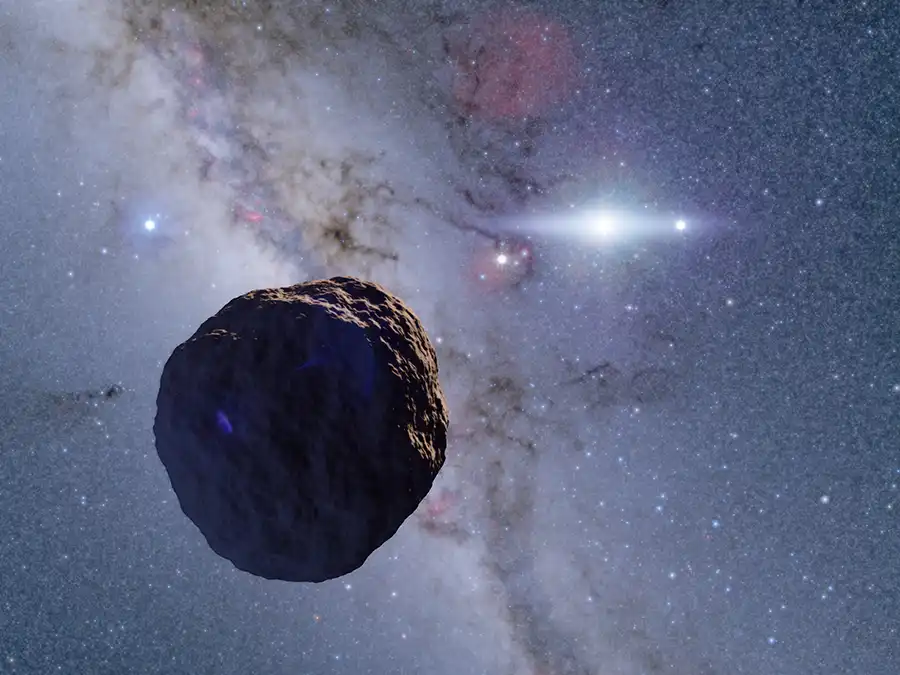
At the edge of the solar system, small chunks of ice and rock behave differently than we’d expect. Observations made by NASA's New Horizons spacecraft show that binary objects prefer to revolve backwards around each other compared to their orbits around the Sun. The observations suggest that this behavior might come from the objects’ gentle pairing, a finding that has implications for planetary formation models.
“This is not what I expected, but it's kind of cool,” said Simon Porter last month at the joint Europlanet Science Congress-Division of Planetary Sciences conference in Helsinki, Finland. Porter, a planetary scientist at the Southwest Research Institute in Boulder, Colorado, used data collected by New Horizons to probe small bodies at the outskirts of the solar system.
Kuiper Belt objects (KBOs) are a challenge to see from Earth. Most are small, dim, and distant, beyond Pluto’s orbit. New Horizons is helping to change that. Before it breezed past Pluto in 2015, the team was already searching the Kuiper Belt for the spacecraft’s next target. Scientists selected Arrokoth, and New Horizons flew past the significantly smaller chunk in 2019. Meanwhile, the team has continued to study several other KBOs from afar, collecting far more information than possible from Earth.
From the Edge
Officially designated 2014 MU69, Arrokoth is the most distant and most primitive object ever explored by spacecraft. (“Arrokoth” is Powhatan/Algonquian for “sky.”) When New Horizons passed it by, the mission unveiled an icy red snowman — a contact binary. The shape and surfaces suggested that the two separate pieces came together with a light touch rather than a devastating collision.

NASA / Johns Hopkins University Applied Physics Laboratory / Southwest Research Institute / Roman Tkachenko
While the views of other KBOs were from farther away, Porter was able to reconstruct the shape of seven other objects. As New Horizons moved through space, it captured these seven objects at different angles of light. “Instead of just looking at them with the Sun at your back, you can see them with variable illumination and shadowing,” Porter says.
That task wasn't easy. Data from the spacecraft is sparse and Porter couldn't simply use the sort of shape models typically used to study asteroids. Instead, he used Arrokoth itself, along with its two separate lobes, Weeyo and Wenu, as three individual shape models. He found that four of the other KBOs New Horizons had imaged are best fit with the shape of a contact binary. Including Arrokoth, that means 63% of the KBOs studied by New Horizons thus far have that snowman shape. Previous Earth-based observations suggested that only 10% to 25% of KBOs were contact binaries, so although these are only a small number of objects, the change in percentage is significant.
“That's cool, because it helps strengthen the case that Arrokoth is a typical KBO,” Porter says, “and contact binary KBOs aren't rare.”
KBOs in Retrograde
Porter also found that most of the contact binaries had retrograde rotation, spinning in a direction opposite to their orbit’s motion. That could tell us something about how they formed.
The solar system started off as a cloud of gas and dust that eventually collapsed to form the Sun. The leftover material, now in a disk around the Sun, continued to spin in the same direction as our newly formed star. Even as small pieces of ice and rock bound together gravitationally, eventually merging into a single larger object, they continued to travel in the same direction.
When newborn objects merged to form larger bodies, they often met in a collision, such as when a Mars-size body ran into Earth in the solar system’s early years. Such violence sometimes changed an object’s spin. Many scientists think such a crash left Venus with retrograde rotation.
But in the sparser outskirts of the solar system, pairs of objects came together more gently, as with Arrokoth, in a “kiss.” How such a light touch could flip spins around is still unclear.
Previous studies have suggested that separated binaries – two objects orbiting one another without touching – are more likely to have a prograde rotation, one that’s in the same direction as its orbit. That contact binaries appear to prefer retrograde rotation “might be telling us something about the formation of KBOs from the protoplanetary disk,” Porter says, “that initially retrograde binaries were more likely to come together to form contact binaries like Arrokoth.
“That, in turn, can really constrain planetary formation models across the solar system.”
Although Porter is working with only a handful of KBOs, he expects to see a significant change as the Vera C. Rubin Observatory, which just came online last June, continues its observations. Although Rubin is an Earth-based observatory, it has the sensitivity for measurements of the brightest KBOs. Even though it won’t be able to see objects as small as those studied by New Horizons, it should be able to provide more insight into the distant edge of the solar system.
“Over the full 10-year program,” Porter pointed out to the conference audience, “we're going to get an awful lot of objects.”
About Nola Taylor Tillman
Nola Taylor Tillman is a freelance science journalist who specializes in writing about space and astronomy. She lives in Atlanta, Georgia with her husband and four cats. You can read more of her writing on www.astrowriter.com.


Comments
You must be logged in to post a comment.