 SUNSET:

 0
0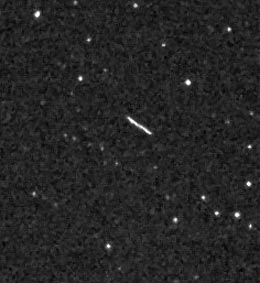
The asteroid was moving so fast that it created a trail in the telescopic star field during just a 4-second exposure.
On July 3rd an 800-meter (half-mile) asteroid called 2004 XP14 flew past Earth at a distance a little greater than that of the Moon. It brightened to magnitude 11 as it crept rapidly across the northern sky.
One amateur waiting with telescope and camera was Johnny Horne of Fayetteville, North Carolina. He took a series of 4-second exposures with a Meade DSI II Pro camera on a Celestron 11 telescope at f/4 as the asteroid passed through the constellation Cassiopeia, moving from lower right to upper left. He combined a series of his pictures into a 1.9-megabyte QuickTime movie showing the asteroid's motion.
About Alan MacRobert
Alan M. MacRobert became an avid Sky & Telescope subscriber in 1966 at age 14, joined the editorial staff in 1982, and is now a senior contributing editor, semi-retired. He played a role in practically every part of the magazine and the company's other products for more than a generation, both on the amateur-observing side and the science-reporting side. In 1994 a book collection of his observing how-tos and telescopic sky tours was published as Star Hopping for Backyard Astronomers. He has produced This Week's Sky at a Glance online every week since 1989.


Comments
You must be logged in to post a comment.