 SUNSET:

 1
1
Bob King
I remember how difficult it was to find my first variable star. With deep-sky objects you're looking for something that stands out from the starry background. But when you're seeking a single star in a field of stars it's easy to get confused. In time, every variable star observer creates their own "rules of the road" mental guide. Things like starting with low magnification, knowing your field of view and becoming adept at creating on-the-spot, small asterisms to guide you through the stellar jungle to the target. I'll often mutter their names out loud during the hunt — roofline, skinny triangle, candy cane, horseshoe. Sounds mad but it works.
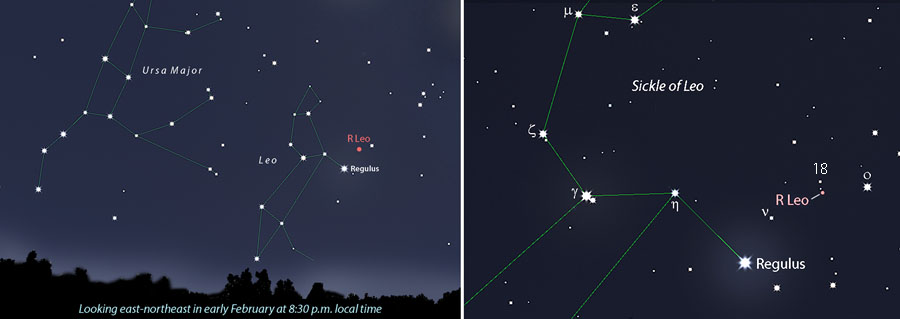
If you're new to variables — stars that change in brightness cyclically or erratically — it's good to start with an easy one. I found the perfect candidate while out observing recently. It's R Leonis, or R Leo for short. You'll find it 5.1° west-southwest of Regulus and high enough in the eastern sky to aim your binoculars at by 8:30 p.m. local time. R Leo currently shines near peak brightness and through a small scope looks like a ruby held to the light. When I last observed it a week ago it gleamed at magnitude 5.9. Since then it's risen even higher to around 5.5-5.7, bright enough to spy with the unaided eye from a dark, moonless sky.
Stellarium with additions by Bob King
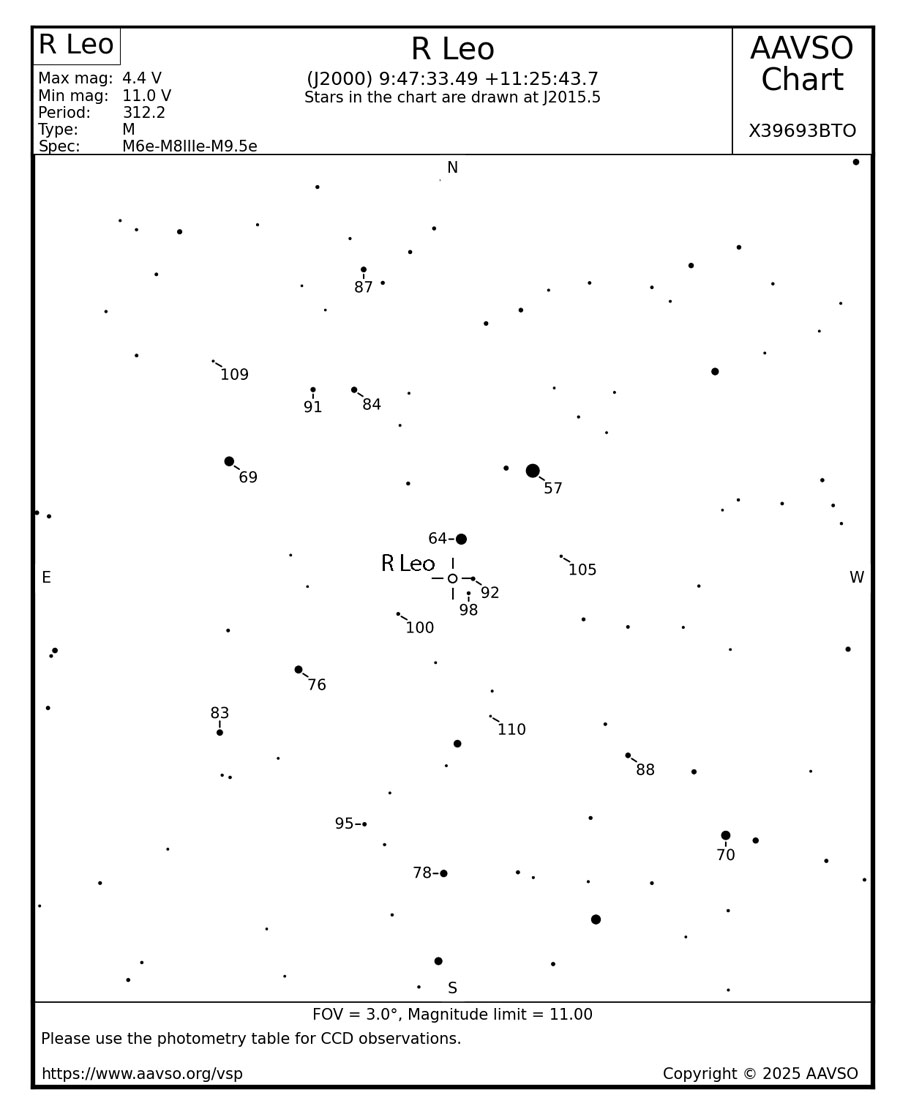
This little gem's easy to find, too. Start at Regulus and slide 2.5° northwest to 5th magnitude Nu (ν) Leonis. From Nu, move an equal distance due west to 5.6-magnitude 18 Leonis. It forms a ½°-long bent finger asterism with 19 Leonis (the knuckle) and R Leonis (fingertip) to its southeast. You can't miss the variable because it's bright and colorful right now. A small telescope will also show two nearby 9th and 10th magnitude stars that together with R Leo form a nifty acute triangle. They'll come in handy for estimating the variable's brightness when it dims to minimum in August-September.
Courtesy of the AAVSO
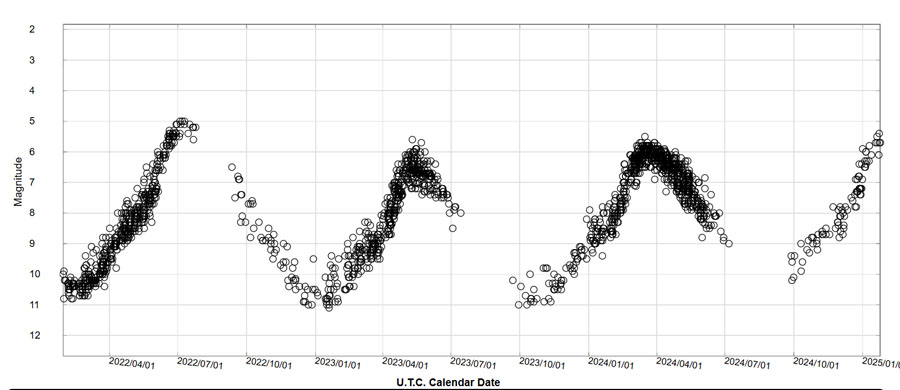
R Leo typically varies between about magnitude 5.5 at maximum and 10.5 at minimum with a period of 312 days. Highs and lows vary from cycle to cycle making each unique. Right now, the star is still climbing toward its predicted maximum on March 20th. How bright will it get? That's for you and I to find out. I encourage you to check the star regularly so you can experience its tempo, color and behavior firsthand. Right now, it's super-easy to see in binoculars, and a 60mm telescope will cover its entire cycle.
Merikanto, CC-SA 4.0
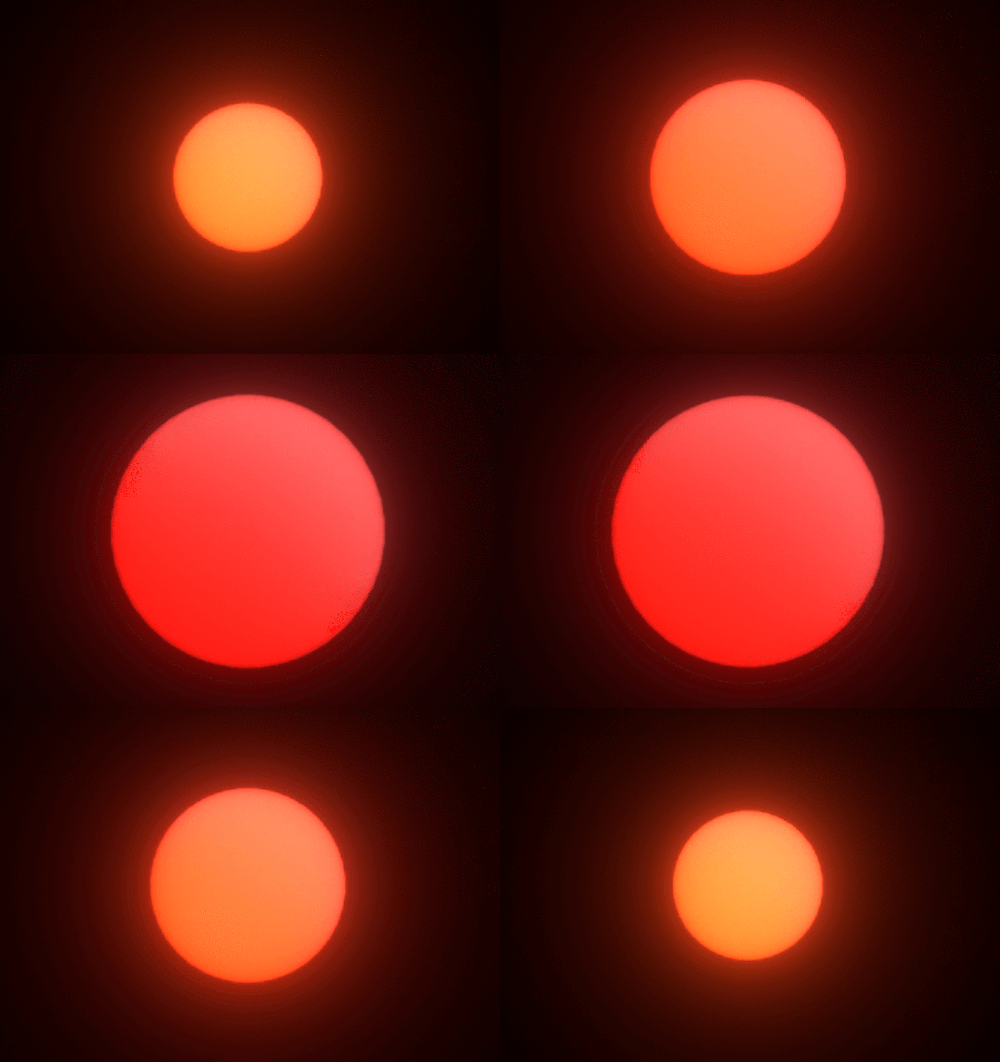
Unlike eclipsing variables, where one star blocks the light of a companion, R Leo's variations are intrinsic — the star rhythmically expands and contracts. Like the prototype Mira, R Leo is a long-period variable star, a relatively cool, pulsating red giant star in the final stages of life. These bloated behemoths begin their lives with masses similar to the Sun's. As a Mira-star ages it runs out of its primary fusion source, hydrogen, and ultimately switches to helium. Helium fuses at a higher temperature, which heats the core and causes the star's outer layers to balloon outward, redden and cool. A study published in 1992 determined R Leo's diameter as 612 ± 96 times that of the Sun. Placed at the center of the solar system its ruddy envelope would reach nearly halfway between Mars and Jupiter.
Pulsations occur as the star seeks but can't achieve equilibrium. The expanding shell cools and contracts, only to be reheated and expand again in a new cycle. As the star's diameter changes so does its luminosity, causing its brightness to fluctuate. Miras are faint when fully distended and brightest during the contraction phase.
Courtesy of the AAVSO
Red giants lose material to space through strong stellar winds in addition to material that escapes through pulsation. In the end, R Leo will eject the remainder of its weakly-bound atmosphere in a farewell kiss called a planetary nebula. Stripped naked, its core will become a white dwarf star roughly the size of the Earth but exceedingly dense and hot. With no more "wood" to throw on the fire the dwarf will spend trillions of years as a stellar ember, gradually cooling down until it becomes a black dwarf. Astronomers expect the Sun to experience a similar fate. For a taste of stellar inconstancy and a vivid image of what the Sun will look like in about 5 billion years, drop by R Leo the next clear night.
About Bob King
I love the sky (day and night) and have been a skywatcher and amateur astronomer since childhood. I'm also a long-time member of the American Association of Variable Star Observers (AAVSO) and Astronomical League. I pen the Astro Bob blog and have written four books: Night Sky with the Naked Eye (2016); Wonders of the Night Sky You Must See Before You Die (2018) and Urban Legends from Space (2019) and Magnificent Aurora, published in 2024. The universe invites us on an adventure every single night. To accept the invitation, we only need look up.


Comments
AB
February 10, 2025 at 4:03 pm
What a neat little meditation/breath exercise I see in the animation of the star. Focus on it, and breathe in/out with the expansion/contraction. And think about connecting with the cosmos 😉
You must be logged in to post a comment.
You must be logged in to post a comment.