 SUNSET:

 0
0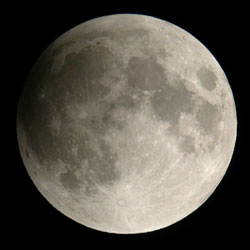
Gary Seronik shot this view of the November 8, 2003, lunar eclipse just as the western edge of the Moon touched Earth's dark umbral shadow. The faint shading visible across the rest of the lunar face is due to Earth's light penumbral shadow.
Courtesy Gary Seronik.
An eclipse of the Moon can be the most dramatic celestial event that most people ever see. But not this time, and not just because it happens at an inconvenient hour. On Sunday morning, April 24, 2005, the full Moon will merely skim through the penumbra — the pale outer fringe — of Earth’s shadow.
The event will be visible before or during early dawn from central and western North America. The eclipse reaches its deepest point at 9:55 Universal Time, which is 4:55 a.m. Central Daylight Time, 3:55 a.m. Mountain Daylight Time, and 2:55 a.m. Pacific Daylight Time. Look for a slight shading on the Moon’s north-northeastern side. Weaker traces of the penumbra may be detectable for about an hour before and after this time.
The event will also be visible around dawn from Central America and western South America, around midnight of April 23–24 from Hawaii, and early on the evening of the 24th local date from Australia, New Zealand, and Japan.

The Moon misses the umbra (dark central part) of Earth’s shadow, passing only through the shadow’s penumbra. The Moon’s disk is drawn for the time of central eclipse and also for when its edge is halfway into the penumbra — which is about when the penumbral shading on the Moon’s face becomes barely detectable.
Sky & Telescope illustration.
The Moon’s dimming is so slight during a penumbral eclipse because Earth blocks only part of the Sun’s brilliant face from shining onto the Moon’s surface. Nevertheless an eclipse is an eclipse, and here’s your chance to bag another one. Make a note to set your alarm clock.
Lunar-eclipse lovers have been spoiled recently, what with a pair of total eclipses occurring in both 2003 and 2004. While there will be a brief partial lunar eclipse in October 2005 and September 2006, and another penumbral eclipse in early March 2006, the next total eclipse of the Moon will not take place until March 3, 2007.
About Alan MacRobert
Alan M. MacRobert became an avid Sky & Telescope subscriber in 1966 at age 14, joined the editorial staff in 1982, and is now a senior contributing editor, semi-retired. He played a role in practically every part of the magazine and the company's other products for more than a generation, both on the amateur-observing side and the science-reporting side. In 1994 a book collection of his observing how-tos and telescopic sky tours was published as Star Hopping for Backyard Astronomers. He has produced This Week's Sky at a Glance online every week since 1989.


Comments
You must be logged in to post a comment.