 SUNSET:

 0
0Astrophysicist Mansi Manoj Kasliwal, whose work has been key to understanding the changing infrared sky, is guiding Palomar Observatory into its next chapter.
Caltech
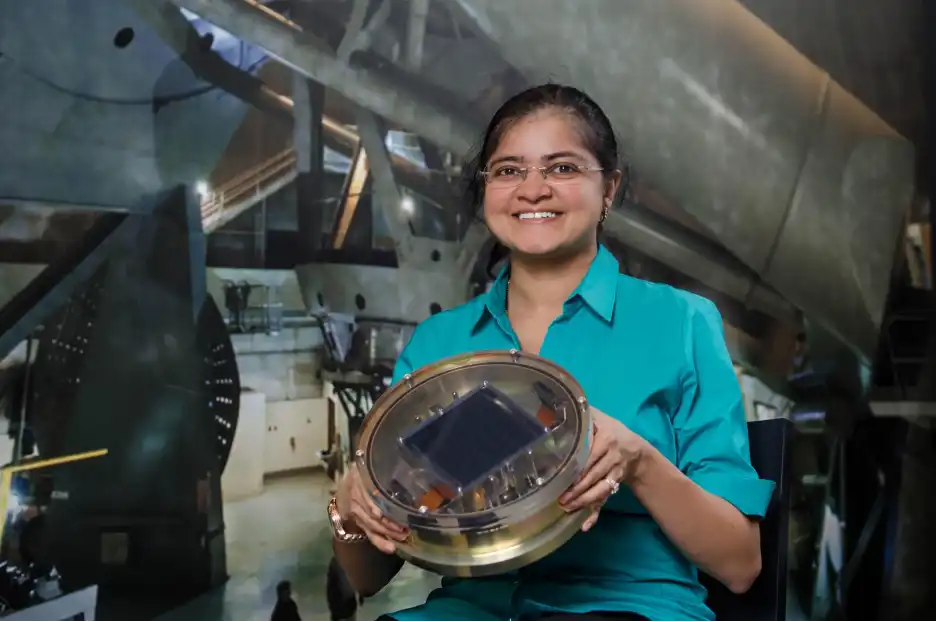
Mansi Manoj Kasliwal, a professor of astronomy at Caltech, has been named the new director of Palomar Observatory, in what is a milestone for women in science. Kasliwal assumes this role as a descendent of generations of women astrophysicists who made historic discoveries at the facility.
English astronomer Margaret Burbidge analyzed data from both Mount Wilson and Palomar observatories in the seminal 1957 paper, “Synthesis of the Elements in Stars.” Though she was first author, to gain even limited telescope access she had to pose as the assistant to her husband Geoffrey Burbidge, as women were not permitted to use them until a decade later.
Vera Rubin became the first woman astrophysicist to officially observe with Palomar’s telescopes in 1965, using them in work that ultimately cemented her role in revealing the existence of dark matter.
Andrea Ghez (UCLA), the fourth woman in history to be awarded the Nobel Prize in Physics in 2020, first developed infrared observing techniques at Palomar as a Caltech graduate student. Building on those techniques, refined over decades with her team at Keck Observatory in Hawai‘i, she revealed evidence of the supermassive black hole at the center of the Milky Way.
Now, almost 90 years after its first operations, Mansi Manoj Kasliwal will be Palomar’s first female director — a scientist whose own discoveries trace cosmic fireworks across the universe. “Mansi has an extraordinary ability to marry visionary science with hands-on leadership,” said Wendy Freedman (University of Chicago), former director of the Carnegie Observatories. “Her superb scientific and technical expertise will ensure that the Palomar Observatory will continue to have a bright future.”
Collision Course
Kasliwal began her career hoping to find out where and how the heaviest elements are formed and synthesized. Massive stars can forge elements as heavy as iron, releasing them in supernova blasts, but other processes are needed to create even heavier elements.
Kasliwal believed her questions could be answered with multi-messenger astronomy, a field that brings together observations of light with data from other “messengers,” including neutrinos, cosmic rays, and gravitational waves. The events that create those messengers are also part of time-domain astronomy, which focuses on the changing sky, stellar events that briefly light up and then fade away.
To follow up on those messengers, Kasliwal led the Global Relay of Observatories Watching Transients Happen (GROWTH), between 2015 and 2020, an international collaboration of about 100 astronomers. Together, they used 18 telescopes across six continents to capture fast-fading transient events.
“Multi-messenger astronomy looks for cosmic fireworks,” Kasliwal explains. “Those fireworks might come from stellar explosions such as novae and supernovae, or from mergers of two neutron stars that briefly light up the night. You need these extreme environments to create heavier elements, like gold, platinum, silver, uranium, and thorium.”
“These exotic moments in the universe are very luminous,” she adds. “But they have short lifetimes. You have to be looking at the right place at the right time.”
As part of GROWTH, Kasliwal was among the first to receive an alert on August 17, 2017, when the Laser Interferometer Gravitational-wave Observatory (LIGO) detected gravitational waves from the collision of two neutron stars. She and her team had to act quickly to locate the source of the cosmic explosion before its emissions disappeared.
LIGO’s alert, sent to Kasliwal’s cell phone, had her on Zoom within minutes, triggering an alert to the GROWTH team. Fast follow-up observations over a large area of sky caught the light from the just-merged neutron stars.
“For the very first time,” Kasliwal explained at the time, “we saw unequivocal evidence of a cosmic mine that was forging about 10,000 Earth-masses of heavy elements, such as gold, platinum, and neodymium.”
Her work on this merger won her the New Horizons in Physics Prize from the Breakthrough Prize Foundation in 2022. It also inspired the years of work that followed, building instrumentation to catch other, similar events.
Kasliwal determined that the neutron star merger’s infrared emissions lingered for almost two weeks, whereas the visible and ultraviolet emissions disappeared within hours. To take advantage of the longer observing window of infrared emissions, Kasliwal designed a new instrument, installed on Palomar in 2018.
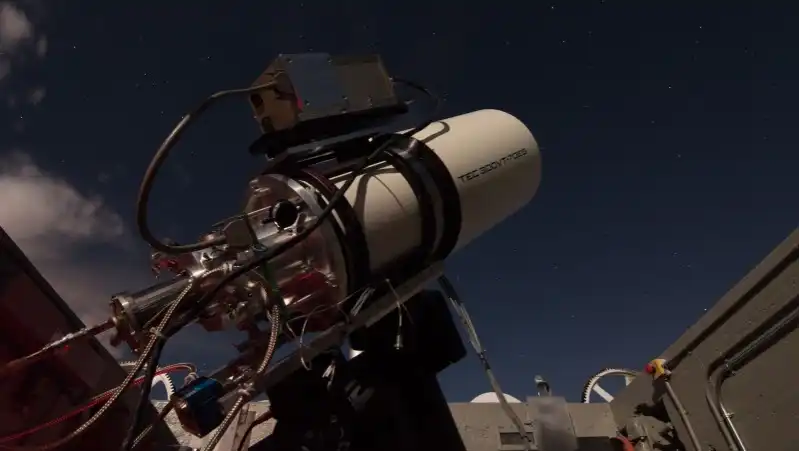
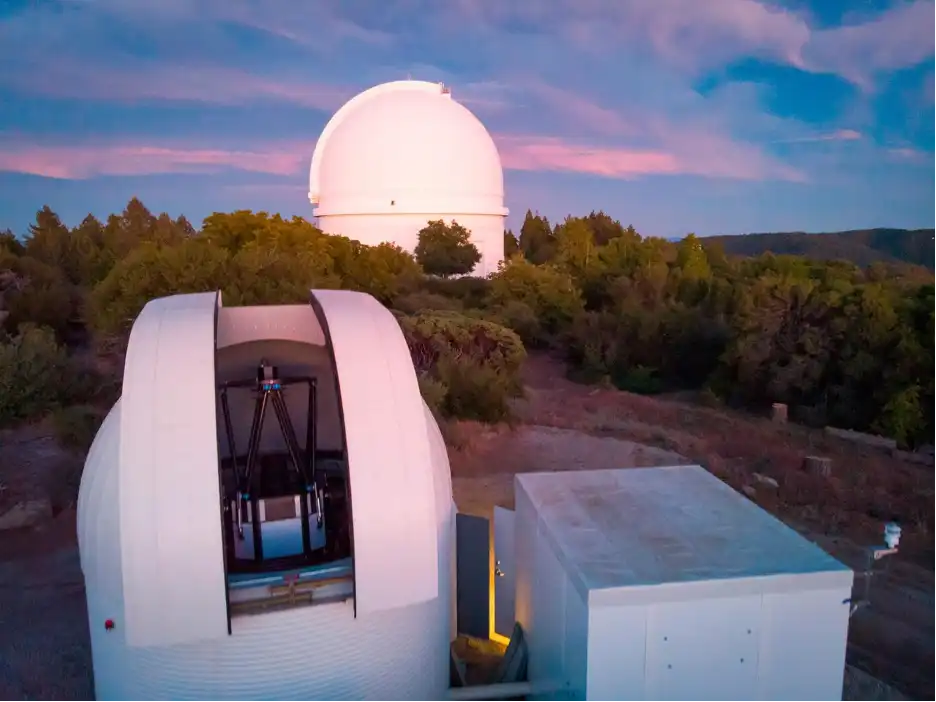
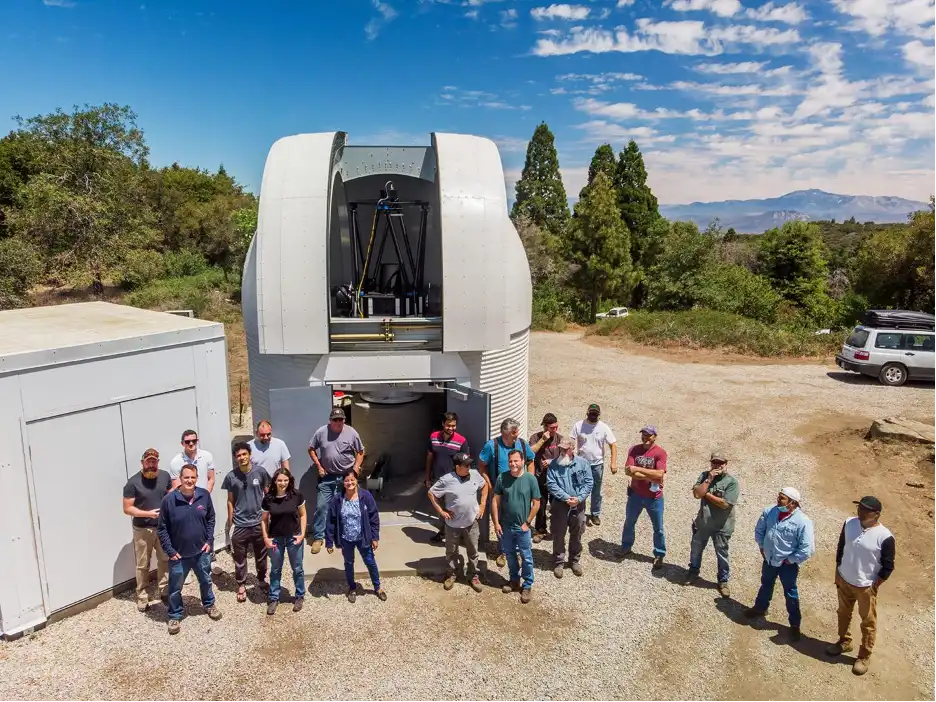
Palomar Gattini-IR is a 12-inch telescope housed in a shed with a metal roof that opens like a clam shell. Despite its small size, it has a field of view 40 times wider than other infrared telescopes. Palomar Gattini-IR can robotically image the entire sky every two nights, capturing ephemeral objects, such as novae, supernovae, gamma-ray bursts, and binary stars before they disappear.
Palomar Gattini-IR’s successful study of infrared variability in the Milky Way galaxy led Kasliwal to develop a subsequent, more ambitious infrared instrument, the Wide-field Infrared Transient Explorer (WINTER), installed on a dedicated 1-meter telescope on Palomar in 2023. It’s 10 times more sensitive than Palomar Gattini-IR.
In the ongoing evolution of instrumentation, Kasliwal’s Palomar experiments have opened up new possibilities for following up on short-lived events at near-infrared wavelengths.
Caltech
The Road to Palomar
Kasliwal credits her family in supporting her path to her current role. Born in Indore, India, Kasliwal excelled in math and science far ahead of her peers, leading her family to send her to finish high school in the U.S.
“In India, traditionally,” says Kasliwal, “women are supposed to be extra protected until they get married, and they are supposed to get married at a young age. You don’t go gallivanting to the other end of the world to pursue some dream.”
She went on to study engineering physics at Cornell, earned her PhD in astronomy at Caltech, and after prestigious fellowships as a post-doctoral fellow at the Carnegie Institution for Science and Princeton University, she returned to Caltech, becoming full professor by 2021.
Palomar’s Ongoing Missions
Matt Dieterich for Caltech
Kasliwal’s work in time-domain astronomy expanded to include the Zwicky Transient Facility, (ZTF) in 2018, an instrument that uses CCD cameras on Palomar’s 48-inch Samuel Oschin telescope to scan the whole sky visible from its location every two days. The instrument’s sensitivity extends telescope’s ability to explore the universe.
“Scientifically, I think Palomar can really shine by using new technologies,” says Kasliwal. “Both the Samuel Oschin 48-inch and the Hale 200-inch telescopes are about 77 years old, but when combining them with the latest groundbreaking technologies in hardware and in software, Palomar completely reinvents itself.”
As the director of Palomar Observatory, Kasliwal’s mission is to continue the evolution of its instruments.
“The integrated system of telescopes on Palomar makes it unique,” Kasliwal points out. “ZTF discoveries are classified at the 200-inch telescope as supernovae or novae, or something we haven’t seen before. Now, the Next Generation Palomar Spectrograph (NGPS) on the 200-inch will allow Palomar to capture three times more photons from starlight than it could previously. Its final installation will be complete this November.”
The implementation of adaptive optics, a technique used to remove the blurring effects of the atmosphere, combined with refinements in software, will further improve Palomar’s optics.
“Together, these improvements will make the observations seven times faster, or detect objects that are seven times fainter, or further away,” Kasliwal says. “By putting a new instrument on the back end of the telescope, Palomar will see further into the universe than ever before.
Matt Dieterich / www.mattdieterich.com
“Palomar has often served as a launch pad for new technologies that are then transported to other observatories,” Kasliwal says. For example, after Palomar Gattini-IR and WINTER successfully opened up the dynamic infrared sky, they enabled advances for the Cryoscope Pathfinder in Antarctica, the next step in Kasliwal’s quest for the ultimate infrared surveyor. In addition to its role in locating the source of gravitational wave events, the pristine atmospheric conditions will enhance Cryoscope’s ability to observe the infrared transient sky (and detect exoplanets to boot).
Kasliwal is looking forward to ushering Palomar Observatory forward, though she admits, “I don't think being an astrophysicist is the easiest profession. It isn’t nine to five, especially for time domain astronomy.
“There has to be this internal hunger for answers that trumps sleep, that trumps all other weekend plans,” she adds. “Astronomers stop dead in their tracks to capture the neutron star merger, to see that black hole being born.”
For this reason, Kasliwal’s Caltech and global collaborators know they can reach her 24/7. Because as Kasliwal remarked, “Nature decides when it wants to answer questions in the deeper universe.”
About Charity Hume
Charity Hume is a writer and educator based in Pasadena, California. Her work bridges science, history, and the creative imagination. A former director of the NYU Creative Writing Program, she leads writing workshops and offers individual coaching at charityhume.com.


Comments
You must be logged in to post a comment.