 SUNSET:

 0
0Observations — including from an amateur astronomer — show that the Plutino 2002 XV93 has a thin wisp of air around it.
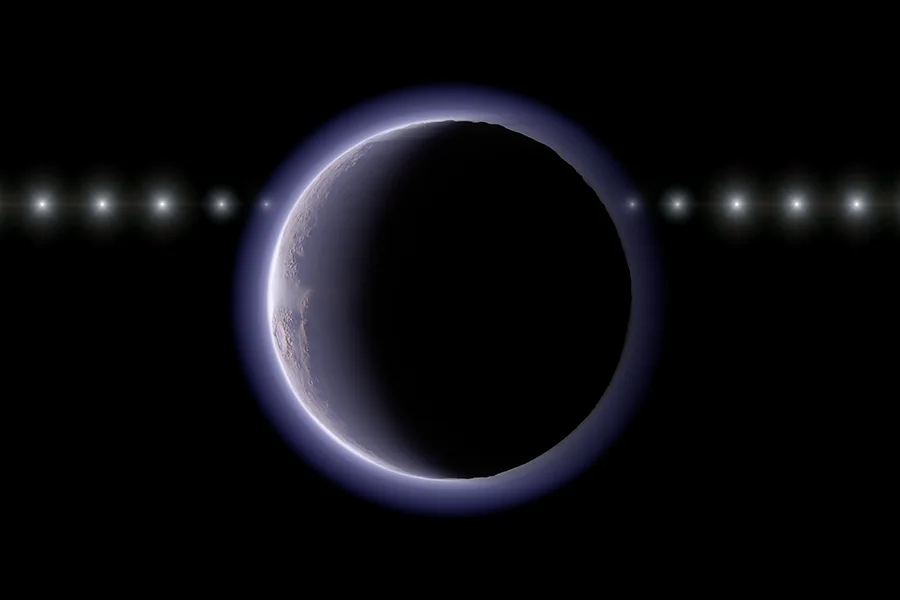
NAOJ / Ko Arimatsu
A team of Japanese professional and amateur astronomers has unexpectedly found an atmosphere clinging to a world sharing a similar orbit to Pluto. It’s the first time astronomers have spotted an atmosphere on a trans-Neptunian object (TNO) other than Pluto itself.
The outer solar system is not normally a place associated with atmospheres. Bodies with small masses — and therefore weak gravity — live in frigid temperatures, meaning most gases freeze solid. But the plutino 612533 2002 XV93 appears to buck this trend, despite only measuring approximately 500 kilometers (300 miles) across. It has a semi-major axis of 39.6 astronomical units, similar to Pluto’s. Also like Pluto, it’s caught in a 2:3 resonance with Neptune, so it completes two orbits around the Sun for every three of Neptune’s.
In January 2024, the team of astronomers watched from several locations across Japan as 2002 XV93 passed in front of a distant star, an event known as an occultation. The star’s light would normally disappear abruptly as the solid surface of the TNO intervened, but that’s not what the team saw. Instead, the starlight appeared attenuated just before and after the TNO passed in front it, suggesting the light passed through a thin atmosphere en route to Earth. The results appear in Nature Astronomy.
The observations were made from three sites: Kyoto University's rooftop, the professional 1.05-meter Kiso Observatory Schmidt telescope, and a 25-centimeter instrument operated by an amateur astronomer in Fukushima. The gradual dimming of starlight detected was consistent with refraction through a thin atmospheric layer with a surface pressure of 100 to 200 nanobars – roughly 50 to 100 times lower than Pluto's atmosphere.
“This discovery challenges the conventional view that trans-Neptunian objects are largely inactive and unchanging worlds,” says team lead Ko Arimatsu (National Astronomical Observatory of Japan).
How 2002 XV93 came by its atmosphere remains a mystery. Arimatsu’s team calculated that the TNO would lose any atmosphere within 1,000 years if there were no processes to replace what’s lost. Follow-up observations with the James Webb Space Telescope show no signs of volatile frozen gases on the surface that might slowly sublimate to sustain an atmosphere.
That leaves two main options: Either the atmosphere is the result of cryovolcanic outgassing from deep inside 2002 XV93, or the icy rock was recently struck by a comet, releasing gases that formed a temporary atmosphere.
“Through future follow-up observations, we hope to clarify how this atmosphere was produced,” says Arimatsu. “We also aim to use campaigns like this one to investigate whether other trans-Neptunian objects may also have atmospheres.”
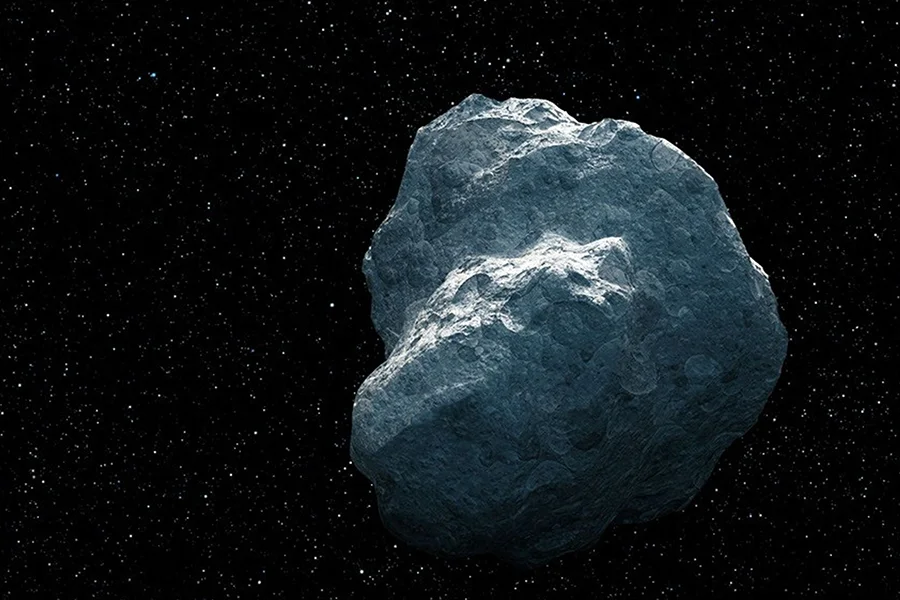
Artwork: NASA, ESA, and G. Bacon (STScI); Science: NASA, ESA, and C. Fuentes (Harvard-Smithsonian Center for Astrophysics)
David Jewitt (UCLA), who was not involved in the research, is happy with the team’s discovery. “The occultation feature is symmetric, like an atmosphere, too well determined to be due to measurement noise and too close to the parent body to be due to a ring,” he says. “Refraction by a near-surface gas envelope is pretty much the remaining explanation.”
As to how the atmosphere formed? “Neither explanation seems particularly likely, although neither can be ruled out with the existing data,” Jewitt says.
“This is potentially one of the first detections of an atmosphere on a TNO since Pluto, which is exciting,” says Bryce Bolin (Eureka Scientific), who was also not involved in the research. “If this result holds, it could imply that small TNOs can host volatile species such as methane, molecular nitrogen, or carbon monoxide, under certain conditions,” he says. “This could provide new constraints on the volatile inventory of the outer solar system and how these materials were distributed and retained during formation.”
“These cold, dead worlds of the outer solar system are not necessarily as cold and dead as we might think,” Jewitt says. “It tells us we should keep looking, to see what other surprises there are.”
About Colin Stuart
Colin Stuart (@colinstuartspace) is an astronomy author and tutor. He also runs a free online astronomy club.


Comments
You must be logged in to post a comment.