 SUNSET:

 0
0Astronomers have tuned in to the celestial “songs” of two red giant stars to reveal their hidden histories — including a case of stellar cannibalism.
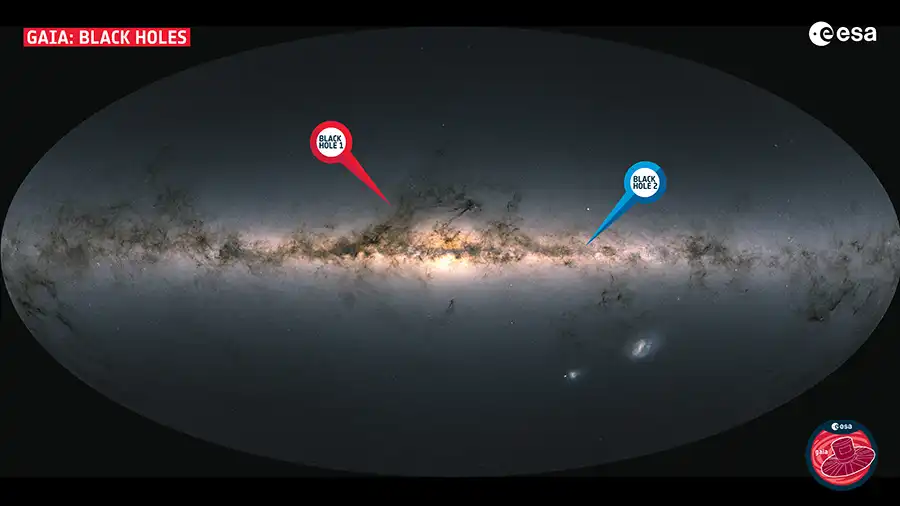
ESA / Gaia / DPAC; CC BY-SA 3.0 IGO
Astronomers have recently tuned in to the “celestial songs,” or oscillations, of two red giants to reveal their remarkable secrets: One is guilty of consuming its companion in a case of stellar cannibalism, while the other may be almost as old as the universe.
The potentially cannibalistic red giant, called BH2*, orbits a dormant black hole, forming a binary system called Gaia BH2. It is a dying star similar to the Sun in mass, though it has ballooned to many times its size in its death throes. Its unexpected age and rotational rate suggest a turbulent past in which it engulfed its companion star — an astronomical twist worthy of Greek classics.
The second red giant, BH3*, also orbits a dormant black hole in a binary system called Gaia BH3. It is an ancient star that’s defying current cosmological models by not displaying the substantial oscillations, or variabilities in its brightness, that astronomers predicted.
These black-hole-anchored binary systems are notable for being some of the closest black hole systems to Earth. Gaia BH2 is located 3,800 light-years away in the constellation Centaurus, while Gaia BH3 is only 1,900 light-years away in the constellation Aquila.
Stellar Vibrations
IAC
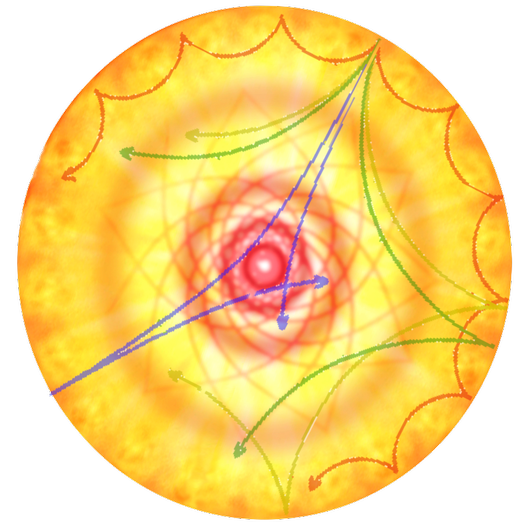
In the study, Daniel Hey (University of Hawai’i) and colleagues used asteroseismology to reveal the characteristics of the red giant stars in both systems. Asteroseismology measures the oscillations, or vibrations, of stars by tracking changes in their brightness. Through these subtle changes, astronomers can ascertain a star’s age, radius, mass, spin rate, and chemical composition, and then infer that star’s formation and evolution.
Hey says a star’s “song” can reveal its inner secrets: “I like to describe [stellar] pulsations as similar to a bell,” he explains. “It’s easy to see that a small, regular star on the main sequence rings at a high pitch and low amplitude (like a small bell!), but a large puffy red giant makes a deep, loud sound. Using just these scalings we can figure out the density, age, [and other characteristics] of the star.”
NASA’s Transiting Exoplanet Survey Satellite (TESS), a space-based observatory, has repeatedly measured the light from more than 1 million stars in its search for exoplanets, providing an ever-expanding database of light curves that anyone can use.
Cannibalistic Past
By understanding the oscillations present within the light curve of BH2*, the researchers measured the red giant star’s size at about 1.2 solar masses. They also found that the star was surprisingly rich in particular kinds of elements called alpha elements. These elements, such as oxygen, magnesium, silicon, and calcium, are produced via fusion in massive stars. If they’re abundant compared to iron, which is produced in the core of longer-lived, less massive stars, then the star must be older.
The proportion of alpha elements to iron, measured previously, had suggested that BH2* should be ancient. But when Hey’s team measured the star’s age from its oscillations, they found it to be unexpectedly youthful 5 billion years old.
Since it is too young to have formed with this elemental enrichment, the researchers classify it as part of a special population of massive (more than 1.1 solar masses), alpha-rich red giants that formed either through mergers with other stars or by adding mass, absorbing significant amounts of gas and dust from their surroundings. Whichever scenario took place in BH2*’s case, it may have happened during the formation of the companion black hole.
Weirder still, while most red giant stars spin slowly, taking 2,000 days to complete a rotation, ground-based observations of BH2*’s brightness suggest it rotates every 398 days — far too quickly for an “isolated red giant of its age,” Hey says. If this rotation rate is real, it cannot be explained solely by the red giant star’s spin at its birth.
Team member Joel Ong (University of Hawai’i) says the fast spin may have come through gravitational interactions during its stellar meal: “The star must have been spun up through tidal interactions with its companion, which further supports the idea that this system has a complex history,” Ong explains.
Additional data provided by future TESS observations and further asteroseismic measurements should reveal more details about the turbulent past of BH2*.
An Ancient Star
In addition to BH2*, researchers observed BH3*, a 0.76-solar-mass red giant that orbits the dormant black hole in the binary system Gaia BH3. BH3* lacks almost all heavier elements, including alpha-elements and iron, so unlike BH2*, it didn’t ingest a stellar companion in its past.
Oddly, BH3* doesn’t show the clear oscillations that the researchers predicted. The results suggest models are incomplete when dealing with stars with few heavy elements. The team speculates that BH3* might be more than 13 billion years old — almost the age of the universe.
Its companion black hole is equally anomalous: It is the most massive black hole produced in the core of collapsing star to be discovered in the Milky Way. At 33 solar masses, its formation is still hotly debated. Yet the age of the system implies it formed from a likewise ancient and heavy-element-poor star.
Fabio Pacucci (Harvard University), who was not involved in this study, highlights the importance of this research in illuminating the hidden histories of these stars and the evolution of their binary systems: “This study is fascinating because it uses tiny "starquakes" to uncover the hidden past of a red giant orbiting a quiet black hole — showing how the star may have merged or interacted with a companion long ago,” he says. “These black holes, such as Gaia BH2 and BH3, are especially intriguing because they are relatively close to Earth — practically in our cosmic backyard.”
Altogether, the research demonstrates the usefulness of asteroseismology in inferring the complex and even cannibalistic evolutionary histories of stars in our galaxy.


Comments
You must be logged in to post a comment.