 SUNSET:

 11
11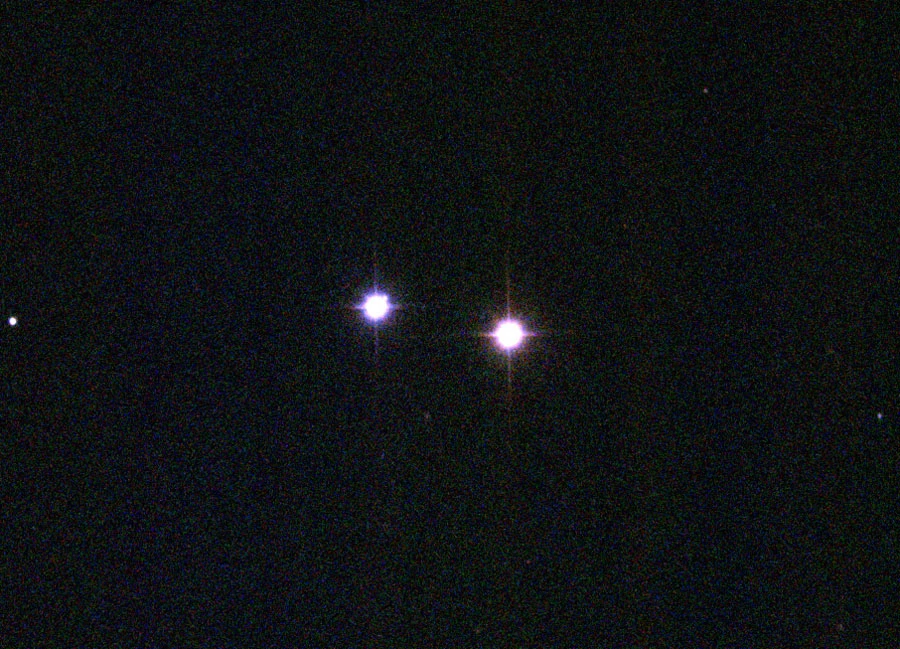
NOIRLab / NSF / AURA
Quick! Where's Messier 40? I had to think about it, too. It's fair to say that this Messier object isn't on most amateurs' radar. Many of us first encountered the object while dutifully completing the Messier catalog. Few have returned. Yet once you know the backstory of this double star — along with the interesting deep-sky company it keeps — you may want to go back for a second look.
Through a small telescope M40 looks like a wide double star, with components of magnitude 9.6 and 10.1 separated by 53″. However, recent parallax measurements from the Gaia space observatory reveal a different story — the stars lie at vastly different distances. Brighter HD 238107 is 1,013 light-years away, while its false companion, HD 238108, is less than half as far at 470 light-years.
Stellarium with annotations by Bob King
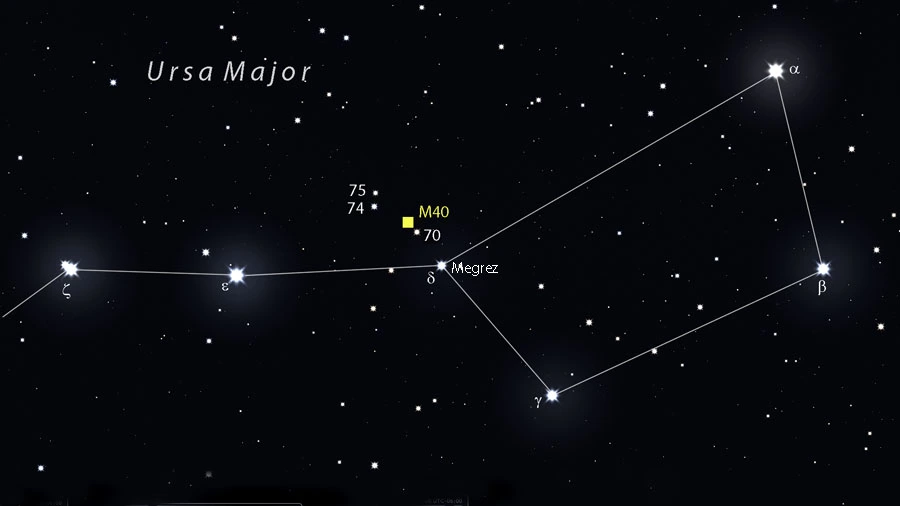
Finding the pair is easy. M40 is located just 1.4° northeast of Megrez, the star that links the handle of the Big Dipper to the bowl. Starting at Megrez, slide 1.1° northeast to 5.5 magnitude 70 Ursae Majoris. Continue on a line ¼° to the northeast and you'll bump into M40. In my 15-inch Dob, the brighter star looked slightly orange, a warmer hue than I expected for a G0-class star. A more recent measurement by Lowell Observatory astronomer Brian Skiff gives the spectral type as K0III, a classification shared with the red giant Arcturus. Evidently, my eye was telling the truth.
Portrait: Library of Polish Academy of Sciences. Book detail: National Library of the Czech Republic. Illustration: Bob King
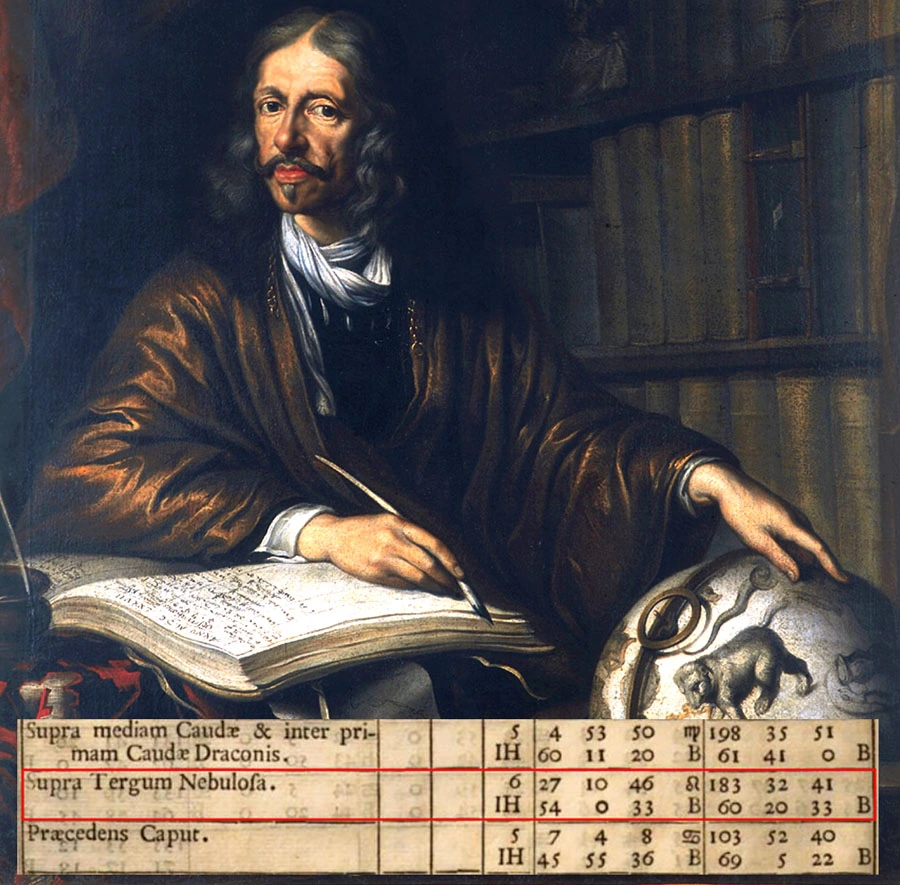
So, how does an optical double find its way into a famous catalog of 110 fuzzy objects masquerading as comets? It began with Johannes Hevelius, a 17th-century Polish astronomer and cartographer who penned a star catalog and atlas of the constellations titled Prodromus Astronomiae, published posthumously in 1690. In it he listed the positions of stars by constellation. Among his entries for Ursa Major, Hevelius described a Supra Tergum Nebulosa, Latin for "a nebulous star, above the back of the [Great Bear]." The position he recorded in 1660 coincides with 74 and 75 Ursae Majoris, a pair of stars 22′ apart with magnitudes of 5.3 and 6.1, respectively.
I recently observed the duo from a dark sky without optical aid. The brighter one was fairly easy to see, but the proximity of fainter 75 Ursae Majoris combined to make them look nebulous. Since Hevelius made his observations for the catalog using naked-eye sights rather than with a telescope, it appears that he mistook the pair as a single star involved in nebulosity. Modern-day observers often run into the same problem: closely spaced faint stars through the telescope look fuzzy, especially in poor atmospheric seeing. The Pleiades cluster in Taurus looks nebulous at first glance to the unaided eye for the same reason.
NASA illustration. Inset: Portrait of Messier in 1770 by Nicolas Anseaume, public domain
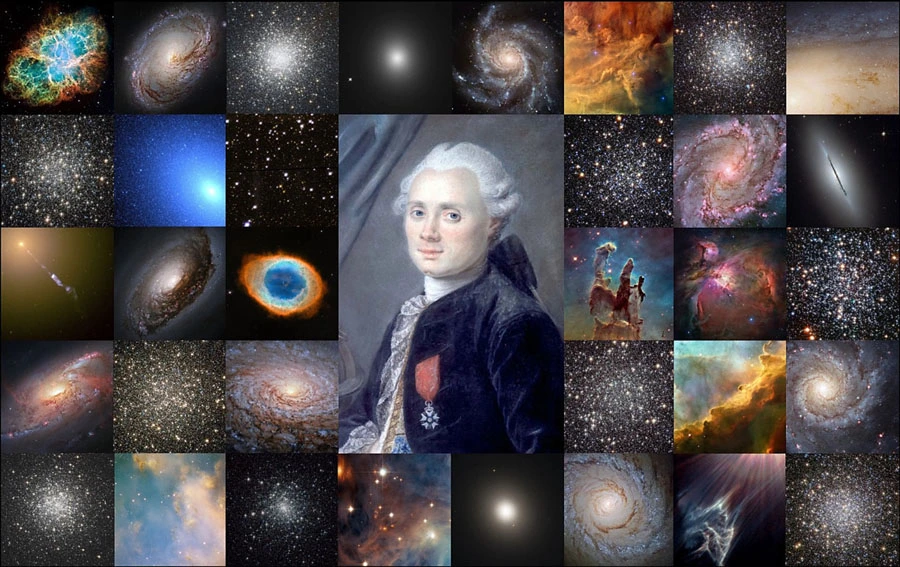
Nearly a century later, Charles Messier, the famed French comet hunter and creator of the Messier catalog, was examining reports of previously reported nebulae not yet included in his list of comet impersonators. He was aware of Hevelius's nebulosa and sought it in his telescope. Here's his report:
"The same night on October 24-25, [1764] I searched for the nebula above the tail of the Great Bear, which is indicated in the book Figure of the Stars, second edition. Its position in 1660 was right ascension 183° 32′ 41″, declination +60° 20′ 33″. By means of this position, I found two stars very near each other and of equal brightness, about 9th magnitude, placed at the beginning of the tail of the Great Bear. One can hardly distinguish them in an ordinary [nonachromatic] refractor of 6 feet [length]. Their position is 182° 45′ 30″, +59° 23′ 50″. We presume that Hevelius mistook these two stars for a nebula."
Messier found no nebulosity associated with the pair. He measured its position and included the object in his catalog as M40. Odd, considering that Hevelius's catalog was based on naked-eye observation and neither star is visible without a telescope. Was Messier unaware of this fact? Odder yet, the right ascension and declination listed by Hevelius point to 74 and 75 Ursae Majoris as the source of nebulosity. Assuming Messier precessed the coordinates, he would have arrived at this brighter, wider "pair," not the much fainter duo of HD 238107 and HD 238108.
Why did Messier include an obviously stellar object he believed was a mistake? I've wrestled with this and suspect that Messier wanted to alert present and future observers to the Polish astronomer's error and also perhaps to put the matter to rest. Whatever his reasoning, he ended up compounding the mistaken observation. Not only was there no nebulous star, but Messier also misidentified Hevelius's find!
The story doesn't end there. After unsuccessful attempts to find the pair by observing greats like William Herschel and William Smyth, M40 appears to have been ignored (or unfound) until Friedrich Winnecke rediscovered it in 1863. The German astronomer included the duo in his Catalog of Double Stars as entry No. 4 or Winnecke 4.
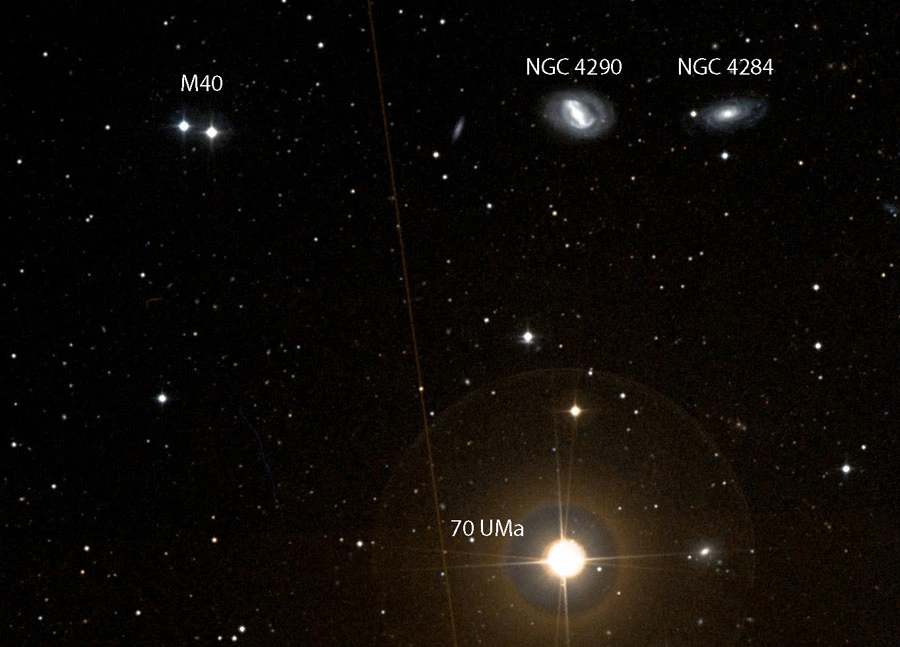
Sloan Digital Sky Survey 9
And so, things stood for more than 100 years. Winnecke 4 essentially replaced M40, which became increasingly forgotten. I've found no mention of it in several popular early 20th-century astronomy books, and it doesn't appear on the Atlas Coeli (Atlas of the Heavens) by Antonin Becvar published in 1962.
In April 1966, Sky & Telescope published a Messier objects list that included M40. But the list provided neither a position nor description, just a reference to a statement by Harvard astronomer and historian Owen Gingerich that the object was a pair of faint stars. This piqued the curiosity of Arizona amateur astronomer John H. Mallas. He contacted Gingerich, who sent him a translation of Messier's original description (quoted above). When Mallas precessed the object's 1764 location to the current era, it was a match for Winnecke 4. M40 was back in the saddle! Mallas sent a letter to Sky & Telescope sharing his discovery, which was published in the August 1966 issue.
There's one more wrinkle. Decades later, parallax measurements released from the Gaia mission in 2018 confirmed that M40 was an optical (physically unrelated) double star, which had been suspected since the early 2000s. That's where things stand today. While questions remain, the story of M40 is a great example of the self-correcting nature of science — even if it took more than 350 years to get most of the puzzle pieces right!
About Bob King
I love the sky (day and night) and have been a skywatcher and amateur astronomer since childhood. I'm also a long-time member of the American Association of Variable Star Observers (AAVSO) and Astronomical League. I pen the Astro Bob blog and have written four books: Night Sky with the Naked Eye (2016); Wonders of the Night Sky You Must See Before You Die (2018) and Urban Legends from Space (2019) and Magnificent Aurora, published in 2024. The universe invites us on an adventure every single night. To accept the invitation, we only need look up.


Comments
Enrico the Great
May 21, 2025 at 3:06 pm
M-40 (Winnecke 4) has always been a sentimental favorite of mine!
You must be logged in to post a comment.
Enrico the Great
May 21, 2025 at 5:20 pm
Thanks for the article----GOOD ONE!
You must be logged in to post a comment.
Bob KingPost Author
May 22, 2025 at 2:19 pm
Thanks so much, Enrico. I appreciate that.
You must be logged in to post a comment.
Andrew James
May 21, 2025 at 8:28 pm
My own suspicion is that M 40 is actually the galaxy NGC 4500, which has a small moderately bright core. (13.1b mag, 1.6′x1.4′, Type SAB) it certainly meets the description of a hazy star and could be construed as comet like.
If its given position in 1660 was right ascension 183° 32′ 41″, as Messier says, but the value was 184° instead of 183°, the position does correspond fairly well with NGC 4500. NGC 4500 position is RA 12h 18m 03s + 59° 30′ 25″ (1660) or 184.514° or 184° 30′ 50″ merely 2′ diff. Messier's declination he says was +59° 23′ 50″ and is reasonably comparable.
Transcription errors are very common in the old catalogues of stars, and it was far more common to use these catalogues and jut offset their positions to the selected deep sky object. It is plausible that's what happened in this situation.
Note: Position of NGC 4500 and M 40 is 1.6° away in PA 94°.
You must be logged in to post a comment.
Bob KingPost Author
May 22, 2025 at 2:00 pm
Hi Andrew,
Thank you for your comment. It's possible, but at magnitude 12.5 I suspect that NGC 4500 would have been too faint for Messier's telescope. In any case, what he did see, he reported accurately, and it matches Winnecke 4.
You must be logged in to post a comment.
Andrew James
May 23, 2025 at 5:23 am
Interesting problem. You realise that the star TYC 3847-713-1 of 10.4 visual magnitude lies just 58 arcseconds away in the same direction. I estimate that the visual magnitude of the galaxy in its core is about 10.6v and similar to the brightness of the star, brighter because it is a starburst galaxy, this seems reasonable. I did a Bayesian analysis of the probability of having a wrong position, which was fairly high. I also made some isophotes of the galaxy, indicating a brighter 10.4V magnitude. Very interested in what you think.
You must be logged in to post a comment.
Bob KingPost Author
May 25, 2025 at 3:08 pm
Hi Andrew,
It's an interesting analysis, but I'm still skeptical. Though a 10.6 (or 10.4) magnitude star would have been visible in Messier's telescope, the core is still an extended object and would appear fainter, somewhat diffuse and less distinct than neighboring TYC 3847-713-1. Stars have a "hard" appearance, whereas extended galactic nuclei like the one in NGC 4500 look soft. Messier reported no nebulosity associated with his M40. The other issue is position. Messier's position matches the "two stars" that comprise Winnecke 4. He also describes M40 as two stars without nebulosity. NGC 4500 is 1.2 degrees from Messier's M40 coordinates — that would be a pretty big error for such an accomplished observer to make.
It wouldn't be difficult to check NGC 4500 and TYC 3847-713-1 through a small 4-6-inch telescope (similar to Messier's) and see how readily visible the galaxy is compared to the star. If you like we can both do this and compare observations at a later date.
You must be logged in to post a comment.
Snazu
May 22, 2025 at 8:26 am
Good old Burnham's Celestial Handbook (1978) included a nice 1 page+ article on M40. While the Handbook suffers from not having been updated it is still a unique and wonderful reference.
You must be logged in to post a comment.
Bob KingPost Author
May 22, 2025 at 1:56 pm
Hi Snazu,
I agree! In writing the article I checked Burnham's to make sure it was being reported as M40 when the set was published in 1978. Of course, Robert did a great writeup.
You must be logged in to post a comment.
Ross Shuart
May 23, 2025 at 1:45 pm
Two other items about M 40 may be of interest.
The Bernhard, Bennett and Rice book "New Handbook of the Heavens", McGraw-Hill, 1941, 1948 has Appendix IX, "Messier Objects" containing an entry for M 40 with a position of 12:19.8 +58:23 (B1950). This is the position of WNC 4. In the "Type of Object" column, the brief description says "Likely 2 stars". This isn't early 20th-century, but it does indicate some awareness of the nature of this object prior to Mallas' correspondence with Gingerich.
WNC 4 is included in S. W. Burnham's 1906 double star catalogue as BDS 6146. There is nothing mentioning Messier. Burnham's position is a little off: 12:16:26 +58:45 (B1900). Precessing the WDS position to 1900 gives 12:17:24.2 +58:38:16. Perhaps the RA is a minute off because of a typo, but the declination difference seems odd.
You must be logged in to post a comment.
Bob KingPost Author
May 25, 2025 at 3:26 pm
Hi Ross,
Excellent detective work. Thanks for sharing the 1948 reference. I read "New Handbook of the Heavens" back in the '60s but no longer have a copy. The 1948 publication date makes it even stranger why M40 wasn't better described in the 1966 Sky & Telescope article. Regarding the Burnham declination being off nearly 7 arc-minutes, looks like you've opened up another small mystery.
You must be logged in to post a comment.
You must be logged in to post a comment.