 SUNSET:

 0
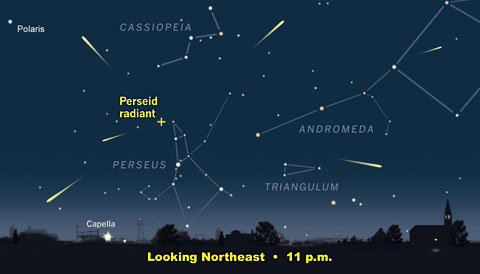
0How well defined is a meteor-shower radiant? Is it a point on the sky or a several-degree-wide spot?
Sky & Telescope
Radiants are spots, not points. A meteor shower’s radiant is the location on the sky where all the meteors would appear to come from if we could see them approaching in the very far distance. However, the members of a meteoroid stream do not travel perfectly in parallel; over the centuries their orbits become increasingly scattered. Their nonparallel paths mean that the shower’s perspective point is not really a point.
For example, the International Meteor Organization’s Handbook for Visual Meteor Observations lists radiant diameters of 3° for the Perseids, 2° for the Leonids, 4° for the Geminids and Eta Aquarids, “complex” for the Orionids and Taurids, and “diffuse” or unknown for many others.
— Alan MacRobert
About Alan MacRobert
Alan M. MacRobert became an avid Sky & Telescope subscriber in 1966 at age 14, joined the editorial staff in 1982, and is now a senior contributing editor, semi-retired. He played a role in practically every part of the magazine and the company's other products for more than a generation, both on the amateur-observing side and the science-reporting side. In 1994 a book collection of his observing how-tos and telescopic sky tours was published as Star Hopping for Backyard Astronomers. He has produced This Week's Sky at a Glance online every week since 1989.


Comments
You must be logged in to post a comment.