 SUNSET:

 1
1
University of Toronto
On New Year’s Day, 1951, in her home outside Toronto, Helen Sawyer Hogg took a look in on her sleeping husband, who had been recovering from bronchitis. To her shock, she found him dead. By nightfall, she was, at 46, a widow with three teenagers.
Yet even in acute grief, she brought her long career in the science of astronomy on a new path, becoming a phenomenon of postwar Canada: a gentle guide who swept her hand to the sky and promised that the stars are for everyone.
Helen Sawyer Hogg ranked then at the forefront of a small but growing force of woman astronomers in the first half of the 20th century. Her lifelong study of variable stars in globular clusters broadened the understanding of these beacons. Adoring students filled her university lectures. Professional groups sought her leadership.
Yet male colleagues addressed her as Mrs. Hogg, not Dr. Hogg. She was chronically underpaid. She did her research at night in cold observatories while raising a family, and the demands nearly drove her out of her field.
Her husband, also a famous astronomer and her biggest fan, encouraged her to keep going. When he died too soon, a key piece of his legacy came into her hands, and in the Hollywood sense of the phrase, a star was born.
Helen Battles Sawyer arrived August 1, 1905, into an old Unitarian family of Lowell, Massachusetts, that educated its women. She was precocious, in love with nature, played the piano and spoke French. At 16, she enrolled at Mount Holyoke College as a chemistry major. Then she witnessed the total solar eclipse of Jan. 24, 1925.
“Despite my horribly cold feet standing in nearly a foot of snow,” she wrote later, “the incredible beauty and grandeur of a total eclipse tied me to astronomy for life.”
Helen came to the notice of Harlow Shapley, director of the Harvard College Observatory, and he awarded her a $650 fellowship to pursue a doctorate with him, studying star clusters.
In these dense stellar neighborhoods, also called globular clusters, some stars brighten and dim, on their own or because something else is acting on them. By the late 1920s, astronomers used that variability to measure galactic distances.
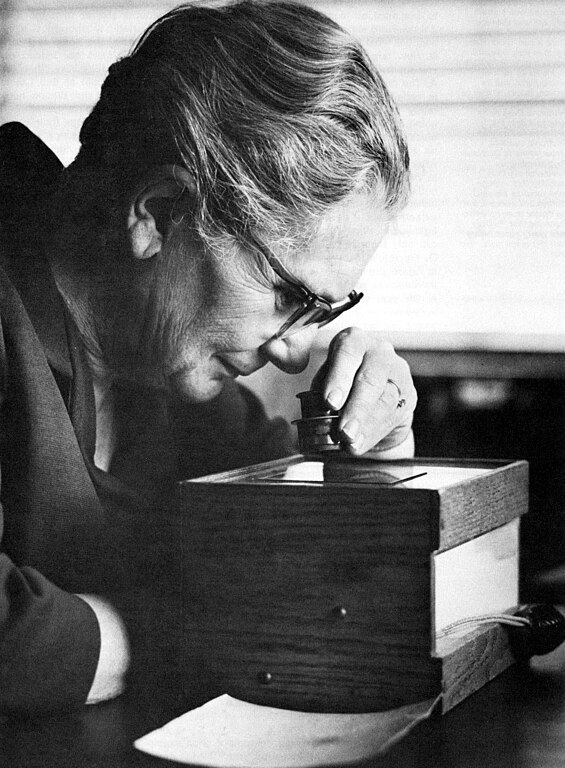
Observing and photographing globular clusters demanded hours at the eyepiece, tweaking the telescope’s Newtonian focus. Under Shapley’s direction, Helen catalogued every variable star she captured and, ahead of her PhD from Radcliffe College, her name appeared on a dozen papers.
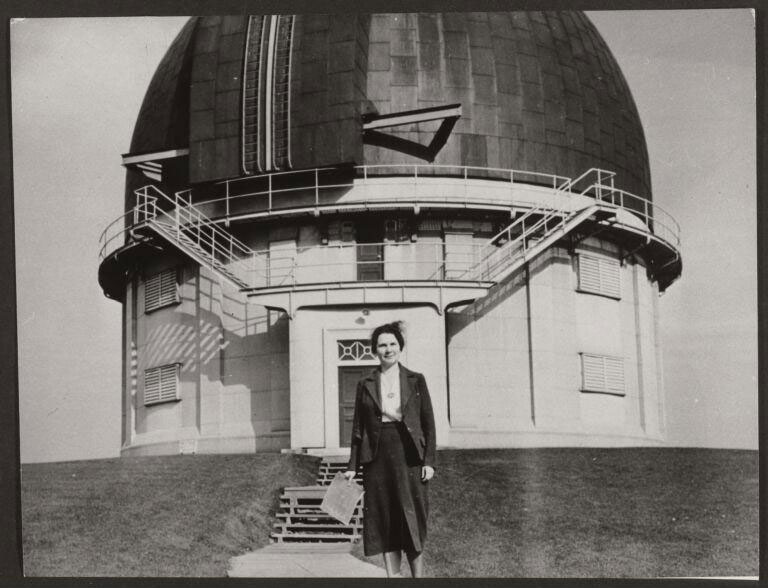
Wolbach Library / Harvard University
Playing matchmaker, Shapley introduced Helen to another Harvard doctoral candidate in astronomy. Frank Scott Hogg was the brilliant son of the town doctor in Preston, Ontario, and earned top honors at the University of Toronto. Rheumatic fever in boyhood had damaged his heart, so when the Hoggs married in September 1930, they knew their time could be brief.
A year later, in their Model A Ford coupe, the Hoggs drove more than 3,000 miles west to Victoria, British Columbia and the Dominion Astrophysical Observatory, where Frank was hired as a staff scientist. There was no job for Helen despite her resume. Amid the Great Depression, the government did not hire married couples together.
But observatory Director J.S. Plaskett gave Helen access to the 72-inch reflecting telescope, and she wasted no time. After barely a month at Dominion, she and Frank took their first photographs of globular clusters. That success set her observatory routine:
“I stayed all night, and after each exposure let the plate holder down in an old leather handbag to the observers on the floor below, who swiftly in the darkroom replaced the exposed plate with a fresh one, and I hauled the bag back up again.”
On the summer solstice 1932, the Hoggs welcomed their first child, a daughter, Sally. With a $200 grant from Plaskett, Helen hired a housekeeper. A month after giving birth, Helen returned to the observatory carrying a swaddled Sally in a basket.
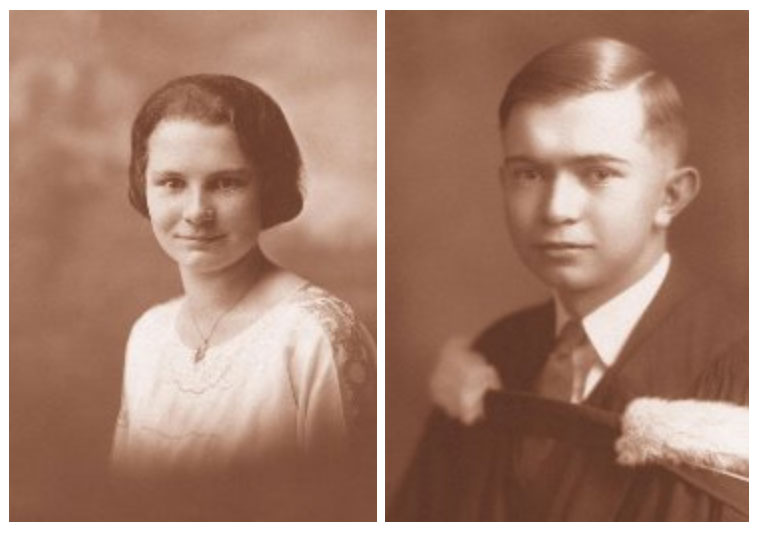
Harvard College Observatory
The Hoggs were so settled in Victoria that Frank declined a job at Harvard. Then the University of Toronto recruited him as a staff scientist to open its David Dunlap Observatory in 1935.
The new 74-inch reflecting telescope surpassed Dominion as the largest in Canada and second-largest in the world. Helen received permission to use it.
In farewell, the in-house Dominion newsletter reported that the local astronomical society hosted a dinner for “Dr. and Mrs. Hogg.”
The Hoggs moved into the Toronto suburb of Richmond Hill in walking distance of the Dunlap. In 1936, the university hired Helen as a research officer, and the Hoggs’ second child David was born that year. James arrived the next.
Maria J. Cahill, professor of English at Husson University in Bangor, Maine, in writing a soon-to-be-released biography of Helen Sawyer Hogg, said that once, when Helen got a raise, the university put the money into Frank’s paycheck.
In 1939, while chasing three young children, Helen published her definitive catalogue of variable stars in globular clusters. Built on her meticulous research, the catalogue carried data on 1,116 variables. She published updates in 1955 with 1,421 variables, and in 1973 with 2,119 variables. She discovered more than 100 variable stars herself.
Frank Hogg’s bad heart kept him from World War II service, but he was a tireless teacher and administrator. In 1941, a colleague who was about to ship out asked Frank to take over “With the Stars,” the weekly astronomy column for the Toronto Star.
With more than 400,000 daily readers then, the Star was Canada’s biggest and most influential newspaper. Frank wrote the column for 10 years, as he became Dunlap’s director and head of the university astronomy department. Helen often helped Frank with the column. Sometimes, she wrote it for him while juggling her teaching load, her research, and her family.
The Hoggs were outdoorsy bird watchers. Helen baked hermit cookies for meetings and school events. When she learned that someone was expecting a baby, Helen knitted booties that fit so securely, no little foot could kick them off.
Like most working mothers, she often felt overwhelmed, and Cahill says she contemplated quitting astronomy because “there was too much on her plate.”
“But she was really lucky that she grew up in this time period when, yes, most of the world was extremely prejudiced against women, but she was around a lot of men and some women who were extraordinarily supportive and gave her an incredible amount of encouragement.”
Especially her husband. And her teacher: In a low moment, Helen wrote to Harlow Shapley of wanting to decline a major astronomy prize she received. “It does not look so good to take the award and quit!”
The self-deprecating Shapley, a lion of American astronomy, urged her to accept the prize, for she had earned it.
“Suppose I should commence turning in medals because I have degenerated into being just a blank, blank director, personality smoother, instigator of labors by others,” he wrote. “Let’s both cheer up.”
At Christmas 1950, Frank Hogg developed bronchitis that worsened, and on Jan. 1, 1951, he died of a heart attack at home at 46. A devastated Helen aimed to be strong for Sally, 19, David, 16, and James, 14.
“Helen understood the terrific loss of Frank for their children,” Cahill says. “She wanted to protect them as much as possible and reassure them that their lives would move forward as planned.”
The death also worried the column’s readers that without an immediate successor, the Star might drop “With the Stars.” They pushed for Helen, and the Star offered her $5 a week, which she accepted. Her first byline ran 12 days after her husband’s death. The headline on the tribute column was simply, “Frank Scott Hogg.”
Helen would write “With The Stars” for 30 years, and the platform elevated her in popular culture. She never ran out of ideas – sunspots, quasars, pulsars, moon phases, planets, telescopes under construction. Every December, she wrote about the Star of Bethlehem. She often spoke to groups and on television; the camera loved the confident scientist in cat’s-eye glasses and sensible cardigan.
But a column is a weekly grind, on top of her other tasks. Once, 12 years in, Helen published a farewell. Readers responded in "a flood of touching letters, each one of which made me feel more guilty at abandoning the column.” She resumed a week later and never missed another deadline.
In 1955, on leave from the university, Helen served as a program director at the National Science Foundation in Washington, D.C. She returned to the university in 1957 a full professor. She was elected president of the Royal Astronomical Society of Canada, a title Frank had held. Her newspaper columns led to celebrity, and her classes were packed not just with astronomy majors.
“Helen was as happy introducing arts students to the wonders of the universe as she was discussing complexities in small graduate seminars with rising scientists,” Dr. Christine Clement, a graduate student with Hogg, told a university publication.
Clement later recalled a dinner at Hogg’s home for the women who worked or studied at the David Dunlap Observatory. After the meal, Hogg showed slides of her recent trip to Samarkand in central Asia, sending the message, Clement said, “that women could have their own interesting and rewarding lives – a novel idea in the early 1960s.”
As a leader of Canadian astronomy, Hogg’s travel schedule accelerated, yet physicist Inge Juliana Sackmann-Christy recalled she was “never too busy to send to her colleagues baby booties at the births of their children with the label inside, ‘Hand Knit by Helen Sawyer Hogg.’ ”
She was knitting for grandchildren now. Sally settled with her family in Richmond Hill, not far from Helen. David followed his parents into astronomy. James became a teacher.
In 1971, Helen was elected the first president of the new Canadian Astronomical Society as a consensus candidate, Cahill says.
“There had been a lot of arguing before it came together. They needed someone who was experienced, dedicated, and could get along with pretty much everybody, and everyone united under Helen. She brought people together. She was a uniting presence.”
In 1976, Helen retired as professor emeritus and published a book based on her newspaper column, titled, The Stars Belong to Everyone: How to Enjoy Astronomy.
“Although the telescope has added enormously to our understanding of the heavens, we should not make the mistake of thinking that we must always have one at hand to enjoy the sky,” she wrote. “Anyone can follow the beautiful and interesting events in the sky without a telescope. For the stars belong to everyone.”
In January 1981, at 76, she set aside the column for good, and the honors rolled in from her nation and her peers. Canada’s astronomical societies established the annual Helen Sawyer Hogg lecture on her contributions. The National Museum of Science and Technology named its Ottawa observatory for her. Asteroid 2917 was named Sawyer Hogg. She received the highest civilian honor, companion to the Order of Canada.
When Helen turned 80, she married a longtime friend, Francis E. L. Priestley, university professor emeritus of English. He died three years later.
On Jan. 28, 1993, Hogg died at 87, grandmother of 10, great-grandmother of six, and author of more than 200 professional papers. Terence Dickinson, who followed Helen in writing “With the Stars,” devoted his next column to her.
The Royal Astronomical Society of Canada noted that Hogg was a member more than 60 years and the only one to speak at the 1933 and the 1980 conventions. Her students, many of them well into their own distinguished careers, remembered the teacher who led by example.
“Helen Hogg is often held up as a role model to young women scientists, and rightly so,” wrote astrophysicist Sara Seager. “But it should not be forgotten that her sheer delight and enthusiasm for her subject was just as inspiring as anything; you couldn’t help but become caught up yourself.”
Anne Saker, a daily journalist for 40 years who lives in Cincinnati, was a member of the Cincinnati Enquirer team that earned the 2018 Pulitzer Prize in local reporting. In 2023, she was inducted into the hall of fame of the Greater Cincinnati Society of Professional Journalists. Contact her at [email protected]
About Anne Saker
Anne Saker ([email protected]) is a Cincinnati writer.


Comments
Dan Pernokis
September 18, 2024 at 10:33 pm
I used to read Dr Hogg's column faithfully every week through the 60's and 70's -- I grew up in Toronto -- and she's a major reason for my interest in astronomy to this day!
You must be logged in to post a comment.
You must be logged in to post a comment.