 SUNSET:

 3
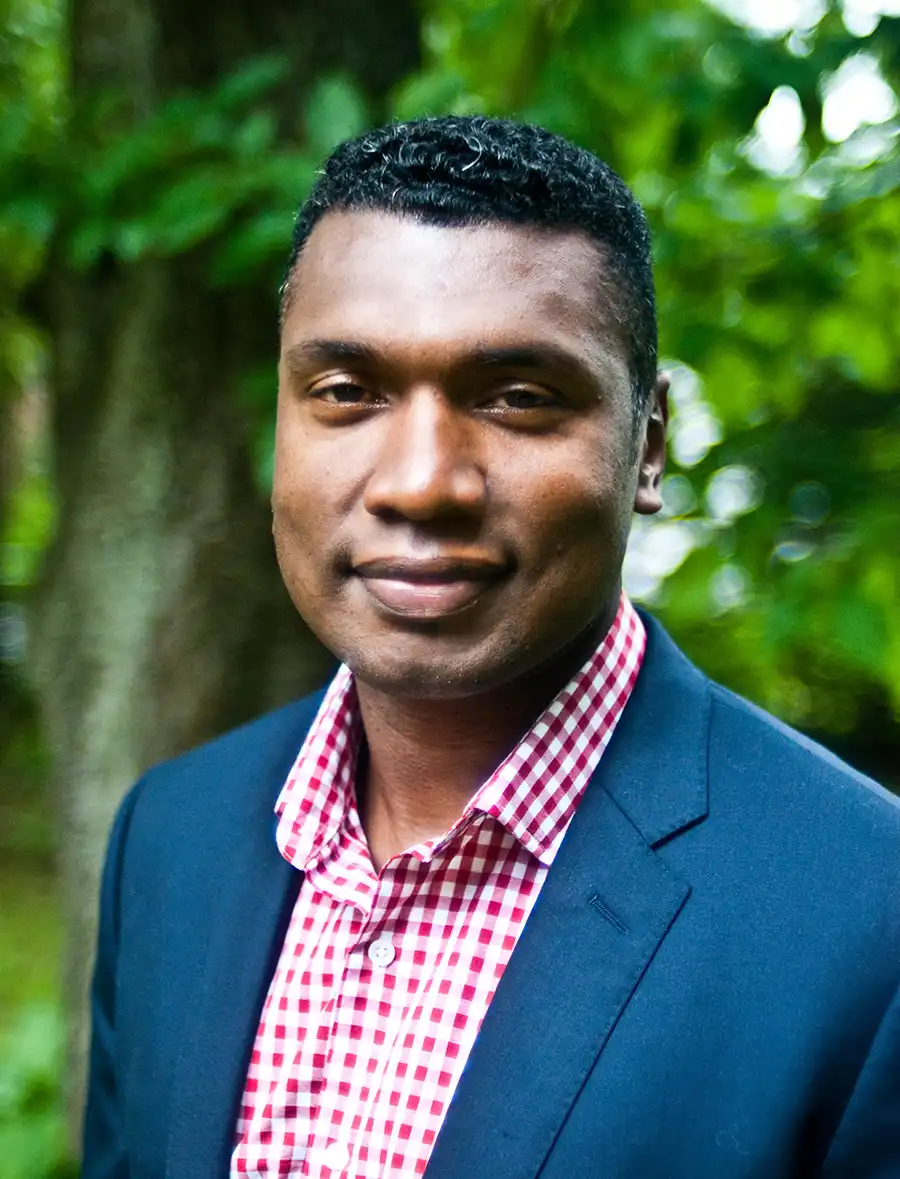
3A fight against conventionality has driven cosmologist Stephon Alexander on a groundbreaking journey through theoretical physics.
Most mornings, with his teenaged daughter off to school, coffee finished, and a day of equations ahead, physicist Stephon Alexander picks up his saxophone. He runs his fingers over the keys. He draws breath. He practices.
Music has driven Alexander, 54, on his groundbreaking journey in theoretical physics. He has brought jazz and science together in best-selling books and public appearances at lecterns and in nightclubs. Through TED Talks, podcasts, and YouTube videos, he has described to millions of people the complementary power of music and math to expand our appreciation of the universe.
That power applies to people, too, Alexander has learned.
“My advisor, Nobel laureate Leon Cooper, once told me, ‘Why should I only talk to people who know what I know?’”
Alexander believes that scientists have a duty to bring in young people, and in 2024, he brought his life’s pursuit to a new focus. He founded an innovative New York City program for economically disadvantaged public high school students, using hip-hop and jazz as a prism to understand physics, coding, and mathematics. Alexander tells Sky & Telescope that the program, named Science + Sound, “is something I would have loved to experience as a young person.”
Meeting life-shaping forces
Born March 30, 1971, in the Caribbean nation of Trinidad, Stephon Haigh-Solomon Alexander spent his childhood on the beach. His father Keith was a computer technician and cab driver and his mother, Felician, a nurse. When Stephon was 8 years old (and thought slow by his teachers), the family emigrated to New York City for his schooling.
He missed his native island, but in the Bronx, Alexander would meet the forces that would shape his life when at 12, he picked up the saxophone. By the time he was in high school, at the famed DeWitt Clinton High School in the Bronx, Alexander was hanging out at the legendary hip-hop studio Strong City, a creative, innovative space that welcomed teenagers who might otherwise have roamed the streets.
But science also appealed to Alexander. On the first day of 10th-grade physics, teacher Daniel Kaplan simply tossed a ball into the air and caught it, over and over. The class stared. Kaplan asked: What’s the ball’s velocity when it lands?
No answer. Then, inspired, Alexander raised his hand. At Kaplan’s nod, he replied: the same velocity as when it left your hand. “Come to my office after class,” Kaplan said. There, Alexander saw photos of Albert Einstein and John Coltrane. Kaplan showed him that it wasn’t a question of music or science. He could choose all of it.
“He had the courage to think differently,” Alexander says. “He challenged us to live a life full of improvisation.”
Through Kaplan’s class, Alexander discovered the Pythagoreans and the “music of the spheres” that those philosophers believed governed the movement of the planets and stars. Even the ancients had heard this harmony of music and science, he realized.
Leaning into what he heard
After obtaining a bachelor’s degree in physics at Haverford College in 1993, Alexander went to Brown University as one of three Black doctoral candidates in physics in the country. The isolation of the coursework was intense. Students excluded him from study groups. Then he froze during a mid-term exam. Demoralized, he left school and returned to Trinidad. In the balm of home, he went through his research and realized he really was onto something. Three months later, back at Brown, he aced his finals and went on to earn his PhD.
In 2001, Alexander published independent work on a string-theory model for inflation. Strings are one-dimensional filaments of energy, and in his alternative view of the Big Bang, the early universe emerged from a destructive event or force at the end of a string, a point called a D-brane, like a bubble popping.
Alexander did postdoctoral fellowships at Imperial College, London, and the Stanford University Linear Accelerator Center. Even in those places, Alexander met physicists who were hidebound and inept with an unusual colleague. Often, they ignored him while he was speaking. Eventually, he stopped going to the office.
“If you’re a Black person, we’re still not used to really valuing our intellect, and that what we might be bringing to the table simply by being us could be valuable in terms of advancing the science,” Alexander told The Guardian in 2021. “There’s a real presumption that there’s nothing or very little to be of value, except maybe for us to entertain them.”
Instead, Alexander took his science into London’s jazz clubs and found a mentor in composer and artist Brian Eno. The physicist sat in with musicians to explore the universe as jazz: Rhythm competes with harmony in cyclic repetition, allowing the improviser to try something new each time.
The music served as inspiration. Perhaps there wasn’t one Big Bang, Alexander realized, but a succession, and in each, the universe riffs on different laws on nature.
Reaching a wider public
Alexander landed at Penn State with his research and his saxophone, then Haverford College, then on to Dartmouth University as the Ernest Everett Just Distinguished Professor, and ultimately back to Brown in 2016 with tenure in the physics department. He lives with his daughter, Kolka, who is in high school.
He was recently elected director of Brown University’s Center for Theoretical Physics He attributes his career progress to scientists who “fostered an environment that enabled me to do my best theorizing while cultivating both rigorous technical skills and a spirit of imagination.”
His roll call of mentors is long and distinguished, including Nobel laureates Leon Cooper and Michael Kosterlitz; his Ph.D. advisor Robert Brandenberger; João Magueijo and Kellogg Stelle at Imperial College, and Michael Peskin and Helen Quinn at SLAC/Stanford.
“I feel incredibly fortunate for the opportunities and challenges I’ve had; they’ve shaped me into who I am today,” he says.
He has published more than 120 papers, book chapters, and other scientific writing. But his 2016 book “The Jazz of Physics” put his decades of work in front of a wider public audience.
“Although it is important for both jazz musicians and physicists to strive for technical and theoretical mastery in their respective disciplines,” he writes, “innovation demands that they go beyond the skill set they have mastered.”
The New York Times assigned the book’s review to jazz musician Dan Tepfer, who observed that Alexander’s “more poetic ideas about music can be powerful, like his speculation ‘that the reason why music has the ability to move us so deeply is that it is an auditory allusion to our basic connection to the universe.’ This not only feels true; it is what musicians live for.”
Alexander has served as president of the National Association of Black Physicists. He has given more than 100 lectures, and he found an appreciative audience online, posting video discussions about quantum mechanics or hip-hop’s embrace of technology. The saxophone stands always handy for improvisation.
He has also performed and collaborated with other musicians who play with big ideas: drummer Will Calhoun, pianist Marc Cary,bassist Melvin Gibbs, guitarist Vernon Reid, percussionist Ronnie Burrage, andcomposer-futurist Jaron Lanier.
In 2021, his second commercial book, The Fear of a Black Universe, argues that science holds itself back with its institutional unwillingness to embrace outsider thinking. He aimed the book “to serve as a source of inspiration and encouragement for individuals who feel disenfranchised and unwelcome in our scientific communities, people who are sometimes, or often, made to feel that they are not valued as contributors to the scientific endeavor.”
Building on all of the ideas
In 2023, he finally had the chance to build on everything he’d been talking and writing about. With a grant from the Simons Foundation, Alexander partnered with the Hip Hop Museum in the Bronx to develop Hip Hop Science, a program that would help young people dive into scientific inquiry through hip-hop and technology. With the project, Alexander wanted to honor his high school teacher Kaplan; Jim Simons, a mathematician, philanthropist and jazz lover; and the wide-open intellectual energy at Strong City studios.
A year later, the program landed in a brick-and-mortar home inside a Union Station tech incubator under the name Sound + Science. Seventy students have gone through the 20-week coursework with modules such as “The Hidden Codes in Electronic Music,” “From Hip-Hop to AI,” and “Music Improvisation and the Evolution of the Mathematics of Computation.”
For years, Alexander says, he wanted to help students who are now as he once was. “Combining the love of music and science is the answer,” he says. “The dream has come true.”
Taking a lesson for himself
Now, as he picks up the saxophone every morning, Stephon Alexander practices less to follow a particular thought and more to work on his breathing.
The thing he loves most about jazz is its freedom, its license to explore anything. But recently, Alexander has come to see new value in the counterweight of discipline. He spends his day with his university students, improvising with physics. Then, one or two evenings a week, he calls one of his music teachers with sax in hand, and he takes a lesson.
About Anne Saker
Anne Saker ([email protected]) is a Cincinnati writer.


Comments
John Ray
September 30, 2025 at 4:39 pm
What a beautiful article. Thank you.
You must be logged in to post a comment.
Michal
September 30, 2025 at 8:25 pm
I agree! The complimentary power of music & physics has a long tradition with Bose, Einstein up to current era of May and Cox.
You must be logged in to post a comment.
Michal
September 30, 2025 at 8:27 pm
correction: complementary
You must be logged in to post a comment.
You must be logged in to post a comment.