 SUNSET:

 0
0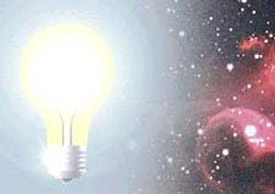
Light pollution illustration.
Sky & Telescope illustration.
Comet watchers today face a problem that did not exist when our great-grandparents witnessed the impressive comets of the late 19th and early 20th centuries: light pollution. In fact, light pollution has spread so much in the last few decades that it compromises the view of the universe for an estimated 90 percent of Americans. For about half of us, the stars in the night sky no longer really come out at all.
Is Light Pollution Inevitable?
Yet, most light pollution is unnecessary. It is not an unavoidable result of having well-lit streets and cities. As much as three-fourths of the murky glow you see blotting out the stars at night is waste light that beams directly skyward from light fixtures that are poorly designed or improperly aimed.
A standard security light, for instance, may send a third to half of its rays above horizontal — directly into the sky — rather than down toward the ground where the light does any good. The upward part is pure waste. This waste goes completely unnoticed (except by astronomers), because people who install outdoor lights don't normally inspect their handiwork from high up in the sky at night!
If the fixture is replaced with a well-designed, "full-cutoff shielded" fixture of various styles now available — one that directs all the light down where it's supposed to go — the bulb wattage can be cut by a third to a half for a big electricity saving. The quality of illumination is actually improved, because of the reduction in annoying glare — the near-horizontal beams that dazzle your eyes directly from a bulb. And we regain some of the lost starry heavens.
Further Reading
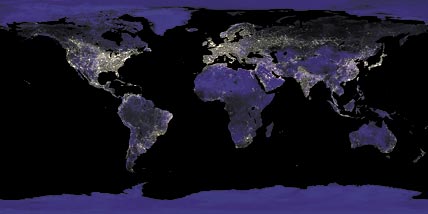
Light pollution plagues astronomers worldwide as revealed in this (otherwise beautiful) nighttime image of Earth from space.
Courtesy Craig Mayhew and Robert Simmon, NASA Goddard SpaceFlight Center.
The United States wastes between $1 billion and $2 billion per year in electricity bills by needlessly spilling light into the sky, according to a study by the International Dark-Sky Association (IDA), a nonprofit group founded to educate the public and industry about light pollution. More on light pollution is available from the International Dark-Sky Association at 3225 N. First Ave., Tucson, AZ 85719. Sky & Telescope supports the IDA's efforts.
For information on educating children on the effects of light pollution, read There Once Was A Sky Full Of Stars.
About Alan MacRobert
Alan M. MacRobert became an avid Sky & Telescope subscriber in 1966 at age 14, joined the editorial staff in 1982, and is now a senior contributing editor, semi-retired. He played a role in practically every part of the magazine and the company's other products for more than a generation, both on the amateur-observing side and the science-reporting side. In 1994 a book collection of his observing how-tos and telescopic sky tours was published as Star Hopping for Backyard Astronomers. He has produced This Week's Sky at a Glance online every week since 1989.


Comments
You must be logged in to post a comment.