 SUNSET:

 0
0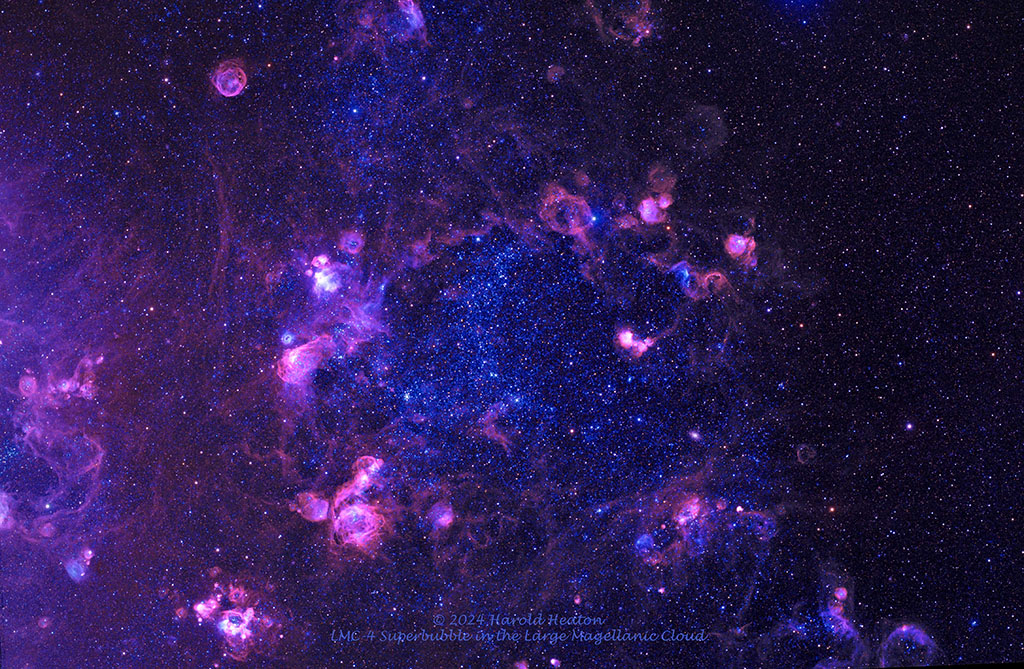
Photographer:
Hal Heaton
Location of Photo:
Gamsberg Mountains, Namibia (Skygems)
Date/Time of photo:
September-December 2024 (4-nights)
Equipment:
Takahashi FSQ-106 refractor (106 mm aperture, f/5); Mooravian C3-61000 CMOS camera (2x2 binning, unguided); Baader filters (R, G, B, H-alpha, OIII)
Description:
The LMC has a large number of giant shells spread across its expanse that span diameters of about 20 to 260 pcs, and 9 much-larger superbubbles that likely have a different origin and evolutionary history. The largest of the latter, LMC-4, is situated in the northeast part of that galaxy, and spans about 1400 x 1000 pc. Its nearly circular rim is dotted with filamentary HII regions brimming with young stars and associations, and a great arc of young blue stars known as Shapley’s Constellation III populates a large portion of its interior. An extensive HI ridge surrounds the entire region with a diameter of about 1600 pc, with the most prominent HI void in the entire LMC at its center. The Tarantula Nebula and the site of SN 1987A lie just off the left-edge of the frame (E is up, N right).
