 SUNSET:

 0
0
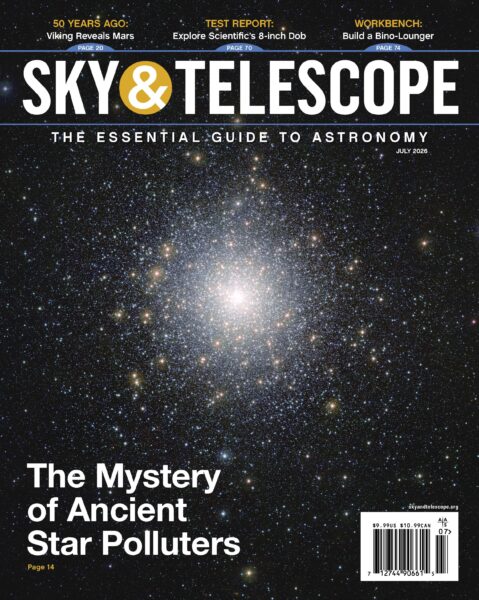
Ancient Star Polluters, Small Observatories, and Viking Touchdowns
In the July 2026 issue of Sky & Telescope, astronomers have been studying the composition of stars in globular clusters, but the results weren’t adding up. Turns out, globulars might form their stars in waves, with early ultra-massive stars “polluting” some of the stars we see today. Take a look for yourself: We have three globular clusters for you to explore this month, along with a plethora of double stars and other deep-sky objects — all found in some of the night sky’s smallest constellations. So join our travels to small observatories across the U.S. that have spent the past two centuries pairing astronomical research with public outreach. For an amateur-built version, we’ll head to Virgina for a look at a stunning mansion built around a fourth-floor observatory with a retractable roof.
FEATURE ARTICLES:
Strange stellar compositions are shedding light on globular clusters’ early years.
By Jan Hattenbach
Fifty years ago, two NASA landers made history when they touched down on the Red Planet.
By Ben Evans
Explore Celestial Vistas Off the Beaten Path
Let’s take a deep dive into some of summer’s smaller constellations.
By Brian Ventrudo
The Clover Hollow Mountain Observatory
This residential rooftop facility puts unusual roof segments to good use.
By Paul Geithner
The Big Role of Small Observatories
How more than 300 U.S. observatories, many now forgotten, changed 1800s science.
By Trudy E. Bell
Beyond the Printed Page:
Build your own bino-chair with these detailed plans.
Receive alerts from this enormous, state-of-the-art observatory.
Watch the Small Magellanic Cloud evolve right in front of us.
Read all about this little-known category of deep-sky objects.
ALSO IN THIS ISSUE:
Stars of Independence and Hope
Celebrate America’s independence this July 4th with Venus, Saturn, and Virgo.
By Stephen James O’Meara
July offers the chance to view five (or six!) planets without the aid of optics.
By Gary Seronik
Distant siblings meet at dawn.
By Bob King
A short star-hop across the Serpens-Ophiuchus boundary reveals a handful of deep-sky treasures.
By Ken Hewitt-White
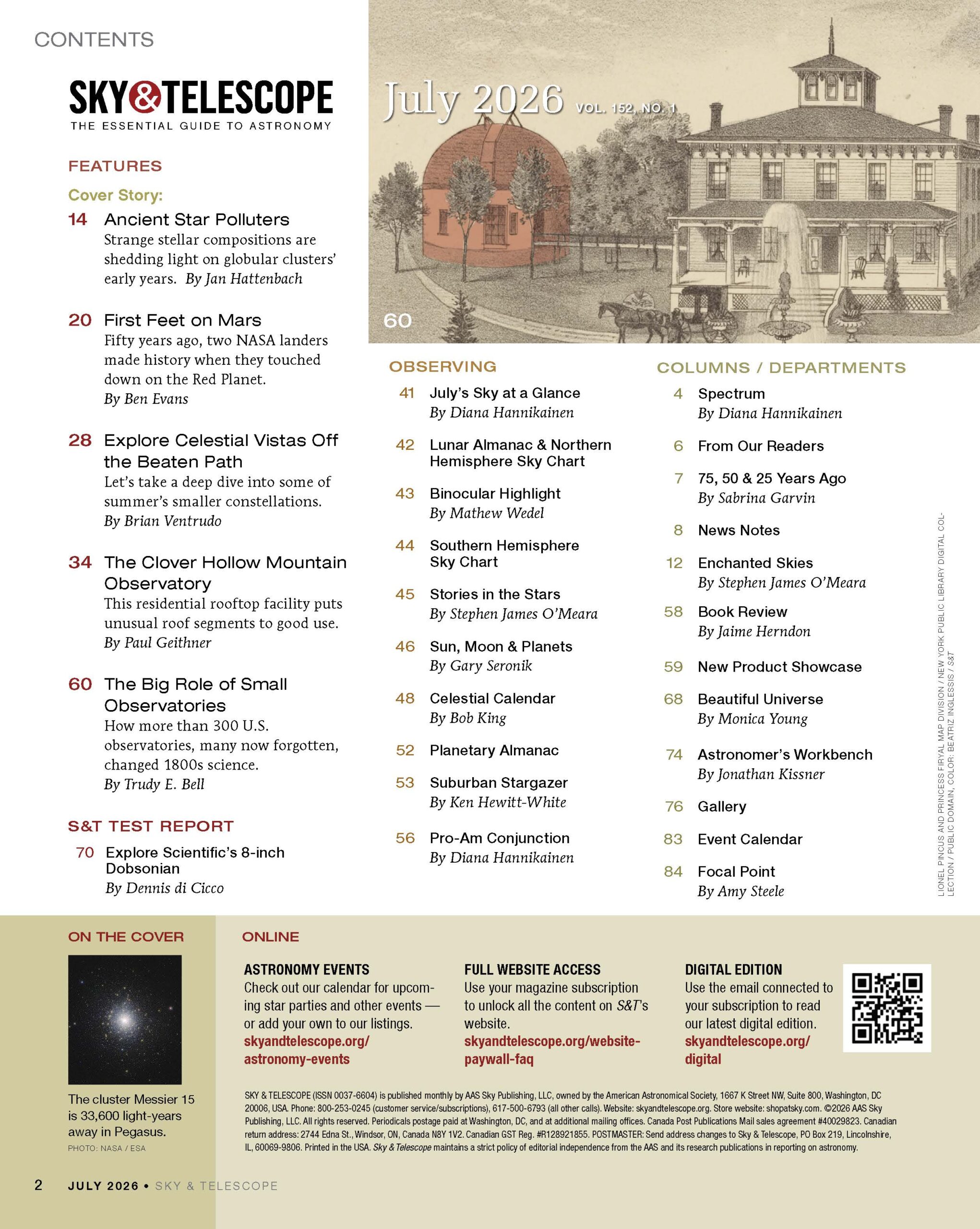
Table of Contents
See what else July’s issue has to offer.

Comments
You must be logged in to post a comment.