 SUNSET:

 0
0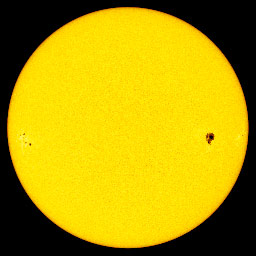
The Sun on May 4th, imaged from space by the Solar and Heliospheric Observatory (SOHO) at 4:29 a.m. Eastern Daylight Time. Click here for an animation of the spot's growth and changes from April 25th to May 4th as the Sun's rotation carried it from the eastern limb across to the western side of the Sun's disk.
SOHO / MDI; animation courtesy SpaceWeather.com.
This year the Sun is on its way to the dullest part of its 11-year activity cycle; solar minimum is due in late 2006. But that doesn't mean nothing's happening! Right now the Sun is displaying a big, complex spot several times larger than Earth.
Sunspot 10756 (or "756" for short) is visible to the unaided eye through a safe solar filter or by the projection method. As of May 4th, it had rotated well past the middle of the Sun's face to the Sun's western side. In the next couple of days it will move closer to the western limb and become more foreshortened.
A solar-filtered telescope shows rich detail in the spot's complicated umbra and penumbra. For more about watching the doings of our home star, see our solar observing section.
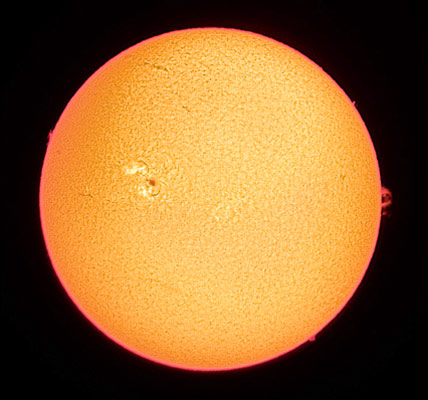
The Sun, with its active region, seen in red hydrogen-alpha light on April 29th. Sky & Telescope assistant editor Sean Walker shot this picture by pointing a Canon A85 digital camera into the eyepiece of a Coronado Personal Solar Telescope.
Courtesy Sean Walker.
About Alan MacRobert
Alan M. MacRobert became an avid Sky & Telescope subscriber in 1966 at age 14, joined the editorial staff in 1982, and is now a senior contributing editor, semi-retired. He played a role in practically every part of the magazine and the company's other products for more than a generation, both on the amateur-observing side and the science-reporting side. In 1994 a book collection of his observing how-tos and telescopic sky tours was published as Star Hopping for Backyard Astronomers. He has produced This Week's Sky at a Glance online every week since 1989.


Comments
You must be logged in to post a comment.