 SUNSET:

 0
0Some daily events in the changing sky for June 13 – 21.
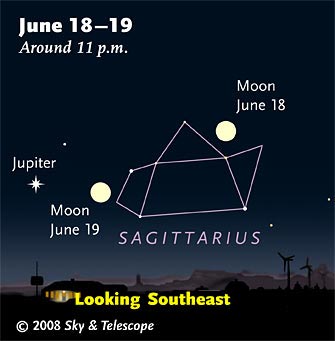
The Moon shines above the spout of the Sagittarius Teapot on the night it's full, and closer to the right of Jupiter the next night.
Sky & Telescope diagram
Friday, June 13
Arcturus looks brighter only because it's nearer: 37 light-years away, compared to Spica's 260. In reality, hotter Spica is 16 times as luminous as Arcturus.
And oh yes, the Moon there is only 1.3 light-seconds away.
Saturday, June 14
Sunday, June 15
Monday, June 16
Tuesday, June 17
Wednesday, June 18
Thursday, June 19
Friday, June 20
In the Northern Hemisphere, this is the longest day and shortest night of the year. The night of summer solstice is traditionally called Midsummer's Night, though this is a misnomer by the modern definition of when the seasons begin and end. Traditionally, on this night spirit creatures were thought to be especially apparent (hence Shakespeare's A Midsummer Night's Dream), and the occasion was celebrated with all-night bonfires.
Saturday, June 21
Want to become a better amateur astronomer? Learn your way around the constellations. They're the key to locating everything fainter and deeper to hunt with binoculars or a telescope. For an easy-to-use constellation guide covering the whole evening sky, use the big monthly foldout map in each issue of Sky & Telescope, the essential magazine of astronomy. Or download our free Getting Started in Astronomy booklet (which only has bimonthly maps).
Once you get a telescope, to put it to good use you'll need a detailed, large-scale sky atlas (set of maps; the standards are Sky Atlas 2000.0 or the smaller Pocket Sky Atlas) and good deep-sky guidebooks (such as Sky Atlas 2000.0 Companion by Strong and Sinnott, the even more detailed Night Sky Observer's Guide by Kepple and Sanner, or the classic Burnham's Celestial Handbook). Read how to use them effectively.
More beginners' tips: "How to Start Right in Astronomy".
This Week's Planet Roundup
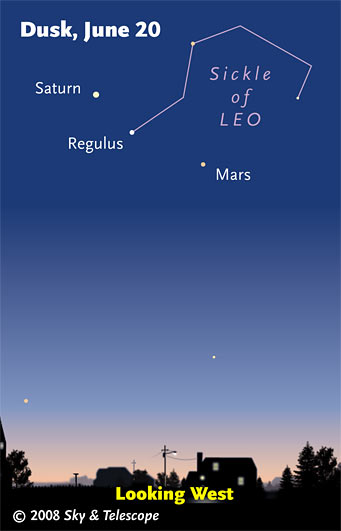
All week, Mars draws closer to Regulus and Saturn in the western twilight.
Sky & Telescope diagram
Mercury and Venus are lost in the glare of the Sun.
Mars (magnitude +1.6, in Leo) is getting low the west after dusk, to the lower right of Saturn and Regulus as shown here. It's closing in on them daily! On June 23rd the three of them will be equally spaced, with each planet just over 4° from Regulus.
In a telescope Mars is a minuscule 4.6 arcseconds wide — a tiny blob.
Jupiter (magnitude –2.7, in eastern Sagittarius) now rises around the end of twilight, left of the Sagittarius Teapot. It gets highest in the south in the early-morning hours.
Saturn (magnitude +0.8, in Leo) glows in the west after dark about 4° upper left of fainter Regulus (magnitude +1.4) as shown here. Look early before they get too low. In particular, get a telescope on Saturn as soon after sunset as you can find it.
Uranus and Neptune (magnitudes 6 and 8, respectively, in Aquarius and Capricornus) are well up in the southeast before the first light of dawn. Use our article and finder charts.
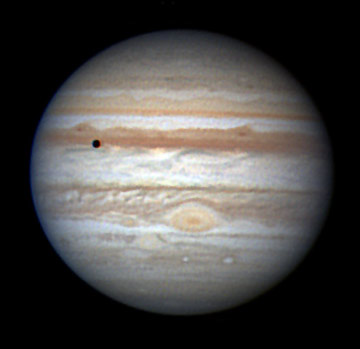
Jupiter on May 24th. The dark North Equatorial Belt is above center. The black dot on it is the shadow of Io. Visible below center are not just one red spot but three; see article. The Great Red Spot remains near System II longitude 121°. North is up (though many telescopes show south up).
Pluto (magnitude 14.0, in northwestern Sagittarius) is highest in the south around 1 a.m., but wait a week or two until the moonlight is gone from the late-night sky.
All descriptions that relate to your horizon or zenith — including the words up, down, right, and left — are written for the world's mid-northern latitudes. Descriptions that also depend on longitude (mainly Moon positions) are for North America. Eastern Daylight Time (EDT) equals Universal Time (UT, UTC, or GMT) minus 4 hours.
----------------------
To be sure to get the current Sky at a Glance, bookmark this URL:
http://SkyandTelescope.com/observing/ataglance?1=1
If pictures fail to load, refresh the page. If they still fail to load, change the 1 at the end of this URL to any other character and try again.
About Alan MacRobert
Alan M. MacRobert became an avid Sky & Telescope subscriber in 1966 at age 14, joined the editorial staff in 1982, and is now a senior contributing editor, semi-retired. He played a role in practically every part of the magazine and the company's other products for more than a generation, both on the amateur-observing side and the science-reporting side. In 1994 a book collection of his observing how-tos and telescopic sky tours was published as Star Hopping for Backyard Astronomers. He has produced This Week's Sky at a Glance online every week since 1989.


Comments
You must be logged in to post a comment.