 SUNSET:

 0
0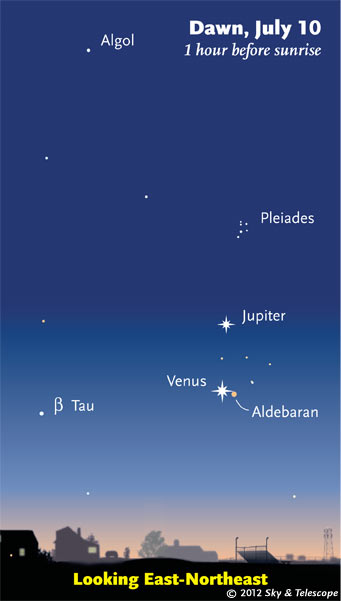
Worth waking up for: Any time this week, set the alarm to catch the dawn planet drama about an hour before your local sunrise time. (If you're on daylight saving time, make sure the Daylight Saving Time box is checked.)
Sky & Telescope diagram
Friday, July 6
See article Predawn Treats for Early Risers for the naked-eye aspect, and to find the asteroids in this scene, Ceres and Vesta: July 2012 – April 2013.
Saturday, July 7
Sunday, July 8
Monday, July 9
Tuesday, July 10
Vega passes the zenith around midnight.
Wednesday, July 11
Thursday, July 12
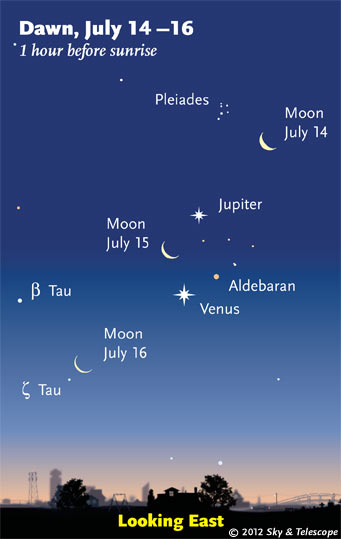
The waning Moon now adds itself to the multifarious dawn scene. (These scenes are drawn for the middle of North America. European observers: move each Moon symbol a quarter of the way toward the one for the previous date. For clarity, the Moon is shown three times actual size.)
Alan MacRobert
Friday, July 13
Saturday, July 14
Want to become a better amateur astronomer? Learn your way around the constellations. They're the key to locating everything fainter and deeper to hunt with binoculars or a telescope.
For an easy-to-use constellation guide covering the whole evening sky, use the big monthly map in the center of each issue of Sky & Telescope, the essential magazine of astronomy. Or download our free Getting Started in Astronomy booklet (which only has bimonthly maps).
Once you get a telescope, to put it to good use you'll need a detailed, large-scale sky atlas (set of charts). The standards are the little Pocket Sky Atlas, which shows stars to magnitude 7.6; the larger and deeper Sky Atlas 2000.0 (stars to magnitude 8.5); and the even larger Uranometria 2000.0 (stars to magnitude 9.75). And read how to use sky charts effectively.
You'll also want a good deep-sky guidebook, such as Sue French's Deep-Sky Wonders collection (which includes its own charts), Sky Atlas 2000.0 Companion by Strong and Sinnott, the bigger Night Sky Observer's Guide by Kepple and Sanner, or the classic if dated Burnham's Celestial Handbook.
This Week's Planet Roundup
The Sun is displaying a spot group big enough to see without optical aid, just a safe solar filter. I can make out its elongated shape through a #14 arc-welder's shade. Active Region AR 1520 is nearing the midline of the Sun as of Wednesday, meaning it's aimed to blast some serious space weather our way if a big flare happens to erupt within it.
See a high-res near-real-time image from SOHO, updated every few hours. Also see our article Sunspot 1520 Rolls Into View.
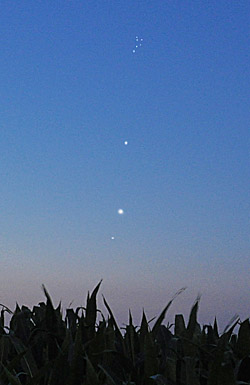
The dawn sky on July 4th, as captured by Gregg Alliss near Marion, Iowa. He took this 7-second exposure through an 18-mm f/7.1 lens at ISO 800. Click on the image for a larger view.
Gregg Alliss
Mercury is disappearing deep in the sunset.
Venus and Jupiter (magnitudes –4.7 and –2.1) shine dramatically in the east-northeast before and during dawn. They remain stacked 5° or 6° apart this week, with Jupiter on top. Watch Aldebaran, much fainter, moving this week from below Venus to its right. Also in Venus's starry background are the Hyades, and above Jupiter are the Pleiades. The asteroids Ceres and Vesta, magnitudes 9.1 and 8.4, are there too! See article Predawn Treats for Early Risers for the naked-eye aspect, and to find the asteroids, Ceres and Vesta: July 2012 – April 2013.
Mars (magnitude +0.8, in Virgo) glows orange in the west-southwest at dusk and lower later. It's to the lower right of the Saturn-and-Spica pair by about 20°. It's heading their way; Mars will pass right between Saturn and Spica in mid-August.
In a telescope Mars is gibbous and very tiny (6.3 arcseconds wide), continuing to fade and shrink.
Saturn (magnitude +0.7, in Virgo) shines in the southwest as the stars come out. Below it by nearly 5° is Spica. After dark they move lower to the west-southwest.
Uranus (magnitude 5.8, at the Pisces-Cetus border) and Neptune (magnitude 7.8, in Aquarius) are high in the southeast and south before the first light of dawn. Finder charts for Uranus and Neptune.
All descriptions that relate to your horizon — including the words up, down, right, and left — are written for the world's mid-northern latitudes. Descriptions that also depend on longitude (mainly Moon positions) are for North America. Eastern Daylight Time (EDT) equals Universal Time (also known as UT, UTC, or GMT) minus 4 hours.
Like This Week's Sky at a Glance? Watch our weekly SkyWeek TV short. It's also playing on PBS!
To be sure to get the current Sky at a Glance, bookmark this URL:
http://SkyandTelescope.com/observing/ataglance?1=1
If pictures fail to load, refresh the page. If they still fail to load, change the 1 at the end of the URL to any other character and try again.
About Alan MacRobert
Alan M. MacRobert became an avid Sky & Telescope subscriber in 1966 at age 14, joined the editorial staff in 1982, and is now a senior contributing editor, semi-retired. He played a role in practically every part of the magazine and the company's other products for more than a generation, both on the amateur-observing side and the science-reporting side. In 1994 a book collection of his observing how-tos and telescopic sky tours was published as Star Hopping for Backyard Astronomers. He has produced This Week's Sky at a Glance online every week since 1989.


Comments
You must be logged in to post a comment.