 SUNSET:

 0
0Some daily events in the changing sky for March 13 – 21.
Comet Lulin is fading this week; it should dim from about magnitude 6 to 7. But now it's free from moonlight again, and it's conveniently highest in early evening, in Gemini. See our article and finder chart.
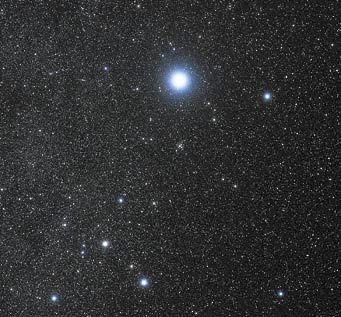
Sirius is far and away the brightest star of Canis Major, the Big Dog, which fills the frame from top to bottom here.
Photo by Akira Fujii
Friday, March 13
Sirius is not only the brightest star after the Sun, but at a distance of 8.6 light-years, it's also the nearest star that's visible to the naked eye from mid-northern latitudes. Alpha Centauri is nearer, but you can't see it from these latitudes. A handful of red-dwarf stars are also nearer, but they're so dim you can't see them without optical aid.
Saturday, March 14
Sunday, March 15
Monday, March 16
Tuesday, March 17
Wednesday, March 18
Thursday, March 19
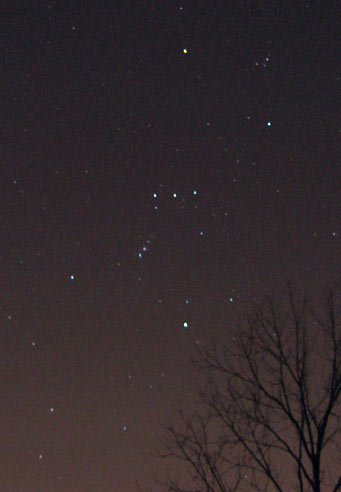
As winter turns to spring, Orion's Belt turns horizontal as Orion sinks lower in the southwestern evening sky. S&T's Tony Flanders took this 15-second exposure with a Canon A80 point-and-shoot digital camera on March 21st two years ago.
Tony Flanders
Friday, March 20
And no, eggs do not balance on end any more easily than at any other time (try it). Why should they? When will this goofy urban legend finally die?
Saturday, March 21
Want to become a better amateur astronomer? Learn your way around the constellations. They're the key to locating everything fainter and deeper to hunt with binoculars or a telescope. For an easy-to-use constellation guide covering the whole evening sky, use the big monthly map in each issue of Sky & Telescope, the essential magazine of astronomy. Or download our free Getting Started in Astronomy booklet (which only has bimonthly maps).
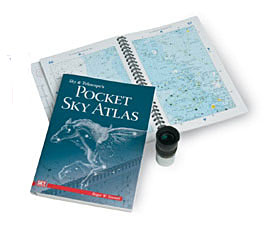
The Pocket Sky Atlas plots 30,796 stars to magnitude 7.6 — which may sound like a lot, but that's less than one star in an entire telescopic field of view, on average. By comparison, Sky Atlas 2000.0 plots 81,000 stars to magnitude 8.5, typically one or two stars per telescopic field. Both atlases include many hundreds of deep-sky targets — galaxies, star clusters, and nebulae — among the stars.
Sky & Telescope
Once you get a telescope, to put it to good use you'll need a detailed, large-scale sky atlas (set of charts; the standards are Sky Atlas 2000.0 or the smaller Pocket Sky Atlas) and good deep-sky guidebooks (such as Sky Atlas 2000.0 Companion by Strong and Sinnott, the even more detailed Night Sky Observer's Guide by Kepple and Sanner, or the classic Burnham's Celestial Handbook). Read how to use them effectively.
Can a computerized telescope take their place? As Terence Dickinson and Alan Dyer say in their Backyard Astronomer's Guide, "A full appreciation of the universe cannot come without developing the skills to find things in the sky and understanding how the sky works. This knowledge comes only by spending time under the stars with star maps in hand and a curious mind." Without these, they note, "the sky never becomes a friendly place."
More beginners' tips: "How to Start Right in Astronomy".
This Week's Planet Roundup
Mercury is disappearing into the sunrise.
S&T Illustration
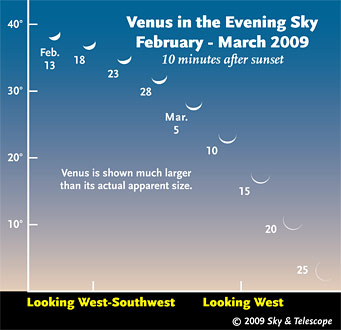
Venus (magnitude –4.5, in Pisces) is still shines brilliantly in the west during evening twilight, but it's getting lower every day. And it's changing rapidly as it swings toward inferior conjunction between Earth and Sun. In a telescope Venus is an eerily thin crescent, waning from 7% sunlit on March 14th to just 3% on the 20th. And it's big: nearly an arcminute from cusp to cusp.
There have been reports over the years of people with exceptionally sharp vision resolving the thin crescent of Venus with the naked eye. If you want to try, look right after sunset in a bright sky before the planet's glare becomes a problem. To reduce the effects of your eye's optical aberrations, try looking through a small, round hole 1 or 2 mm wide in a piece of aluminum foil or cardboard. Of course, this also reduces your eye's aperture and theoretical resolving power, so experiment with different-sized holes. Send me your results! Email amacrobert(AT) skyandtelescope(DOT)com, and put Venus Crescent in the subject line.
Telescopically, Venus is best seen in the afternoon daylight; it's less glary against a bright sky, and it's higher in steadier air. Just don't let your telescope accidentally point at the Sun! Safest is to observe in the shade of a building located to your west.
For more on Venus's especially favorable conjunction phenomena this year, see the March Sky & Telescope, page 58, or online.
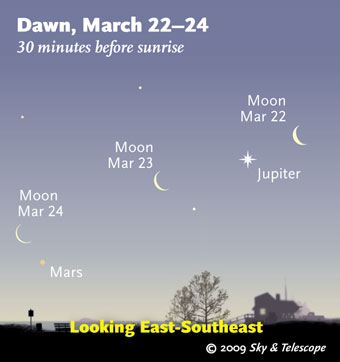
Daylight saving time makes it easier to get up in time to see dawn sky sights. On Sunday morning March 22nd, Jupiter shines left of the waning Moon. Although they look close together, Jupiter is actually 2,200 times farther away just now. And it's 40 times bigger!
These scenes are always drawn for the middle of North America (to be exact, latitude 40° north, longitude 90° west). European observers: Move each Moon symbol a quarter of the way toward the one for the previous date. In the Far East, move it halfway.
Alan MacRobert
Mars (magnitude +1.2) is very low in the sunrise glow. Using binoculars, look for it just above the east-southeast horizon, well to the lower left of much brighter Jupiter, about 30 minutes before sunrise. Good luck.
Ceres, the largest asteroid, is now magnitude 7.3 above the back of Leo. Spot it with binoculars using the article and finder chart in the March Sky & Telescope, page 60, or online.
Jupiter (magnitude –2.0, in Capricornus this year) is getting a little higher in the dawn each week. Look for it very low in the east-southeast about an hour before sunrise.
Saturn (magnitude +0.5, near the hind foot of Leo) is just past opposition. It glows low in the east at dusk, well up in the southeast by midevening, and highest in the south around midnight daylight saving time. Don't confuse Saturn with slightly fainter Regulus 18° (nearly two fist-widths at arm's length) to its upper right in early evening, and more directly to Saturn's right late at night.
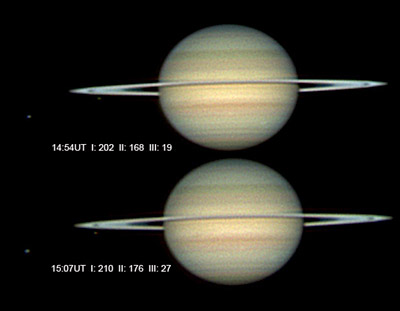
Saturn two days before opposition, imaged by Christopher Go of Cebu, Philippines, on March 6th. The images were taken 13 minutes apart; note the motions of Saturn's moons Dione (left) and Tethys (just below ring) during this time.
Saturn's rings are 3½° from edge on. The rings will open to 4° by late May, then will close to exactly edge-on next September 4th — when, unfortunately, Saturn will be out of sight practically in conjunction with the Sun.
P.S.: Remember the quadruple transit of Saturnian moons across the planet's face that made news on February 24th? Hubble was looking, and the Hubble Heritage Project has just released the images. Wow. These are not science-fiction space art, they are actual photographs.
Here's a timetable (in Universal Time) of all of transits by Titan and/or its shadow for the rest of 2009.
Uranus is hidden behind the glare of the Sun.
Neptune is hidden deep in the glow of sunrise, far in the background of Jupiter and Mars.
Pluto (in northwestern Sagittarius) is in the southeast before dawn.
All descriptions that relate to your horizon or zenith — including the words up, down, right, and left — are written for the world's mid-northern latitudes. Descriptions that also depend on longitude (mainly Moon positions) are for North America. Eastern Daylight Time (EDT) equals Universal Time (known as UT, UTC, or GMT) minus 4 hours.
To be sure to get the current Sky at a Glance, bookmark this URL:
http://SkyandTelescope.com/observing/ataglance?1=1
If pictures fail to load, refresh the page. If they still fail to load, change the 1 at the end of the URL to any other character and try again.
About Alan MacRobert
Alan M. MacRobert became an avid Sky & Telescope subscriber in 1966 at age 14, joined the editorial staff in 1982, and is now a senior contributing editor, semi-retired. He played a role in practically every part of the magazine and the company's other products for more than a generation, both on the amateur-observing side and the science-reporting side. In 1994 a book collection of his observing how-tos and telescopic sky tours was published as Star Hopping for Backyard Astronomers. He has produced This Week's Sky at a Glance online every week since 1989.


Comments
You must be logged in to post a comment.