 SUNSET:

 0
0Some daily events in the changing sky for March 19 – 27.
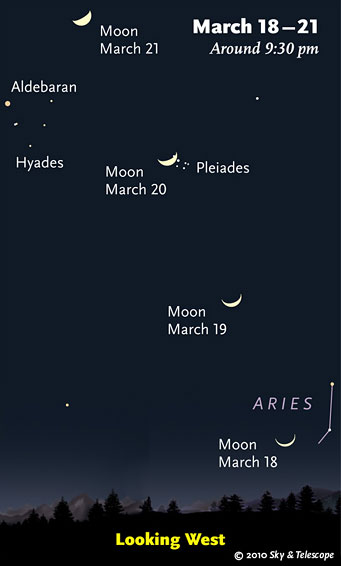
Don't miss the Moon-Pleiades conjunction on Saturday the 20th. The Moons here are always drawn three times their actual apparent size for clarity, and they are always positioned as seen from about the middle of North America (seen from latitude 40° north, longitude 90° west).
Sky & Telescope diagram
Friday, March 19
For instance, in Boston this evening the Belt should be perfectly horizontal around 8:20 p.m. How accurately can you time this event at your location? Orion's Belt is slightly curved, so judge by the two stars on its ends. Can you find a sighting reference to make your measurement more precise, and track the time's day-to-day change? Welcome to pre-telescopic astronomy.
Saturday, March 20
For the U.S. and Canada, writes David Dunham of the International Occultation Timing Association, "Several 8th to 6th magnitude stars will be occulted, and one 5th-mag. star. Predictions of these (and of other total lunar occultations for all of 2010 for stars to mag. 6.0) for 40 of the larger North American cities can be downloaded in .zip files from Bob Sandy's website. There are some regional sites with predictions of fainter stars, for example for stars to 8th mag. in the Mid-Atlantic region (computed for near Washington, DC) at the bottom of my Mid-Atlantic occultation and expedition page."
Sunday, March 21
Monday, March 22
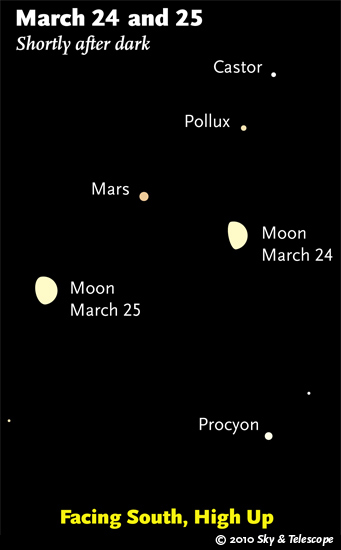
The Moon passes Mars on Wednesday and Thursday evenings.
Sky & Telescope diagram
Tuesday, March 23
Wednesday, March 24
Thursday, March 25
Friday, March 26
Saturday, March 27
Want to become a better amateur astronomer? Learn your way around the constellations. They're the key to locating everything fainter and deeper to hunt with binoculars or a telescope.
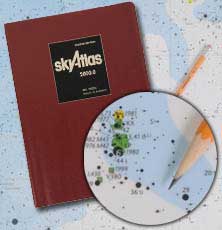
Sky Atlas 2000.0 (the color Deluxe Edition is shown here) plots 81,312 stars to magnitude 8.5. That includes most of the stars that you can see in a good finderscope, and typically one or two stars that will fall within a 50× telescope's field of view wherever you point. About 2,700 deep-sky objects to hunt are plotted among the stars.
Alan MacRobert
For an easy-to-use constellation guide covering the whole evening sky, use the big monthly map in the center of each issue of Sky & Telescope, the essential magazine of astronomy. Or download our free Getting Started in Astronomy booklet (which only has bimonthly maps).
Once you get a telescope, to put it to good use you'll need a detailed, large-scale sky atlas (set of charts; the standards are Sky Atlas 2000.0 or the smaller Pocket Sky Atlas) and good deep-sky guidebooks (such as Sky Atlas 2000.0 Companion by Strong and Sinnott, the more detailed and descriptive Night Sky Observer's Guide by Kepple and Sanner, or the classic Burnham's Celestial Handbook). Read how to use them effectively.
Can a computerized telescope take their place? I don't think so — not for beginners, anyway (and especially not on mounts that are less than top-quality mechanically). As Terence Dickinson and Alan Dyer say in their Backyard Astronomer's Guide, "A full appreciation of the universe cannot come without developing the skills to find things in the sky and understanding how the sky works. This knowledge comes only by spending time under the stars with star maps in hand."
This Week's Planet Roundup
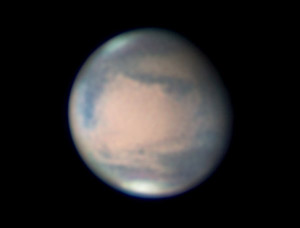
Mars was only 10.8 arcseconds wide on the evening of March 16th when S&T's Sean Walker took this image at 7:41 p.m. EDT. The North Polar Cap (bottom) seems to be diminishing. Note the cloud in Hellas (at the 11 o'clock position on the limb) and the apparent blue cloud over Syrtis Major (left limb). Walker used a DMK camera on a Celestron 14-inch Schmidt-Cassegrain scope. He writes, "One hour later, the seeing was so bad I couldn”™t be sure there was a polar cap on Mars!"
S&T: Sean Walker
Mercury emerges into view very low in the west in bright twilight late this week. Look for it well to the lower right of bright Venus. Binoculars will help. Come late March and early April, Venus and Mercury will be closely paired in better view.
Venus (magnitude –3.9) is slowly emerging into better view low in the evening twilight. Look for it almost due west as sunset fades.
Mars, now dimming into the distance at magnitude –0.1, shines very high in the southeast to south in early evening, and southwest later. It's in Cancer, drawing away from Pollux and Castor in Gemini.
In a telescope Mars is gibbous and shrinking: from 10.3 to 9.7 arcseconds in diameter this week. The north polar cap remains its most visible marking. Identify other surface features using the Mars map and observing guide in the December Sky & Telescope, page 57.
Jupiter is still hidden in the glow of sunrise.
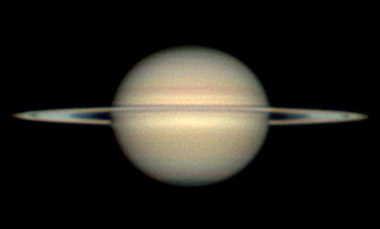
Now that Saturn is past opposition (which came on the night of March 21–22), its rings have reverted to their normal brightness. For a couple of days around opposition the rings brighten slightly due to backscattering of light toward the Sun and Earth (the Seeliger effect).
In other Saturn news, the Saturn Electrostatic Disturbance white spot in the southern latitudes seems to have faded out of view as quickly as it brightened. (It's on the opposite side of Saturn from this image, but other images no longer show it.) Christopher Go took this shot at 13:38 Universal Time March 24, 2010, in very good seeing. South is up.
Saturn (magnitude +0.5, in the head of Virgo) is at opposition this week: rising around sunset, shining highest in the middle of the night, and setting around sunrise. In a telescope Saturn's rings are tilted only 3° from edge-on. They'll narrow further to 1.7° in May and early June, then begin widening again.
Uranus and Neptune are hidden in the glow of sunrise.
Pluto (magnitude 14, in northwestern Sagittarius) is well up in the south-southeast before dawn.
All descriptions that relate to your horizon or zenith — including the words up, down, right, and left — are written for the world's mid-northern latitudes. Descriptions that also depend on longitude (mainly Moon positions) are for North America. Eastern Standard Time (EST) equals Universal Time (also known as UT, UTC, or GMT) minus 5 hours.
To be sure to get the current Sky at a Glance, bookmark this URL:
http://SkyandTelescope.com/observing/ataglance?1=1
If pictures fail to load, refresh the page. If they still fail to load, change the 1 at the end of the URL to any other character and try again.
About Alan MacRobert
Alan M. MacRobert became an avid Sky & Telescope subscriber in 1966 at age 14, joined the editorial staff in 1982, and is now a senior contributing editor, semi-retired. He played a role in practically every part of the magazine and the company's other products for more than a generation, both on the amateur-observing side and the science-reporting side. In 1994 a book collection of his observing how-tos and telescopic sky tours was published as Star Hopping for Backyard Astronomers. He has produced This Week's Sky at a Glance online every week since 1989.


Comments
You must be logged in to post a comment.