 SUNSET:

 0
0Friday, March 16
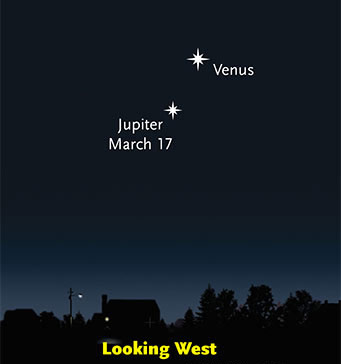
Now it's Jupiter's turn to be the lower of the two bright western lights. This is the view shortly after dark from 40° north latitude. If you're south of there, the lineup will be more tipped.
Sky & Telescope diagram
Saturday, March 17
Sunday, March 18
Monday, March 19
Tuesday, March 20
Wednesday, March 21
Thursday, March 22
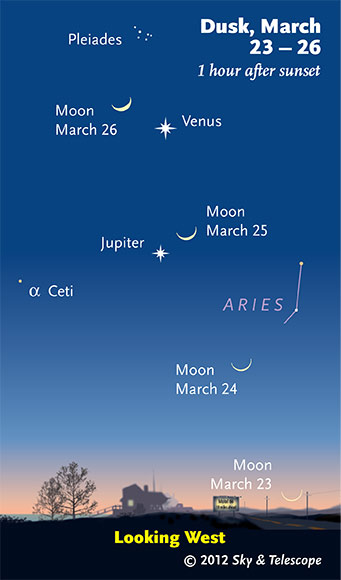
Watch the waxing crescent Moon march through its latest pairups with Jupiter and Venus. (These scenes are drawn for the middle of North America. European observers: move each Moon symbol a quarter of the way toward the one for the previous date. For clarity, the Moon is shown three times actual size.)
Sky & Telescope diagram
Friday, March 23
Saturday, March 24
Want to become a better amateur astronomer? Learn your way around the constellations. They're the key to locating everything fainter and deeper to hunt with binoculars or a telescope.
For an easy-to-use constellation guide covering the whole evening sky, use the big monthly map in the center of each issue of Sky & Telescope, the essential magazine of astronomy. Or download our free Getting Started in Astronomy booklet (which only has bimonthly maps).
Once you get a telescope, to put it to good use you'll need a detailed, large-scale sky atlas (set of charts). The standards are the little Pocket Sky Atlas, which shows stars to magnitude 7.6; the larger and deeper Sky Atlas 2000.0 (stars to magnitude 8.5); and the even larger Uranometria 2000.0 (stars to magnitude 9.75). And read how to use sky charts effectively.
You'll also want a good deep-sky guidebook, such as Sue French's new Deep-Sky Wonders collection (which includes its own charts), Sky Atlas 2000.0 Companion by Strong and Sinnott, the bigger Night Sky Observer's Guide by Kepple and Sanner, or the classic if dated Burnham's Celestial Handbook.
Can a computerized telescope replace charts? I don't think so — not for beginners, anyway, and especially not on mounts and tripods are less than top-quality mechanically (able to point with better than 0.3° repeatability). As Terence Dickinson and Alan Dyer say in their Backyard Astronomer's Guide, "A full appreciation of the universe cannot come without developing the skills to find things in the sky and understanding how the sky works. This knowledge comes only by spending time under the stars with star maps in hand."
This Week's Planet Roundup
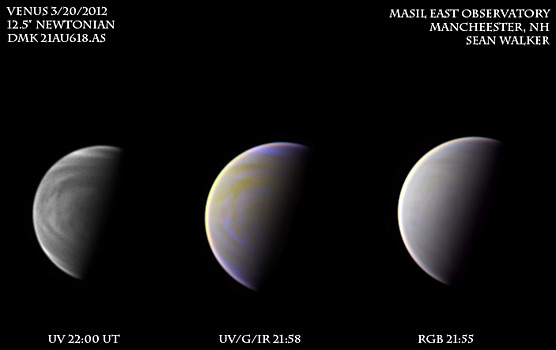
Venus imaged in five colors. To the eye Venus's clouds are almost always pure blank white, but stacked-video imaging can sometimes pull out subtle features. S&T's Sean Walker caught the cloudy planet at dichotomy late on the afternoon of March 20th, imaging with his 12.5-inch reflector (see photo of it below) through near-ultraviolet (UV), blue (B), green (G), red (R), and near-infrared (IR) filters during excellent seeing.
S&T: Sean Walker
.
Mercury has faded right out as it drops back into the glow of sunset. Its next good evening apparition won't come until the second half of June.
Venus and Jupiter are moving apart now but still form a spectacular pair in the western evening sky. They're 4° apart on March 16th and 9&@176; apart by the 23rd. Venus stays shining at about the same height at dusk all this month and next, but Jupiter is sliding lower. These are the two brightest celestial objects after the Sun and Moon, being magnitudes –4.4 and –2.1 now, respectively.
In a telescope Venus is a brilliant white "half moon" 22 arcseconds tall. Jupiter shows a much lower surface brightness, since it's farther from the Sun, but its apparent diameter is somewhat larger: 33 arcseconds.
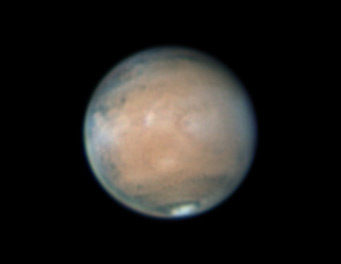
The bland side of Mars was presented to Earth when S&T's Sean Walker took this image on the night of March 20–21, a few hours after the Venus pictures above. Mars was 13.4 arcseconds wide.
South is up, and celestial east is to the right (the following side; Mars's morning side). Notice the clouds, the much-shrunken North Polar Cap, and the dark collar that has been laid bare around the cap.
S&T: Sean Walker
Mars (magnitude –1.0) shines bright fire-orange in Leo. Fainter Regulus glitters 7° to its right or upper right during evening. Mars was at opposition on March 3rd; now it's starting to fade and shrink a bit as Earth pulls ahead of it along our faster, inside-track orbit around the Sun.
But at least Mars is shining higher in the evening sky now, reaching a good altitude for telescopic observing at a more convenient hour. It's at its highest in the south around midnight daylight saving time. Mars is still about 13.6 arcseconds wide, practically the same as its 13.9″ at opposition. It won't appear this big and close again until 2014. Watch the North Polar Cap continuing to dwindle; spring is about to give way to summer in Mars's northern hemisphere. See our Mars map and observing guide in the April Sky & Telescope, page 50.
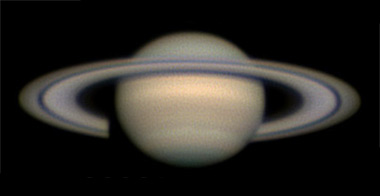
Saturn's rings are tipped a good 15° from our line of sight. South is up. Note the very pale light band in the north temperate region, the remnant of the dramatic, billowing white outbreak that attracted so much attention last year. Christopher Go took this image on January 21, 2012.
Saturn (magnitude +0.3, in Virgo) rises in the east around 9 or 10 p.m. and shines highest in the south around 3 a.m. Accompanying it 6° to its right or upper right is Spica, about half as bright at magnitude +1.0 and bluer. In a telescope Saturn's rings are tilted 14.5° from our line of sight.
Uranus and Neptune are behind the glare of the Sun.
All descriptions that relate to your horizon — including the words up, down, right, and left — are written for the world's mid-northern latitudes. Descriptions that also depend on longitude (mainly Moon positions) are for North America. Eastern Daylight Time (EDT) equals Universal Time (also known as UT, UTC, or GMT) minus 4 hours.
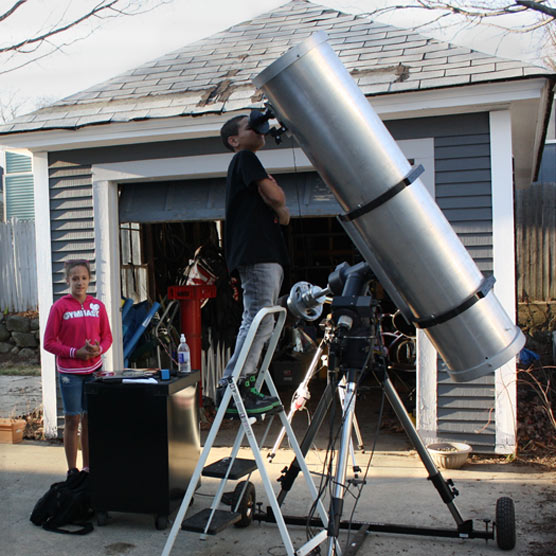
Taking a break from imaging Venus on the afternoon of March 20th, Sean Walker gave neighborhood kids looks at the planet through his 12.5-inch reflector. The filter wheel is still in place at the eyepiece.
S&T: Sean Walker
.
Like This Week's Sky at a Glance? Watch our new weekly SkyWeek TV short. It's also playing on PBS!
To be sure to get the current Sky at a Glance, bookmark this URL:
http://SkyandTelescope.com/observing/ataglance?1=1
If pictures fail to load, refresh the page. If they still fail to load, change the 1 at the end of the URL to any other character and try again.
About Alan MacRobert
Alan M. MacRobert became an avid Sky & Telescope subscriber in 1966 at age 14, joined the editorial staff in 1982, and is now a senior contributing editor, semi-retired. He played a role in practically every part of the magazine and the company's other products for more than a generation, both on the amateur-observing side and the science-reporting side. In 1994 a book collection of his observing how-tos and telescopic sky tours was published as Star Hopping for Backyard Astronomers. He has produced This Week's Sky at a Glance online every week since 1989.


Comments
You must be logged in to post a comment.