 SUNSET:

 0
0Some daily events in the changing sky for March 21 – 29.
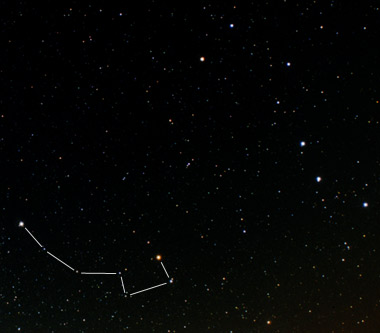
After dark in late March, the Big Dipper (upper right) seems to be unloading its contents toward the much dimmer Little Dipper (outlined). Polaris forms the end of the Little Dipper's handle.
Akira Fujii
Friday, March 21
Saturday, March 22
Sunday, March 23
This is the best season of the year for seeing the evening zodiacal light (if you're in the Northern Hemisphere) — because this is when the ecliptic extends most nearly upright from the western horizon at dusk.
Monday, March 24
Tuesday, March 25
If you have a dark enough sky for fainter stars to show, you can trace out the whole Herdsman as a stick-figure cartoon seen in profile sitting and smoking a pipe. That's how we've drawn the constellation in the monthly fold-out evening-sky map in Sky & Telescope and in our downloadable Getting Started in Astronomy booklet.
Wednesday, March 26
Spica is the brightest star of Virgo, a big, dim constellation of a stick-figure girl. She's holding Spica in one hand (the name "Spica" is Latin for the ear of wheat she's supposed to be holding), and is sowing springtime grain with the other hand. Again, see how the stick figure is drawn in Sky & Telescope or our Getting Started in Astronomy booklet.
Thursday, March 27
Friday, March 28
Saturday, March 29
Want to become a better amateur astronomer? Learn your way around the constellations. They're the key to locating everything fainter and deeper to hunt with binoculars or a telescope. For an easy-to-use constellation guide covering the whole evening sky, use the big monthly foldout map in each issue of Sky & Telescope, the essential magazine of astronomy. Or download our free Getting Started in Astronomy booklet (which only has bimonthly maps).
Once you get a telescope, to put it to good use you'll need a detailed, large-scale sky atlas (set of maps; the standards are Sky Atlas 2000.0 or the smaller Pocket Sky Atlas) and good deep-sky guidebooks (such as Sky Atlas 2000.0 Companion by Strong and Sinnott, the even more detailed Night Sky Observer's Guide by Kepple and Sanner, or the enchanting though increasingly dated Burnham's Celestial Handbook). Read how to use them effectively.
More beginners' tips: "How to Start Right in Astronomy".
This Week's Planet Roundup
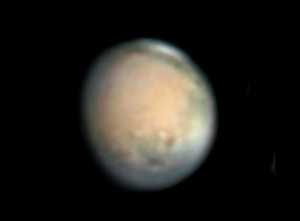
You can still see stuff on Mars?! Yup — if you've got a biggish scope and a good video-imaging setup. On the evening of March 24th, when Mars was only 7.4 arcseconds wide, S&T's Sean Walker made this image with his 12.5-inch reflector. He stacked hundreds of the sharpest video frames shot through red, green, and blue filters and combined them with ulfiltered luminance frames (sensitive to near-infrared, where surface features show up especially well).
North is up. Note the north polar cap and its very dark collar, and the bright evening cloud over Aurorae Sinus and Mare Erythraeum (right limb). The central meridian longitude is 106°.
S&T: Sean Walker
Mercury and Venus are sinking together deep into the glare of sunrise. They're just above the eastern horizon as dawn grows bright. Try with binoculars.
Mars (magnitude +0.7, in Gemini) shines high in the southwest during evening, high over Orion. In a telescope Mars is a tiny 7.5 arcseconds wide. A telescope will show, however, that Mars is gibbous. On March 30th the planet will be at eastern quadrature, 90° east of the Sun.
Jupiter (magnitude –2.1, in Sagittarius) shines in the southeast before and during dawn. The farther south you live, the higher you'll be able to observe it before dawn gets too bright.
Saturn (magnitude +0.2, near Regulus in Leo) glows high in the southeast after dark and stands highest in the south around 11 p.m. daylight saving time.
Fainter Regulus (magnitude +1.4) is now just 3° from Saturn: to its upper right in early evening, directly right of it later, and lower right after midnight (daylight saving time). Watch Saturn and Regulus draw even closer together in the coming weeks.
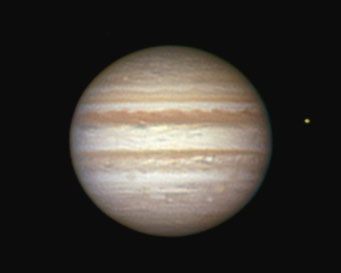
Jupiter is getting high enough in early dawn to show detail fairly well in a telescope — at least during good seeing. Currently, the North Equatorial Belt (brown band just above center) remains wide and very dark. Can your scope split the thinner, doubled North Temperate Belt just above it? The South Equatorial Belt (just below center) has divided into a dark northern half and a lighter southern half. And the Equatorial Zone, after being remarkably dark last year, has returned to its normal bright state. Mike Salway took this image from Australia (where Jupiter rises quite high before dawn) on March 2nd. North is up, and the System II central-meridian longitude was 216°.
Saturn and Regulus form a narrow triangle with Gamma (γ) Leonis, only a little dimmer than Regulus at magnitude +2.1, located 8° directly to Saturn's north.
Uranus and Neptune are still low in the glow of dawn.
Pluto (magnitude 14.0, in northwestern Sagittarius) is well up in the south-southeast before dawn's first light.
All descriptions that relate to your horizon or zenith — including the words up, down, right, and left — are written for the world's mid-northern latitudes. Descriptions that also depend on longitude (mainly Moon positions) are for North America. Eastern Daylight Time (EDT) equals Universal Time (UT, UTC, or GMT) minus 4 hours.
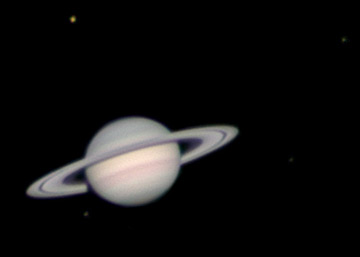
Saturn with four of its satellites, shot on the evening of March 25th. Orange Titan is at top, Rhea is at top right, Dione is directly to Saturn's right, and Tethys is just to the planet's lower left. North is up. Scott Hammonds took the raw video frames in Florida using a Meade 10-inch Schmidt-Cassegrain telescope and a DMK 21AU04.AS camera; processing by Sean Walker.
Scott Hammonds and Sean Walker
"Rational and innocent entertainment of the highest kind."
— John Mills, 19th century Scottish manufacturer and founder of Mills Observatory, on amateur astronomy.
To be sure you always get the current Sky at a Glance, bookmark this URL:
http://SkyandTelescope.com/observing/ataglance?1=1
If pictures fail to load, refresh the page.
About Alan MacRobert
Alan M. MacRobert became an avid Sky & Telescope subscriber in 1966 at age 14, joined the editorial staff in 1982, and is now a senior contributing editor, semi-retired. He played a role in practically every part of the magazine and the company's other products for more than a generation, both on the amateur-observing side and the science-reporting side. In 1994 a book collection of his observing how-tos and telescopic sky tours was published as Star Hopping for Backyard Astronomers. He has produced This Week's Sky at a Glance online every week since 1989.


Comments
You must be logged in to post a comment.