 SUNSET:

 0
0Some daily events in the changing sky for April 25 – May 3.
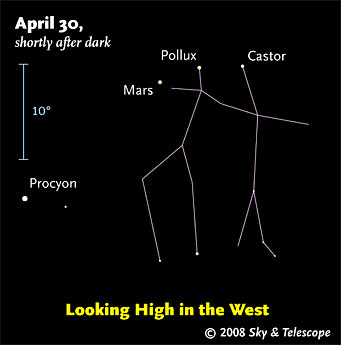
Watch as Mars moves past the heads of the Gemini twins in the next few days, while Procyon watches from below. The blue 10° scale is about the size of your fist held at arm's length.
Sky & Telescope diagram
Friday, April 25
Saturday, April 26
Sunday, April 27
Monday, April 28
Tuesday, April 29
Wednesday, April 30
Thursday, May 1
Friday, May 2
Saturday, May 3
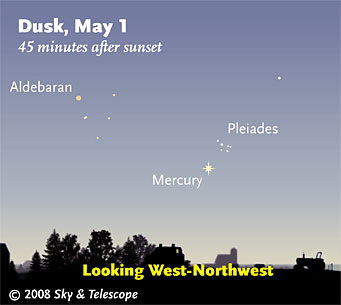
Mercury is emerging up into good view after sunset. Use binoculars to pick out the Pleiades.
Sky & Telescope diagram
Want to become a better amateur astronomer? Learn your way around the constellations. They're the key to locating everything fainter and deeper to hunt with binoculars or a telescope. For an easy-to-use constellation guide covering the whole evening sky, use the big monthly foldout map in each issue of Sky & Telescope, the essential magazine of astronomy. Or download our free Getting Started in Astronomy booklet (which only has bimonthly maps).
Once you get a telescope, to put it to good use you'll need a detailed, large-scale sky atlas (set of maps; the standards are Sky Atlas 2000.0 or the smaller Pocket Sky Atlas) and good deep-sky guidebooks (such as Sky Atlas 2000.0 Companion by Strong and Sinnott, the even more detailed Night Sky Observer's Guide by Kepple and Sanner, or the enchanting though increasingly dated Burnham's Celestial Handbook). Read how to use them effectively.
More beginners' tips: "How to Start Right in Astronomy".
This Week's Planet Roundup
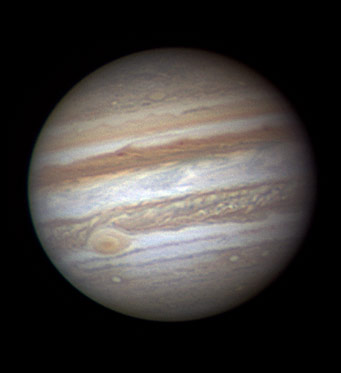
Amateur planetary imaging (by the stacked-video-frame method) continues to blow away anything you're ever likely to see directly in the eyepiece. Paul Haese in Australia took this image of Jupiter on the morning of April 28th, when Jupiter's System II central-meridian longitude was 92°. North is up (but remember that many telescopes will show south up). The North Equatorial Belt (brown band just above center) remains very dark. The South Equatorial Belt (just below center) is full of white turbulence. The Great Red Spot shows an internal ring and a central dark spot. Note the very different colors of the belts in the in the northern and southern hemispheres. Haese used a Peltier-cooled Celestron C14 Schmidt-Cassegrain telescope at about f/34 with a Skynyx 2-0 camera.
Paul Haese
Mercury (about magnitude –1) is rapidly emerging into evening view. Look for it above the west-northwest horizon as twilight fades. It's getting higher and easier every day. Don't confuse it with Aldebaran, far to its upper left.
Mercury is often called "elusive," but by the end of this week it is plain and obvious as it passes south (lower left) of the Pleiades. See the sky scene above.
Venus is lost in the glare of the Sun.
Mars (magnitude +1.2, in Gemini) shines high in the west during evening. It forms a curved line with Pollux and Castor to its upper right or right. Watch as the line becomes less curved every day. It straightens out completely on May 4th.
Compare Mars's color to that of Pollux, which is just about equally bright. Pollux is an orange giant of spectral type K0 III. To me, the tint of Mars looks slightly deeper.
In a telescope Mars is a disappointing 5.9 arcseconds wide — a very tiny gibbous blob.
Jupiter (magnitude –2.4, in eastern Sagittarius) rises around 1 or 2 a.m. daylight saving time and glares in the south-southeast by early dawn. The farther south you live, the higher you'll be able to observe it with your telescope before dawn gets too bright.
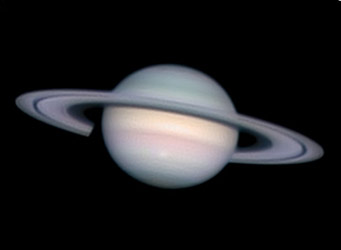
A white storm is visible in Saturn's South Temperate Zone — and since this picture was taken, it has divided into two! The original storm shows plainly in this stacked-video image taken by Sean Walker through a 12.5-inch reflector at 0:42 UT April 23rd during excellent seeing. "The white spot was visible in an eyepiece at over 500x, particularly through a green filter," Walker writes. North is up.
To find when the white spots are in view: For your date, look up Saturn's System II central-meridian longitude in this table (it's the "CMII" column). That's the value for 0:00 Universal Time (UT or GMT) on your date. To this value, add 33.8° for each whole hour since 0:00 UT, and 0.56° for each minute, for the time you plan to observe. See what you get. Find a good Saturn-observing time and date for you that results in something around 75°, and plan to be out then with your scope.
S&T: Sean Walker
Saturn (magnitude +0.5, in Leo) glows very high in the south to southwest during evening, just 2¼° from fainter Regulus (magnitude +1.4). Saturn and Regulus will remain nearly this close together for a month to come.
Telescope users: can you see the new white storm on Saturn? How big a telescope will do it? See the picture caption to predict when the white spot will be turned into view (which happens at least twice a day).
There's more to Saturn than you may realize! See our Saturn observing guide in the April Sky & Telescope, page 66. Saturn's rings now appear open by 10°, our best view of them until December 2010.
Uranus and Neptune are low in the southeast before dawn.
Pluto (magnitude 14.0, in northwestern Sagittarius) is highest in the south before dawn's first light.
All descriptions that relate to your horizon or zenith — including the words up, down, right, and left — are written for the world's mid-northern latitudes. Descriptions that also depend on longitude (mainly Moon positions) are for North America. Eastern Daylight Time (EDT) equals Universal Time (UT, UTC, or GMT) minus 4 hours.
To be sure to get the current Sky at a Glance, bookmark this URL:
http://SkyandTelescope.com/observing/ataglance?1=1
If pictures fail to load, refresh the page. If they still fail to load, change the 1 at the end of the URL to any other character and try again.
About Alan MacRobert
Alan M. MacRobert became an avid Sky & Telescope subscriber in 1966 at age 14, joined the editorial staff in 1982, and is now a senior contributing editor, semi-retired. He played a role in practically every part of the magazine and the company's other products for more than a generation, both on the amateur-observing side and the science-reporting side. In 1994 a book collection of his observing how-tos and telescopic sky tours was published as Star Hopping for Backyard Astronomers. He has produced This Week's Sky at a Glance online every week since 1989.


Comments
You must be logged in to post a comment.