 SUNSET:

 0
0Some daily events in the changing sky for November 30 – December 8.
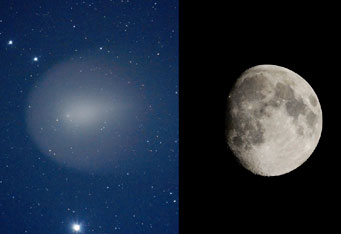
The head of Comet Holmes was about 0.6° wide, just a bit larger than the Moon, on November 21st as shown in this pair of images that Gary Seronik shot at the same scale. The comet has continued swelling since then. Click image for larger view.
S&T: Gary Seronik
Comet Holmes is once again easy to spot with the unaided eye, now that the evening sky is moonless again. It continues fading gradually, but it's big. Look for it a bit above Alpha Persei. Binoculars give a beautiful view. See our recent update with finder chart, full story, and reader photos.
And don't look now, but another comet is on the way in! Comet 8P/Tuttle is still only 9th magnitude, but it should brighten to 6th magnitude from late December through mid-January. And while Comet Holmes stays stuck in Perseus for months, Comet Tuttle (being much nearer) will dive from the north celestial pole all the away across the evening sky and below the southern horizon during the same time. See the article and charts in the January Sky & Telescope, page 73.
Friday, November 30
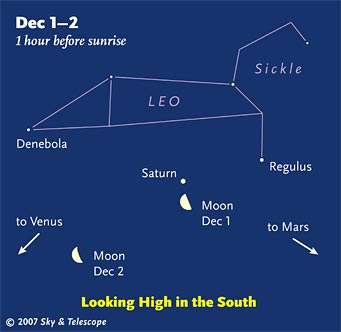
Catch the Moon carrying on with Saturn on the morning December begins. (These scenes are drawn for the middle of North America. European observers: move each Moon symbol a quarter of the way toward the one for the previous date. For clarity, the Moon is shown three times actual size.)
Sky & Telescope diagram
Saturday, December 1
Sunday, December 2
Monday, December 3
Tuesday, December 4
Wednesday, December 5
Thursday, December 6
Friday, December 7
Saturday, December 8
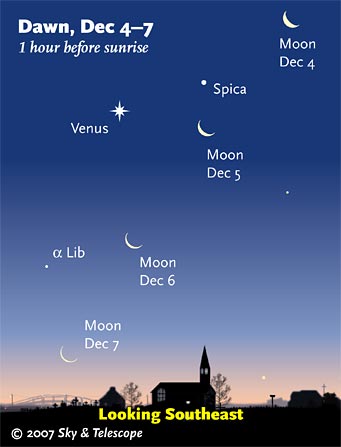
Watch the waning Moon pass Venus and Spica in the chilly December dawn.
Sky & Telescope diagram
Want to become a better amateur astronomer? Learn your way around the constellations. They're the key to locating everything fainter and deeper to hunt with binoculars or a telescope. For an easy-to-use constellation guide covering the whole evening sky, use the big monthly foldout map in each issue of Sky & Telescope, the essential magazine of astronomy. Or download our free Getting Started in Astronomy booklet (which only has bimonthly maps).
Once you get a telescope, to put it to good use you'll need a detailed, large-scale sky atlas (set of maps; the standard is Sky Atlas 2000.0) and good deep-sky guidebooks (such as Sky Atlas 2000.0 Companion by Strong and Sinnott, the even more detailed Night Sky Observer's Guide by Kepple and Sanner, or the enchanting though increasingly dated Burnham's Celestial Handbook). Read how to use them effectively.
More beginners' tips: "How to Start Right in Astronomy".
This Week's Planet Roundup
Mercury is lost in the glow of sunrise. During its recent fine morning apparition, John Boudreau of Saugus, Massachusetts, shot perhaps the best amateur imagery of Mercury we've ever seen.
Venus (magnitude –4.2, in Virgo) is the bright "Morning Star" blazing in the southeast before and during dawn. Spica, much dimmer, shines within a few degrees of it.
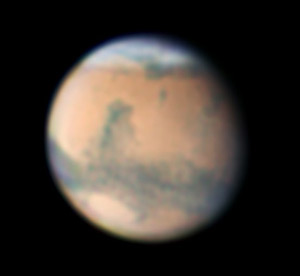
Syrtis Major juts upward in this image of Mars taken by S&T's Sean Walker on the morning of November 19th. The huge North Polar Hood of clouds was thin enough that surface features showed through. And note the bright haze filling the Hellas Basin, near the limb at the 7 o'clock position. Mars was 14 arcseconds wide, and the central-meridian longitude was 269°. Walker used a 12.5-inch reflector, a DMK 21AF04.AS camera, and CS RGB color filters.
S&T: Sean Walker
Mars, shining bright yellow-orange (magnitude –1.3) in Gemini, now rises as early as 6 or 7 p.m. and is high up in fine view in the east by 9 or 10. It shines very high in the early-morning hours — passing near the zenith, in fact, for observers at mid-northern latitudes (around 2 a.m.).
In a telescope Mars now appears 15 arcseconds in diameter, almost as wide as the 15.9" it will display when nearest Earth on the night of December 18th. For all about observing Mars with a telescope this season, see the guide and surface-feature map in the November Sky & Telescope, page 66.
Jupiter (magnitude –1.8) is disappearing into the sunset. Can you still catch it just above the southwest horizon in bright twilight? Bring binoculars.
Saturn (magnitude +0.7) rises by about midnight and is very high in the south before dawn. Fainter Regulus (magnitude +1.4) is 8° to Saturn's upper right after they rise, and directly right of it as they fade out in dawn's glow.
Uranus (magnitude 5.8, in Aquarius) is still well placed in the south right after dark, high above Fomalhaut.
Neptune (magnitude 7.9, in Capricornus) is getting lower in the southwest. Finder charts for Uranus and Neptune are in the July Sky & Telescope, page 60, and online.
All descriptions that relate to your horizon or zenith — including the words up, down, right, and left — are written for the world's midnorthern latitudes. Descriptions that also depend on longitude (mainly Moon positions) are for North America. Eastern Standard Time (EST) equals Universal Time (UT, UTC, or GMT) minus 5 hours.
To be sure you always get the current Sky at a Glance, bookmark this URL:
http://SkyandTelescope.com/observing/ataglance?1=1
About Alan MacRobert
Alan M. MacRobert became an avid Sky & Telescope subscriber in 1966 at age 14, joined the editorial staff in 1982, and is now a senior contributing editor, semi-retired. He played a role in practically every part of the magazine and the company's other products for more than a generation, both on the amateur-observing side and the science-reporting side. In 1994 a book collection of his observing how-tos and telescopic sky tours was published as Star Hopping for Backyard Astronomers. He has produced This Week's Sky at a Glance online every week since 1989.


Comments
You must be logged in to post a comment.