 SUNSET:

 0
0Some daily events in the changing sky for February 5 – 13.
Friday, February 5
Saturday, February 6
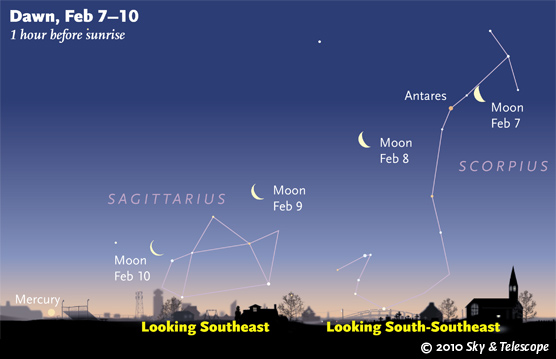
Early risers can watch the crescent Moon wane as it moves morning to morning from Antares toward Mercury. (These scenes are drawn for the middle of North America. European observers: move each Moon symbol a quarter of the way toward the one for the previous date. For clarity, the Moon is shown three times actual size.)
Sky & Telescope diagram
Sunday, February 7
Monday, February 8
Tuesday, February 9
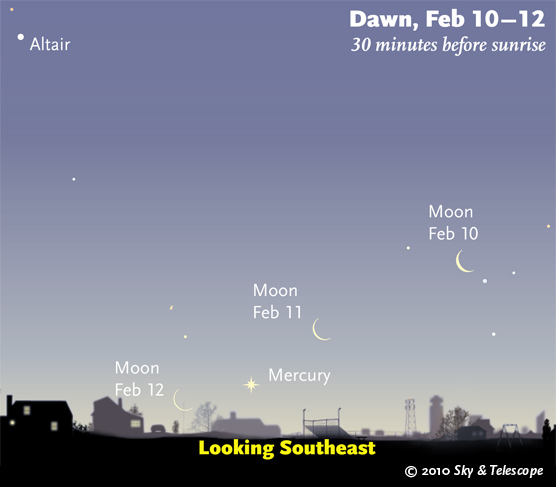
Use binoculars to pick the thin Moon and Mercury out of the brightening dawn.
Alan MacRobert
Wednesday, February 10
Thursday, February 11
Friday, February 12
Before dawn Saturday morning (for the Americas), Vesta forms a "double star" with the 7th-magnitude star HD 89930 that changes orientation dramatically every hour. They're within about 1 arcminute of each other when seen before dawn from North America.
Saturday, February 13
Want to become a better amateur astronomer? Learn your way around the constellations. They're the key to locating everything fainter and deeper to hunt with binoculars or a telescope. For an easy-to-use constellation guide covering the whole evening sky, use the big monthly map in the center of each issue of Sky & Telescope, the essential magazine of astronomy. Or download our free Getting Started in Astronomy booklet (which only has bimonthly maps).
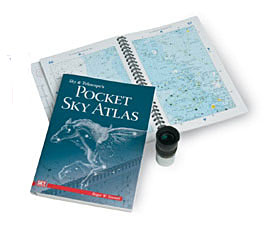
The Pocket Sky Atlas plots 30,796 stars to magnitude 7.6 — which may sound like a lot, but that's less than one star in an entire telescopic field of view, on average. By comparison, Sky Atlas 2000.0 plots 81,312 stars to magnitude 8.5, typically one or two stars per telescopic field. Both atlases include many hundreds of deep-sky targets — galaxies, star clusters, and nebulae — to hunt among the stars.
Sky & Telescope
Once you get a telescope, to put it to good use you'll need a detailed, large-scale sky atlas (set of charts; the standards are Sky Atlas 2000.0 or the smaller Pocket Sky Atlas) and good deep-sky guidebooks (such as Sky Atlas 2000.0 Companion by Strong and Sinnott, the more detailed and descriptive Night Sky Observer's Guide by Kepple and Sanner, or the classic Burnham's Celestial Handbook). Read how to use them effectively.
Can a computerized telescope take their place? I don't think so — not for beginners, anyway (and especially not on mounts that are less than top-quality mechanically). As Terence Dickinson and Alan Dyer say in their Backyard Astronomer's Guide, "A full appreciation of the universe cannot come without developing the skills to find things in the sky and understanding how the sky works. This knowledge comes only by spending time under the stars with star maps in hand and a curious mind." Without these, "the sky never becomes a friendly place."
More beginners' tips: "How to Start Right in Astronomy".
This Week's Planet Roundup
Mercury (magnitude –0.2) is sinking low into the sunrise. Look for it just above the east-southeast horizon about 30 minutes before sunup. Binoculars help.
Venus is hidden deep in the sunset.
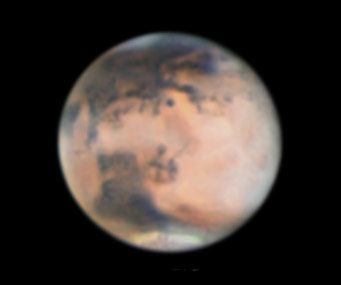
Dramatic things are happening on Mars's north polar cap (bottom) as it shrinks in the Martian springtime. Note the yellow dust storm on the cap's left side here, and the dulling of its right side compared to recent imagery in which it was bright white. At top are dark Mare Erythraeum, Margaritifer Sinus, Aurorae Sinus, and the Solis Lacus region. Lower left of center are dark Niliacus Lacus and Mare Acidalium. Note the many white clouds.
Veteran planetary imager Donald C. Parker of Coral Gables, Florida, took this superb image on the evening of February 2nd (at 4:00 Feb. 3 Universal Time), when the central meridian longitude was 62°. Click on the image for larger views and more information. South is up.
Parker used a 16-inch Newtonian reflector and a Skynyx 2-0 camera. Stacked-video imagery like this can show detail on a planet much more clearly than the eye can see through the same telescope.
Donald C. Parker
Mars, fiery bright at magnitude –1.1, shines in the east-northeast in twilight and higher in the east after dinnertime. It's in Cancer, more than halfway from Regulus below it to Pollux and Castor above it. Mars is highest in the south by 11 or midnight. Binoculars show M44, the Beehive Star Cluster, 3° or 4° roughly to Mars's south.
In a telescope Mars is still 13.8 arcseconds wide; it passed closest to Earth on January 27th and was at opposition on the 29th. The north polar cap has recently faded in brilliance due to dust, as seen at right. Identify other surface features using the Mars map and observing guide in the December Sky & Telescope, page 57.
Jupiter (magnitude –2.0) is descending into the sunset glow low in the west-southwest.
Saturn (magnitude +0.7, in Virgo) rises in the east around 9 p.m. and stands highest in the south around 2 a.m. In a telescope Saturn's rings are tilted only 4.5° from edge-on to us, and they'll narrow further in the coming months.
Uranus is sinking into the sunset.
Neptune is hidden behind the glare of the Sun.
Pluto is low in the southeast before dawn.
All descriptions that relate to your horizon or zenith — including the words up, down, right, and left — are written for the world's mid-northern latitudes. Descriptions that also depend on longitude (mainly Moon positions) are for North America. Eastern Standard Time (EST) equals Universal Time (also known as UT, UTC, or GMT) minus 5 hours.
To be sure to get the current Sky at a Glance, bookmark this URL:
http://SkyandTelescope.com/observing/ataglance?1=1
If pictures fail to load, refresh the page. If they still fail to load, change the 1 at the end of the URL to any other character and try again.
About Alan MacRobert
Alan M. MacRobert became an avid Sky & Telescope subscriber in 1966 at age 14, joined the editorial staff in 1982, and is now a senior contributing editor, semi-retired. He played a role in practically every part of the magazine and the company's other products for more than a generation, both on the amateur-observing side and the science-reporting side. In 1994 a book collection of his observing how-tos and telescopic sky tours was published as Star Hopping for Backyard Astronomers. He has produced This Week's Sky at a Glance online every week since 1989.


Comments
You must be logged in to post a comment.