 SUNSET:

 0
0Some daily events in the changing sky for April 2 – 10.
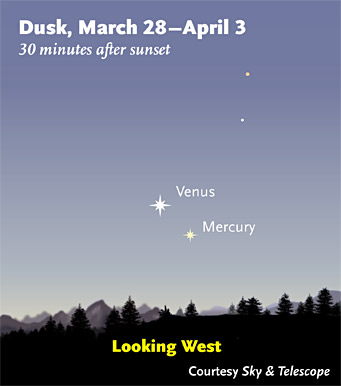
Bright Venus and lesser Mercury form an eye-catching pair low in the western twilight. You're free to copy and repost this image to do some astronomy outreach! Just be sure to include a link to SkyandTelescope.com.
Sky & Telescope magazine
Friday, April 2
Saturday, April 3
Three reasons conspire to make Venus shine so brightly despite its greater distance right now. It’s about twice as big a planet as Mercury, it’s covered with brilliantly reflective white clouds compared to Mercury’s dark gray rocks and dust, and Venus is currently showing us more of its sunlit dayside.
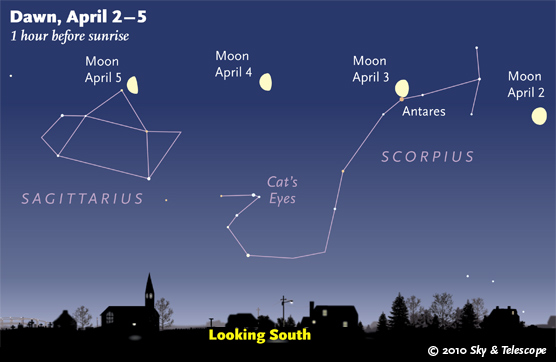
In early dawn the waning Moon crosses Scorpius and Sagittarius. For clarity, the Moon is drawn three times actual size. It's positioned as seen at the time of dawn near the middle of North America (at latitude 40° north, longitude 90° west).
Sky & Telescope diagram
Sunday, April 4
Monday, April 5
Tuesday, April 6
Wednesday, April 7
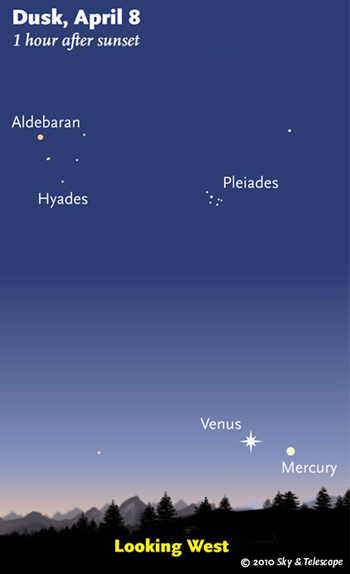
Mercury is fading, but both planets are a little higher in the dusk than they were a week ago. As night falls, the Pleiades and Hyades come into view.
You're welcome to copy and repost this image as long as a link to SkyandTelescope.com is included. A high-res print-media version is available from our press release.
Sky & Telescope diagram
Thursday, April 8
Friday, April 9
Saturday, April 10
Want to become a better amateur astronomer? Learn your way around the constellations. They're the key to locating everything fainter and deeper to hunt with binoculars or a telescope.
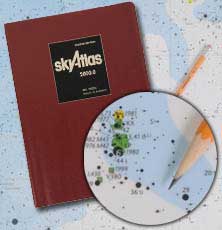
Sky Atlas 2000.0 (the color Deluxe Edition is shown here) plots 81,312 stars to magnitude 8.5. That includes most of the stars that you can see in a good finderscope, and typically one or two stars that will fall within a 50× telescope's field of view wherever you point. About 2,700 deep-sky objects to hunt are plotted among the stars.
Alan MacRobert
For an easy-to-use constellation guide covering the whole evening sky, use the big monthly map in the center of each issue of Sky & Telescope, the essential magazine of astronomy. Or download our free Getting Started in Astronomy booklet (which only has bimonthly maps).
Once you get a telescope, to put it to good use you'll need a detailed, large-scale sky atlas (set of charts; the standards are Sky Atlas 2000.0 or the smaller Pocket Sky Atlas) and good deep-sky guidebooks (such as Sky Atlas 2000.0 Companion by Strong and Sinnott, the more detailed and descriptive Night Sky Observer's Guide by Kepple and Sanner, or the classic Burnham's Celestial Handbook). Read how to use them effectively.
Can a computerized telescope take their place? I don't think so — not for beginners, anyway (and especially not on mounts that are less than top-quality mechanically). As Terence Dickinson and Alan Dyer say in their Backyard Astronomer's Guide, "A full appreciation of the universe cannot come without developing the skills to find things in the sky and understanding how the sky works. This knowledge comes only by spending time under the stars with star maps in hand."
This Week's Planet Roundup
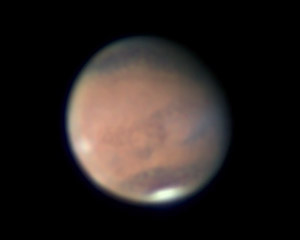
Mars was 9.0 arcseconds wide, and near the zenith, on the evening of April 2nd when S&T's Sean Walker took this image. The North Polar Cap (bottom) is diminishing in the northern-hemisphere spring. Walker writes, "The bright cloud on the edge of Mars was almost as bright visually as the polar cap!" He used a DMK camera on a Celestron 14-inch Schmidt-Cassegrain scope.
S&T: Sean Walker
Mercury and Venus are beautifully paired low in the west during twilight this week. Venus is by far the brighter of the two. Look for Mercury to its lower right. Venus is magnitude –3.9. Mercury is fading, from magnitude –0.8 on April 2nd to –0.5 on April 5th, +0.3 on the 10th, and +1.4 on the 15th. They appear closest together (3°) on April 3rd and 4th.
This is as good an apparition as often-elusive Mercury ever puts on (for skywatchers at mid-northern latitudes). And with Venus lighting the way to it, you could hardly ask for Mercury to be any easier. Think photo opportunity. Use a fairly long lens to get a good image scale.
Mars, dimming into the distance at magnitude +0.3, shines very high in the southwest during evening. It's in Cancer, left of Pollux and Castor and above Procyon. With binoculars, look for the Beehive Star Cluster to Mars's left.
In a telescope Mars is gibbous and shrinking: from 9.0 to 8.4 arcseconds in diameter this week. Can you still see the north polar cap? Identify any other surface features you may see using the Mars map and observing guide in the December Sky & Telescope, page 57.
Jupiter (magnitude –2.1) is emerging very low in the glow of dawn. Look for it just above the eastern horizon about 40 or 30 minutes before your local sunrise time.
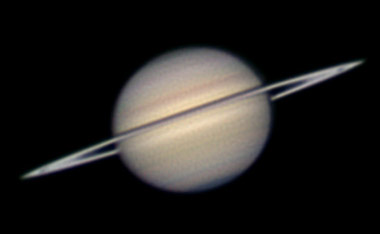
The low tilt of Saturn's rings this season is allowing a good look at both the southern and northern hemispheres of the planet. South is up in this image taken by S&T's Sean Walker on the night of April 3rd. Note the broad, bright Equatorial Zone, the reddish South Equatorial Belt, and the dark bluish North Polar Region.
S&T: Sean Walker
Saturn (magnitude +0.6, in the head of Virgo) is two weeks past opposition. Look for it in the east-southeast at dusk, higher in the southeast by late evening, and highest in the south by 11 or midnight. In a telescope Saturn's rings are tilted only 2.6° from edge-on. They'll narrow to 1.7° in May and early June, then begin widening again.
Uranus and Neptune are hidden in the glow of sunrise.
Pluto (magnitude 14, in northwestern Sagittarius) is well up in the south-southeast before dawn.
All descriptions that relate to your horizon or zenith — including the words up, down, right, and left — are written for the world's mid-northern latitudes. Descriptions that also depend on longitude (mainly Moon positions) are for North America. Eastern Daylight Time (EDT) equals Universal Time (also known as UT, UTC, or GMT) minus 4 hours.
To be sure to get the current Sky at a Glance, bookmark this URL:
http://SkyandTelescope.com/observing/ataglance?1=1
If pictures fail to load, refresh the page. If they still fail to load, change the 1 at the end of the URL to any other character and try again.
About Alan MacRobert
Alan M. MacRobert became an avid Sky & Telescope subscriber in 1966 at age 14, joined the editorial staff in 1982, and is now a senior contributing editor, semi-retired. He played a role in practically every part of the magazine and the company's other products for more than a generation, both on the amateur-observing side and the science-reporting side. In 1994 a book collection of his observing how-tos and telescopic sky tours was published as Star Hopping for Backyard Astronomers. He has produced This Week's Sky at a Glance online every week since 1989.


Comments
You must be logged in to post a comment.