 SUNSET:

 0
0Friday, May 27
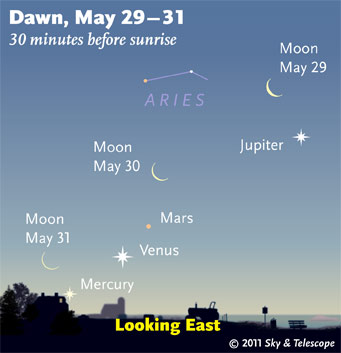
Watch the Moon pass over the dawn planet lineup in the closing days of May. (The visibility of the fainter objects in bright twilight is exaggerated here. These scenes are always drawn for the middle of North America. European observers: move each Moon symbol a quarter of the way toward the one for the previous date.)
Sky & Telescope diagram
Saturday, May 28
Sunday, May 29
Monday, May 30
Tuesday, May 31
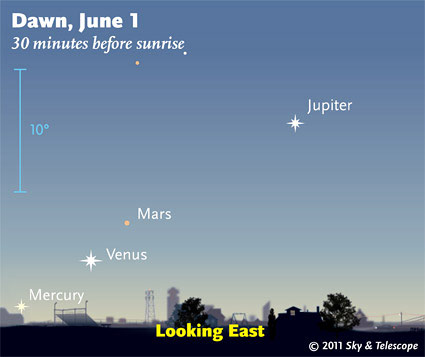
The four-planet lineup before sunrise continues to lengthen, with Jupiter moving farther to the upper right and Mercury to the lower left. The 10° scale is about the width of your fist at arm's length.
Sky & Telescope diagram
Wednesday, June 1
Thursday, June 2
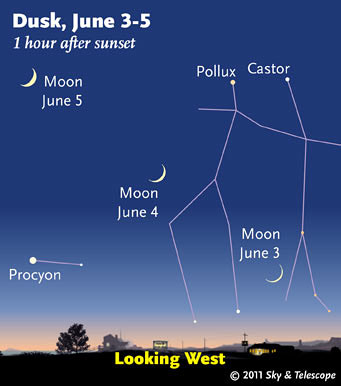
The waxing Moon adorns the western twilight.
Sky & Telescope diagram
Friday, June 3
Saturday, June 4
Want to become a better amateur astronomer? Learn your way around the constellations. They're the key to locating everything fainter and deeper to hunt with binoculars or a telescope.
For an easy-to-use constellation guide covering the whole evening sky, use the big monthly map in the center of each issue of Sky & Telescope, the essential magazine of astronomy. Or download our free Getting Started in Astronomy booklet (which only has bimonthly maps).
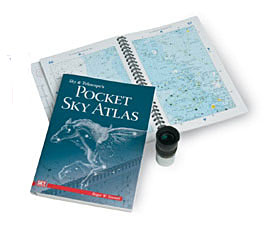
The Pocket Sky Atlas plots 30,796 stars to magnitude 7.6 — which may sound like a lot, but that's less than one star in an entire telescopic field of view, on average. By comparison, Sky Atlas 2000.0 plots 81,312 stars to magnitude 8.5, typically one or two stars per telescopic field. Both atlases include many hundreds of deep-sky targets — galaxies, star clusters, and nebulae — to hunt among the stars.
Sky & Telescope
Once you get a telescope, to put it to good use you must have a detailed, large-scale sky atlas (set of charts). The standards are the Pocket Sky Atlas, which shows stars to magnitude 7.6; the larger Sky Atlas 2000.0 (stars to magnitude 8.5); and the even larger and deeper Uranometria 2000.0 (stars to magnitude 9.75). And read how to use sky charts effectively.
You'll also want a good deep-sky guidebook, such as Sky Atlas 2000.0 Companion by Strong and Sinnott, or the more detailed and descriptive Night Sky Observer's Guide by Kepple and Sanner, or the classic if dated Burnham's Celestial Handbook.
Can a computerized telescope take their place? I don't think so — not for beginners, anyway, and especially not on mounts that are less than top-quality mechanically. As Terence Dickinson and Alan Dyer say in their Backyard Astronomer's Guide, "A full appreciation of the universe cannot come without developing the skills to find things in the sky and understanding how the sky works. This knowledge comes only by spending time under the stars with star maps in hand."
This Week's Planet Roundup
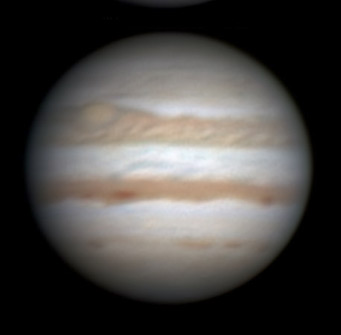
Jupiter is climbing higher now at the beginning of dawn for better telescopic viewing, but it's still far from its best. Christopher Go obtained this fine stacked-video image anyway on June 1st. It shows that Jupiter's dark South Equatorial Belt (above center) has fully returned and is very wide and turbulent. The North Equatorial Belt remains darker red-brown. The Great Red Spot is at left, with the SEB practically emcompassing it. The normally white Red Spot Hollow around it is now dark. South is up.
Alan MacRobert
Low in the dawn, Mercury, Venus, Mars, and Jupiter continue drawing farther apart in a long diagonal line. Jupiter is the highest and easiest. Far to its lower left are faint Mars, then bright Venus, and then very-low Mercury, as shown in the scenes above. Bring binoculars for Mars and Mercury. (See our daily animation, which runs through June 1st. Pause the animation at the date of your choice.)
Saturn (magnitude +0.6, in Virgo) is in excellent evening view high in the south. And just 1/3° to its right or upper right is fainter Porrima (Gamma Virginis), turning Saturn into a striking naked-eye "double star"! Meanwhile, Spica shines 14° to Saturn's lower left or left.
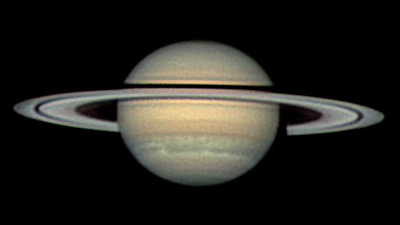
Saturn's white activity continues in the planet's northern hemisphere, as seen in this image taken by Christopher Go on May 30th. South is up. This image was created from stacked, selected video frames (taken with an 11-inch scope); don't expect to see this much detail visually!
Christopher Go
In a telescope Saturn's rings are 7.3° from edge on, their minimum tilt for more than a decade to come. The rings are casting a relatively wide, prominent black shadow southward onto the globe, and the globe's shadow on the rings is visible just off the globe's celestial east (following) side. Saturn's six-months-old white outbreak is still active, as shown here. Read more about this storm as studied from the Cassini Saturn orbiter and the Very Large Telescope in Chile.
See how many of Saturn's satellites you can identify in your scope using our Saturn's Moons tracker.
And don't skip over Porrima, which is now in the same low- or medium-power telescopic field! It's it's a fine, close telescopic binary star with equal components and a current separation of 1.7 arcseconds. Use high power and hope for good seeing. Saturn and Porrima will appear closest together (¼° apart) from June 6th through 12th. See the article in the April Sky & Telescope, page 56.
Uranus (magnitude 5.9, in western Pisces) is low in the east before the first light of dawn.
Neptune (magnitude 7.9, in Aquarius) is in the southeast before dawn.
Pluto (magnitude 14 in Sagittarius, and back here by popular request) is highest in the south before dawn. A finder chart for it will appear in the July Sky & Telescope, page 64.
All descriptions that relate to your horizon — including the words up, down, right, and left — are written for the world's mid-northern latitudes. Descriptions that also depend on longitude (mainly Moon positions) are for North America. Eastern Daylight Time (EDT) equals Universal Time (also known as UT, UTC, or GMT) minus 4 hours.
To be sure to get the current Sky at a Glance, bookmark this URL:
http://SkyandTelescope.com/observing/ataglance?1=1
If pictures fail to load, refresh the page. If they still fail to load, change the 1 at the end of the URL to any other character and try again.
About Alan MacRobert
Alan M. MacRobert became an avid Sky & Telescope subscriber in 1966 at age 14, joined the editorial staff in 1982, and is now a senior contributing editor, semi-retired. He played a role in practically every part of the magazine and the company's other products for more than a generation, both on the amateur-observing side and the science-reporting side. In 1994 a book collection of his observing how-tos and telescopic sky tours was published as Star Hopping for Backyard Astronomers. He has produced This Week's Sky at a Glance online every week since 1989.


Comments
You must be logged in to post a comment.