 SUNSET:

 0
0Some daily events in the changing sky for February 15 – 23.
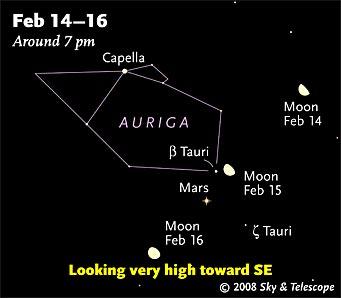
The waxing Moon shines near Mars and especially Beta (β) Tauri on the evening of the 15th, while Capella looks on. This view is drawn for the middle of North America. European observers: move each Moon symbol a quarter of the way toward the one for the previous date.
Sky & Telescope diagram
Friday, February 15
Saturday, February 16
Sunday, February 17
Monday, February 18
Tuesday, February 19
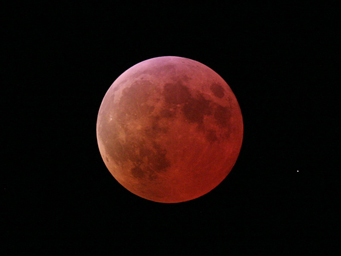
A preview of the Moon on the 20th? The total lunar eclipse of March 3-4, 2007, was a relatively bright one. S&T editor Rick Fienberg captured this view from Garching, Germany, where he was attending a planning meeting for the International Year of Astronomy 2009. Click image for larger view.
S&T: Rick Fienberg
Wednesday, February 20
And take advantage of the dark sky during the total eclipse to have a look for Comet Holmes, very big but very dim, as described at the bottom of this page.
Thursday, February 21
At any random time you glance up at Algol, you have a 1-in-30 chance of catching it at least 1 magnitude fainter than normal.
Friday, February 22
Saturday, February 23
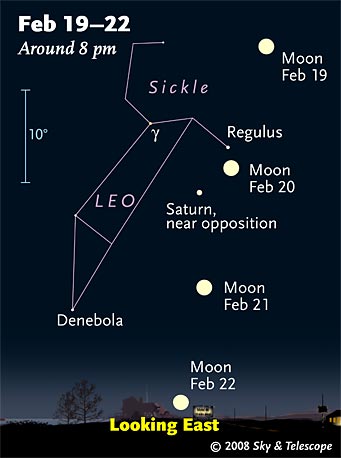
The full Moon on the evening of the 20th — shown here when not in eclipse! — shines near Saturn and Regulus. This uneclipsed view is drawn for eastern North America. (European observers: to get your early-evening view, move each Moon symbol a quarter of the way toward the one for the previous date.) For clarity, the Moon is drawn three times its actual size.
Sky & Telescope diagram
Want to become a better amateur astronomer? Learn your way around the constellations. They're the key to locating everything fainter and deeper to hunt with binoculars or a telescope. For an easy-to-use constellation guide covering the whole evening sky, use the big monthly foldout map in each issue of Sky & Telescope, the essential magazine of astronomy. Or download our free Getting Started in Astronomy booklet (which only has bimonthly maps).
Once you get a telescope, to put it to good use you'll need a detailed, large-scale sky atlas (set of maps; the standard is Sky Atlas 2000.0) and good deep-sky guidebooks (such as Sky Atlas 2000.0 Companion by Strong and Sinnott, the even more detailed Night Sky Observer's Guide by Kepple and Sanner, or the enchanting though increasingly dated Burnham's Celestial Handbook). Read how to use them effectively.
More beginners' tips: "How to Start Right in Astronomy".
This Week's Planet Roundup
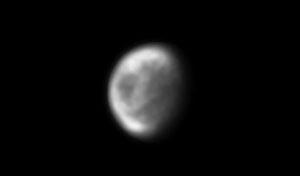
That's Venus?! Yep — as seen on February 7th in ultraviolet light, and with a lot of contrast enhancement. Although in white light Venus is featureless, classical visual observers long claimed to see very subtle marks on it from time to time, especially through a violet filter. Going even farther up the spectrum makes them plain.
S&T: Sean Walker
Mercury is emerging from deep in the glow of sunrise. Late in the week, use binoculars to look for it a little left of bright Venus.
Venus (magnitude –3.9, moving from Sagittarius into Capricornus) is getting lower every morning. Look for it above the southeast horizon about 30 or 40 minutes before sunrise, well to the lower left of Jupiter.
Mars (about magnitude –0.1, in eastern Taurus) shines very high in the south during evening, high above Orion. The fairly bright star near it is Beta (β) Tauri, or El Nath, magnitude +1.6 and pale blue-white. In a telescope, Mars dwindles from 10.4 to 9.6 arcseconds in apparent diameter this week. See the observing guide and surface-feature map in the November Sky & Telescope, page 66, or the short version online.
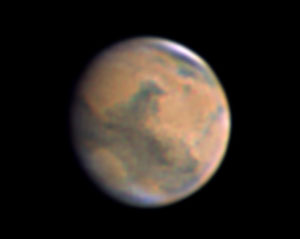
Shooting from the Winter Star Party with Don Parker's 10-inch Takahashi Mewlon 250 DK scope, Sean Walker recorded Mars's north polar cap (top) in clear view now that the the north polar cloud hood is gone. Notice south polar clouds beginning to form. Syrtis Major is just left of the central meridian. The time was 4:44 UT February 4, 2008.
S&T: Sean Walker
Jupiter (magnitude –2.0, in Sagittarius) shines low in the southeast before and during dawn. It's moving ever farther to the upper right of Venus.
Saturn (magnitude +0.3, in Leo) comes to opposition on the night of the 23rd. It glows low in the east as twilight fades, rises higher all evening, and stands highest in the south around midnight. Fainter Regulus (magnitude +1.4) is 6° west of Saturn: to its upper right after they rise. Only a little dimmer than Regulus is Gamma (γ) Leonis (magnitude +2.1), located 8° to Regulus's north. The three make an eye-catching triangle.
In a telescope, watch this week for the Seeliger effect, a brightening of Saturn's rings for several days around oppposition. The reason for this? The ice particles making up the rings "backscatter" sunlight (reflect it back the way it came) more efficiently than the material in Saturn's cloud tops. When Saturn is at opposition, Earth is in the line of backscattering. A daily series of images will show this particularly well.
Uranus and Neptune are hidden in the glare of the Sun.
Pluto (magnitude 14.0, in Sagittarius) is low in the southeast before the first light of dawn.
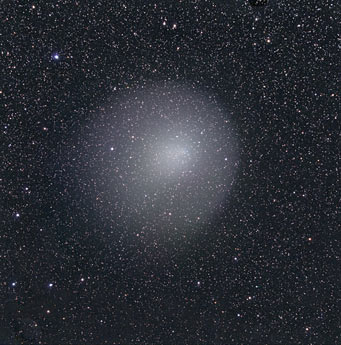
"Here's the latest in my continuing saga of photographing Comet Holmes with the TV-NP127is (5-inch) telescope and Apogee Alta camera," writes S&T's Dennis di Cicco. "This shot is from Monday evening in the cold and high wind. Exposures were 40 minutes blue, 40 minutes green, and 50 minutes red. The field here is almost exactly 3° wide, with north up. This comet is getting huge! So much so that I initially had a difficult time seeing it in a short exposure because it looked like the typical 'hot spot' in the center of the frame due to optical vignetting." Click image for larger view.
S&T: Dennis di Cicco
Comet Holmes continues to grow ever bigger and dimmer. At the Winter Star Party in the dark Florida Keys, says Sean Walker, "Comet Holmes was still naked eye, but only just — it was an averted-vision object as of February 7th. Ghostly through 8x50 binoculars." On February 11th through suburban light pollution, Dennis di Cicco could not see it with the naked eye at all when he took the picture at right. The comet is between the feet of Perseus; chart.
All descriptions that relate to your horizon or zenith — including the words up, down, right, and left — are written for the world's midnorthern latitudes. Descriptions that also depend on longitude (mainly Moon positions) are for North America. Eastern Standard Time (EST) equals Universal Time (UT, UTC, or GMT) minus 5 hours.
To be sure you always get the current Sky at a Glance, bookmark this URL:
http://SkyandTelescope.com/observing/ataglance?1=1
If pictures fail to load, refresh the page.
About Alan MacRobert
Alan M. MacRobert became an avid Sky & Telescope subscriber in 1966 at age 14, joined the editorial staff in 1982, and is now a senior contributing editor, semi-retired. He played a role in practically every part of the magazine and the company's other products for more than a generation, both on the amateur-observing side and the science-reporting side. In 1994 a book collection of his observing how-tos and telescopic sky tours was published as Star Hopping for Backyard Astronomers. He has produced This Week's Sky at a Glance online every week since 1989.


Comments
You must be logged in to post a comment.