 SUNSET:

 0
0Some daily events in the changing sky for December 7 – 15.
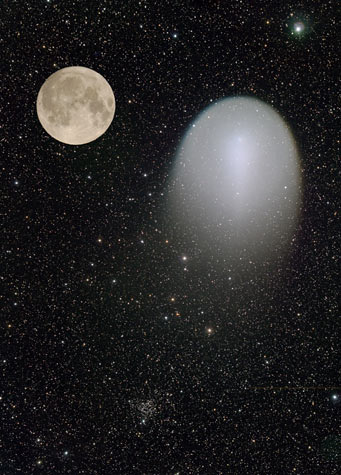
"It's one thing to be told that Comet Holmes is bigger than the Moon," writes S&T's Dennis di Cicco, "but it's another to see it. I made this composite view of Comet Holmes on Dec. 1st with the full Moon inserted at the proper scale." And now the comet is even larger! Use binoculars, and look early in the week; by about the 13th moonlight begins returning. The star cluster in the comet's tail near bottom is NGC 1245. Click image for larger view.
S&T: Dennis di Cicco
Comet Holmes remains high in a moonless sky. It continues fading, but it's big — much bigger than the Moon now, as shown at right. Look for it in Perseus west of Alpha Persei. Binoculars give a beautiful view. See our update with finder chart, full story, and reader photos.
And don't look now, but another comet is on the way in! Comet 8P/Tuttle is still very dim at about magnitude 8.5 (just about as predicted), but it should reach 6th magnitude from late December through mid-January. And while Comet Holmes stays stuck in Perseus for months, Comet Tuttle (being much nearer Earth) will dive from near the north celestial pole across the evening sky to the southern horizon during the same time. See the article and charts in the January Sky & Telescope, page 73.
Friday, December 7
Saturday, December 8
Sunday, December 9
Monday, December 10
Tuesday, December 11
Wednesday, December 12
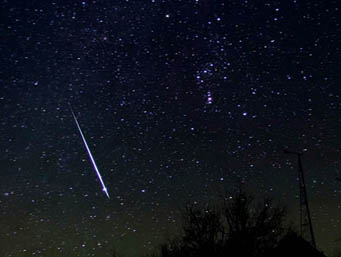
During the 2004 Geminid meteor shower, Alan Dyer caught a bright fireball with a tripod-mounted digital camera. He used a wide-field, 16-mm lens for a 1-minute exposure at f/2.8 with an ISO setting of 800. Expect to shoot a lot of frames before you get this lucky. Click image for larger view.
Alan Dyer
Thursday, December 13
Friday, December 14
Saturday, December 15
Want to become a better amateur astronomer? Learn your way around the constellations. They're the key to locating everything fainter and deeper to hunt with binoculars or a telescope. For an easy-to-use constellation guide covering the whole evening sky, use the big monthly foldout map in each issue of Sky & Telescope, the essential magazine of astronomy. Or download our free Getting Started in Astronomy booklet (which only has bimonthly maps).
Once you get a telescope, to put it to good use you'll need a detailed, large-scale sky atlas (set of maps; the standard is Sky Atlas 2000.0) and good deep-sky guidebooks (such as Sky Atlas 2000.0 Companion by Strong and Sinnott, the even more detailed Night Sky Observer's Guide by Kepple and Sanner, or the enchanting though increasingly dated Burnham's Celestial Handbook). Read how to use them effectively.
More beginners' tips: "How to Start Right in Astronomy".
This Week's Planet Roundup
Mercury is lost in the glare of the Sun.
Venus (magnitude –4.2, passing from Virgo into Libra) is the bright "Morning Star" in the southeast before and during dawn. Look for Spica, much dimmer, off to its upper right. Arcturus shines much farther to Venus's upper left.
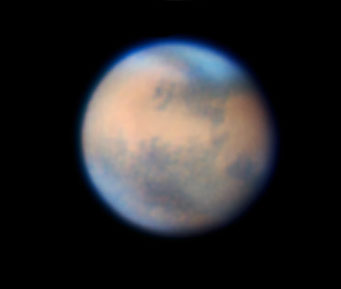
Mars as it appeared on the night of Dec. 11. Note the North Polar Hood of clouds (top) breaking up, and the strong morning clouds now showing up (lower left). The bright region at center is Chryse; below it are Margaritifer Sinus and Aurorae Sinus. Dark, two-pronged Sinus Meridiani is nearing the evening limb at right. The time was 3:47 UT December 12th; the central-meridian longitude was 40°.
S&T:
Mars blazes bright yellow-orange (magnitude –1.4) in Gemini. It rises as early as 6 p.m. and is high up in fine view in the east by 9, awaiting your telescope. Mars shines very high in the early-morning hours — passing near the zenith, in fact, for observers at mid-northern latitudes (around 1 or 2 a.m.).
In a telescope Mars appears about 15.6 arcseconds in diameter this week, essentially the same as the 15.9" it will display when nearest Earth on December 18th. For all about observing Mars with a telescope this season, see the guide and surface-feature map in the November Sky & Telescope, page 66.
Jupiter is lost in the sunset.
Saturn (magnitude +0.7) rises around 11 p.m. and is highest in the south before dawn. Fainter Regulus (magnitude +1.4) is 9° to Saturn's upper right after they rise, and directly right of it as they fade out in dawn's glow.
Uranus (magnitude 5.8, in Aquarius) is still well placed in the south right after dark, high above Fomalhaut.
Neptune (magnitude 7.9, in Capricornus) is getting lower in the southwest. Finder charts for Uranus and Neptune are in the July Sky & Telescope, page 60, and online.
All descriptions that relate to your horizon or zenith — including the words up, down, right, and left — are written for the world's midnorthern latitudes. Descriptions that also depend on longitude (mainly Moon positions) are for North America. Eastern Standard Time (EST) equals Universal Time (UT, UTC, or GMT) minus 5 hours.
To be sure you always get the current Sky at a Glance, bookmark this URL:
http://SkyandTelescope.com/observing/ataglance?1=1
About Alan MacRobert
Alan M. MacRobert became an avid Sky & Telescope subscriber in 1966 at age 14, joined the editorial staff in 1982, and is now a senior contributing editor, semi-retired. He played a role in practically every part of the magazine and the company's other products for more than a generation, both on the amateur-observing side and the science-reporting side. In 1994 a book collection of his observing how-tos and telescopic sky tours was published as Star Hopping for Backyard Astronomers. He has produced This Week's Sky at a Glance online every week since 1989.


Comments
You must be logged in to post a comment.