 SUNSET:

 0
0Some daily events in the changing sky for June 26 – July 4.
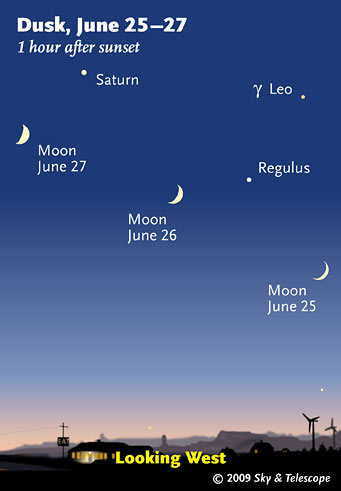
Back in the evening sky, the waxing crescent Moon again passes Regulus and Saturn on successive days. (These scenes are drawn for the middle of North America. European observers: move each Moon symbol a quarter of the way toward the one for the previous date.)
Sky & Telescope diagram
Friday, June 26
Saturday, June 27
Sunday, June 28
Monday, June 29
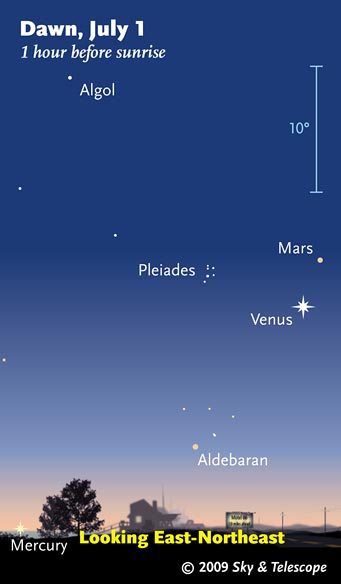
Venus and Mars are finally widening at dawn.
Sky & Telescope diagram
Tuesday, June 30
Wednesday, July 1
Thursday, July 2
Friday, July 3
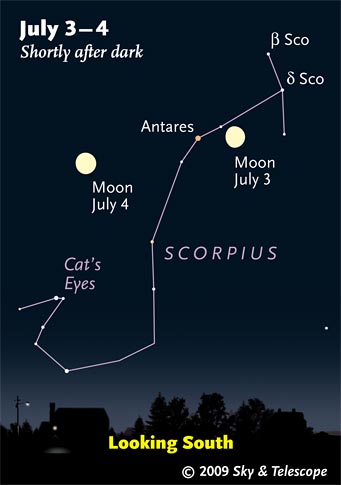
The Moon crosses Scorpius as the holiday weekend begins.
Sky & Telescope diagram
Saturday, July 4
Want to become a better amateur astronomer? Learn your way around the constellations. They're the key to locating everything fainter and deeper to hunt with binoculars or a telescope. For an easy-to-use constellation guide covering the whole evening sky, use the big monthly map in each issue of Sky & Telescope, the essential magazine of astronomy. Or download our free Getting Started in Astronomy booklet (which only has bimonthly maps).
Once you get a telescope, to put it to good use you'll need a detailed, large-scale sky atlas (set of charts; the standards are Sky Atlas 2000.0 or the smaller Pocket Sky Atlas) and good deep-sky guidebooks (such as Sky Atlas 2000.0 Companion by Strong and Sinnott, the more detailed and descriptive Night Sky Observer's Guide by Kepple and Sanner, or the classic Burnham's Celestial Handbook). Read how to use them effectively.
Can a computerized telescope take their place? I don't think so — not for beginners, anyway, and especially not on mounts that are less than top-quality mechanically. As Terence Dickinson and Alan Dyer say in their Backyard Astronomer's Guide, "A full appreciation of the universe cannot come without developing the skills to find things in the sky and understanding how the sky works. This knowledge comes only by spending time under the stars with star maps in hand and a curious mind." Without these, "the sky never becomes a friendly place."
More beginners' tips: "How to Start Right in Astronomy".
This Week's Planet Roundup
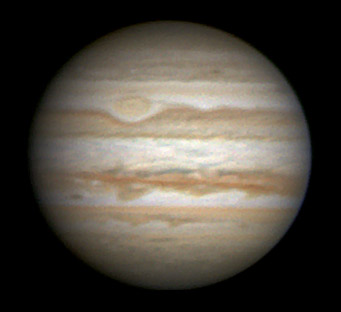
Jupiter's Great Red Spot (GRS) is pale this year, and the South Equatorial Belt, which the Red Spot sits in, looks pretty quiet. But the North Equatorial Belt (NEB, below center) is going nuts! In the parts of the NEB north of the Great Red Spot, the prominent white swirls of three weeks ago have morphed into dark chaos. Also note the very long, straight, diagonal red-brown line crossing the NEB.
Christopher Go took this image at 17:54 UT June 17, 2009, when the central-meridian longitude (System II) was 150°. South is up.
For all of the Red Spot's central-meridian crossing times, good worldwide, use our Red Spot calculator or print out our list for 2009.
Mercury (about magnitude 0) is having a poor apparition deep in the glow of dawn. Look for it early in the week about 28° lower left of Venus and Mars. Binoculars will help.
Venus and Mars (magnitudes –4.2 and +1.1, respectively) remain together due east during dawn. Venus is a dazzler; Mars is 130 times fainter. Mars is only 2.6° above Venus on the morning of June 26th; it widens to 5° above Venus by July 4th. Early in dawn, look for the Pleiades to their left.
Four reasons combine to create their great disparity in brightness. Mars is farther from the Sun so it's illuminated less brightly than Venus, Mars is a smaller planet, its surface is darker and less reflective than Venus's white clouds, and Mars is currently farther from Earth.
Jupiter (magnitude –2.6, in Capricornus) rises around 11 p.m. and shines brightly in the south at dawn. The sharpest telescopic glimpses may come during morning twilight, when the atmospheric seeing sometimes turns very steady.
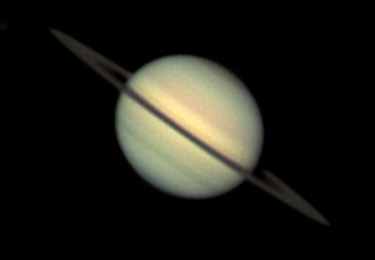
On June 16th Saturn's rings were still tipped 3.7° to our line of sight, but they were tipped a mere 0.8° to the incoming sunlight. All year the rings' tilt to the Sun has been steadily decreasing, and accordingly, the rings have been getting darker and darker. Keep watch! Saturn is becoming harder to observe as it moves lower in the west each evening.
S&T's Sean Walker took this stacked-video image using a 14-inch Schmidt-Cassegrain scope at f/22, a DMK21AU04.AS camera, and Custom Scientific RGB filters.
S&T: Sean Walker
Saturn (magnitude +1.0, in Leo) is still fairly high in the west at dusk, but it sinks lower as evening advances. In a telescope Saturn's rings are narrowing, appearing only 3° from edge on. And see how they've dimmed! The caption at right tells why.
Uranus (magnitude 5.8, in Pisces), is high in the southeast before dawn.
Neptune (magnitude 7.9, in Capricornus) remains only about 3/4° from Jupiter, but it's 16,000 times fainter. See our finder charts for Uranus and Neptune.
Pluto (14th magnitude, in northwestern Sagittarius) is highest in the south around midnight. See the finder chart in the June Sky & Telescope, page 53.
All descriptions that relate to your horizon or zenith — including the words up, down, right, and left — are written for the world's mid-northern latitudes. Descriptions that also depend on longitude (mainly Moon positions) are for North America. Eastern Daylight Time (EDT) equals Universal Time (also known as UT, UTC, or GMT) minus 4 hours.
"Science is built up of facts, as a house is with stones. But a collection of facts is no more a science than a heap of stones is a house."
— Henri Poincaré (1854–1912)
To be sure to get the current Sky at a Glance, bookmark this URL:
http://SkyandTelescope.com/observing/ataglance?1=1
If pictures fail to load, refresh the page. If they still fail to load, change the 1 at the end of the URL to any other character and try again.
About Alan MacRobert
Alan M. MacRobert became an avid Sky & Telescope subscriber in 1966 at age 14, joined the editorial staff in 1982, and is now a senior contributing editor, semi-retired. He played a role in practically every part of the magazine and the company's other products for more than a generation, both on the amateur-observing side and the science-reporting side. In 1994 a book collection of his observing how-tos and telescopic sky tours was published as Star Hopping for Backyard Astronomers. He has produced This Week's Sky at a Glance online every week since 1989.


Comments
You must be logged in to post a comment.